02 Aug 2025
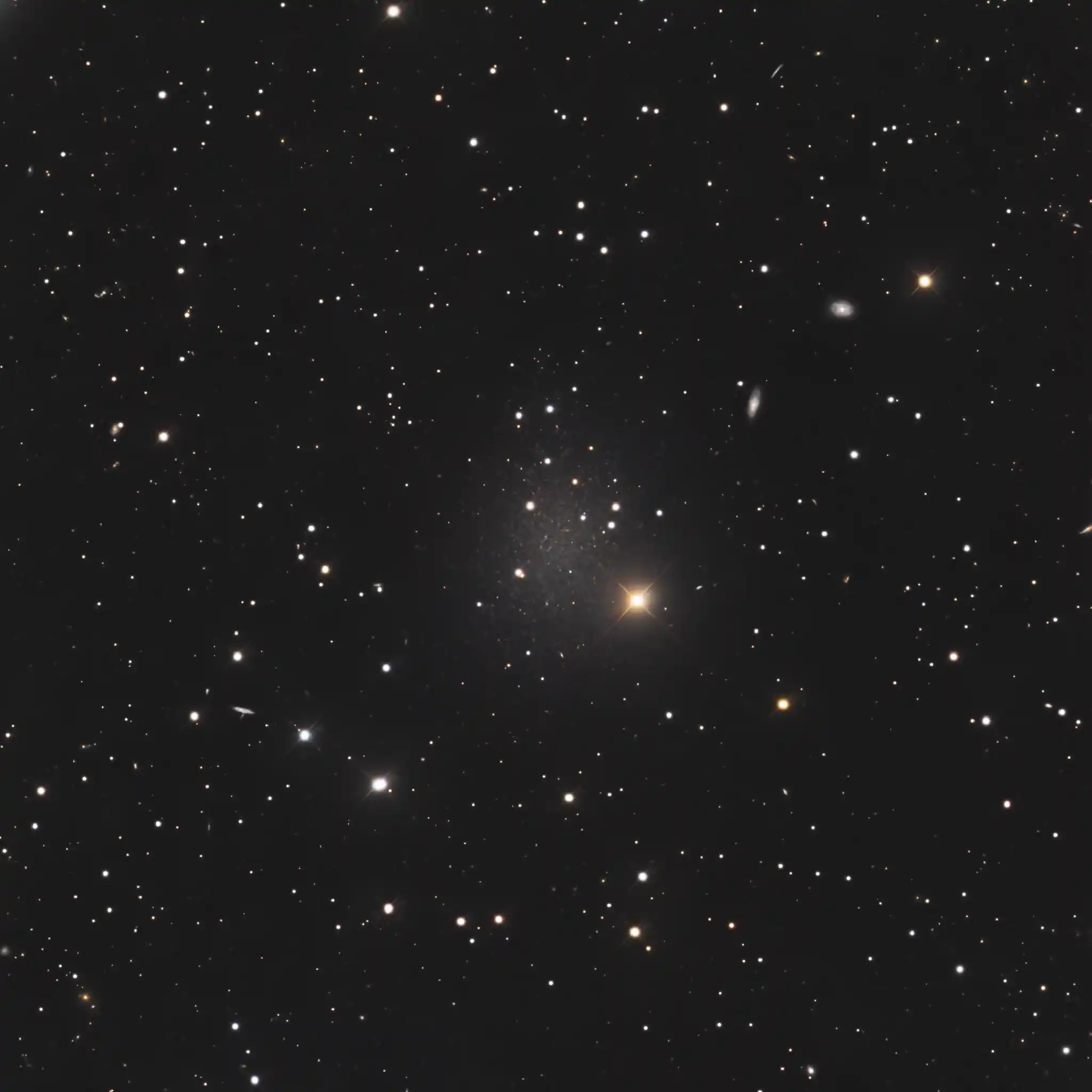
PGC 2807158 - Pegasus Dwarf Spheroidal Galaxy
The Pegasus Dwarf Spheroidal Galaxy, also designated Peg dSph,PGC 2807158 or Andromeda VI, is a faint satellite of the Andromeda Galaxy (M31) located in the constellation Pegasus at a distance of about 2.7 million light-years.Discovered in 1999 by Armandroff, Jacoby, and Davies in a KPNO survey for Local Group members. This dwarf spheroidal contains an exclusively old, metal-poor stellar population (>10 Gyr) with no signs of recent star formation, and it is devoid of detectable gas. Its low surface brightness and diffuse structure make it a challenging target for deep-sky imaging, often requiring long exposures and careful processing to reveal its faint glow against the background sky.
Data acquired via Telescope Live's SPA-2 CCD system at their facility in Spain and labelled as Peg DIG actually shows Peg dSph. The data was very faint and required creation of synthetic luminance using all available frames. The final result is rather underwhelming and would benefit from at least 3x longer exposure. Because there were only 12 frames per channel, some satellite trails did not reject cleanly - I had to employ Clone Stamp tool to get rid of them. Despite TL data being pre-callibrated, some dust donuts remained - I managed to removed them together with satellite trails while working with starless images. Other than that the processing was rather straightforward. I only had to crate galaxy mask with help of PixelMath to not include any stars as they quickly got out of hand when applying Curves Transformation.
Peg DIG
6 credit
- Type of target............................................................................................................................Galaxy
- Camera............................................................................................................................FLI PL16803
- Target coordinates............................................................................................................................RA 357.9433 Dec 24.5864
- Hemisphere............................................................................................................................Northern
- Telescope location............................................................................................................................Spain
- Transient event............................................................................................................................No
- Observed on............................................................................................................................27 Jun 2022 - 02 Jul 2022
Filter | Avg Exp (s) | Total Exposure | Subframes |
|---|---|---|---|
| Blue | 600 | 2h | 12 |
| Green | 600 | 2h | 12 |
| Red | 600 | 2h | 12 |
| Luminance | 600 | 2h | 12 |