05 Sept 2025
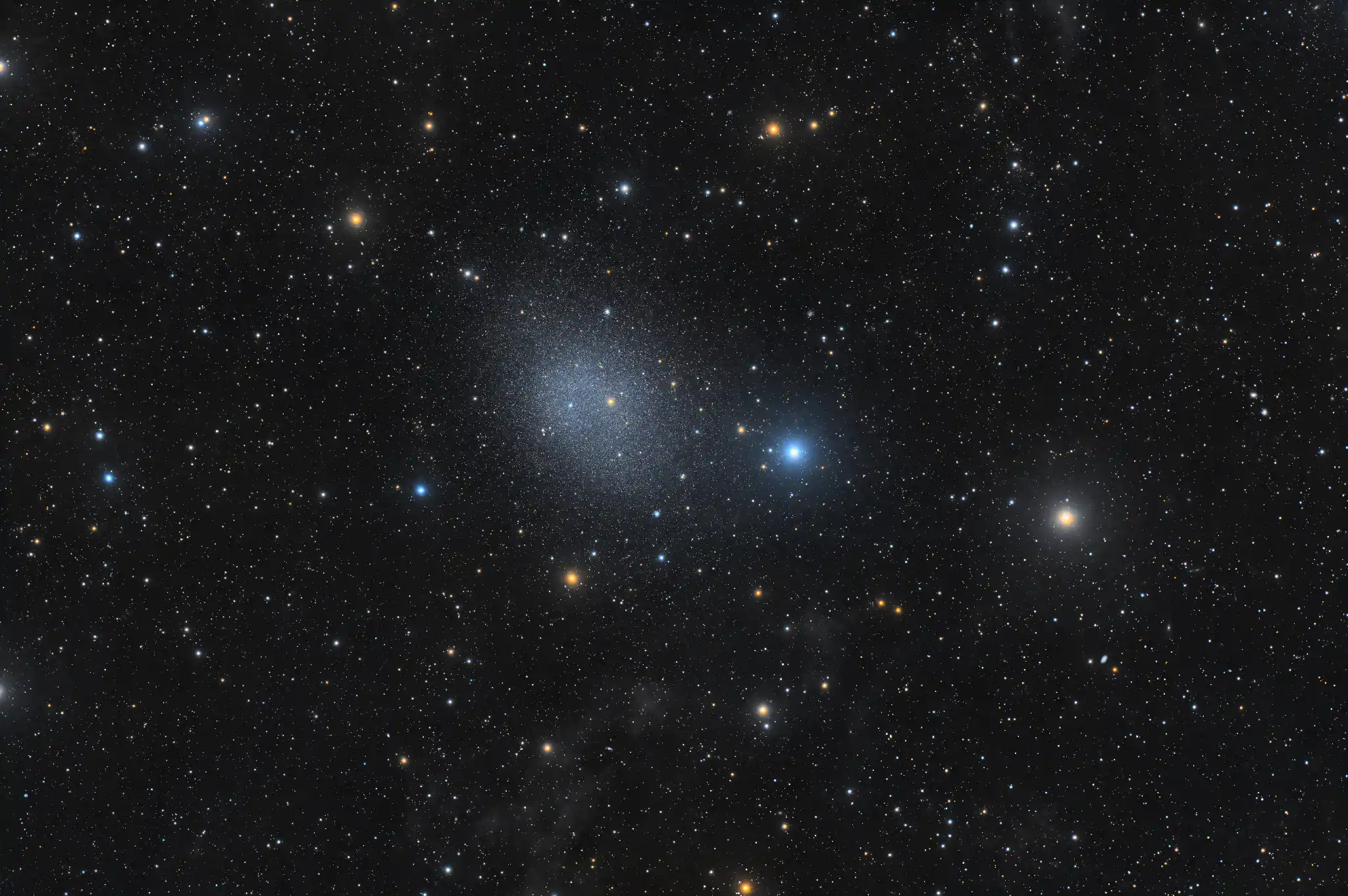
Fornax Dwarf Galaxy
The Fornax Dwarf Galaxy is a small elliptical (dE2) satellite of the Milky Way, discovered by Harlow Shapley in 1938 using photographic plates at Boyden Observatory. It lies about 450,000 - 460,000 light‑years from Earth. This galaxy is remarkable in that, although it is a low-luminosity dwarf spheroidal, it houses an unusually large six globular clusters, especially notable being NGC 1049, discovered in 1835 - before the galaxy itself.
Fornax contains multiple stellar populations spanning a wide range of ages - from ancient (>10 Gyr) to intermediate (~1-10 Gyr) and even some young (≤1 Gyr) stars - displaying a pronounced radial age and metallicity gradient, with younger and more metal-rich stars concentrated toward its center. Notably, one of its globular clusters, Fornax 4, is about 3 Gyr younger than the others, while Fornax 6 - a recently confirmed member - is unusually metal-rich and relatively young, at around 2 billion years old.
This is a wide-field LRGB image of the Fornax Dwarf Spheroidal, captured from Telescope Live’s Australian site using the Takahashi FSQ-106ED. With a modest 2 hours of total integration, the target's extremely low surface brightness and sparse stellar population make it a demanding object, yet the image still captures its diffuse glow and context among foreground stars. Surrounding nebulosity is much closer to Earth in our own Milky Way galaxy.
Sources:
wikipedia.org
www.aanda.org
astronomy.com
universemap.net
Data credit: Telescope.Live
Fornax Dwarf Galaxy
1 credit
- Type of target............................................................................................................................Galaxy
- Camera............................................................................................................................QHY 600M
- Target coordinates............................................................................................................................RA 39.9708 Dec -34.5139
- Hemisphere............................................................................................................................Southern
- Telescope location............................................................................................................................Australia
- Transient event............................................................................................................................No
- Observed on............................................................................................................................21 Nov 2024 - 03 Jan 2025
Filter | Avg Exp (s) | Total Exposure | Subframes |
|---|---|---|---|
| Luminance | 300 | 30m | 6 |
| Red | 300 | 30m | 6 |
| Green | 300 | 30m | 6 |
| Blue | 300 | 30m | 6 |