11 Nov 2025
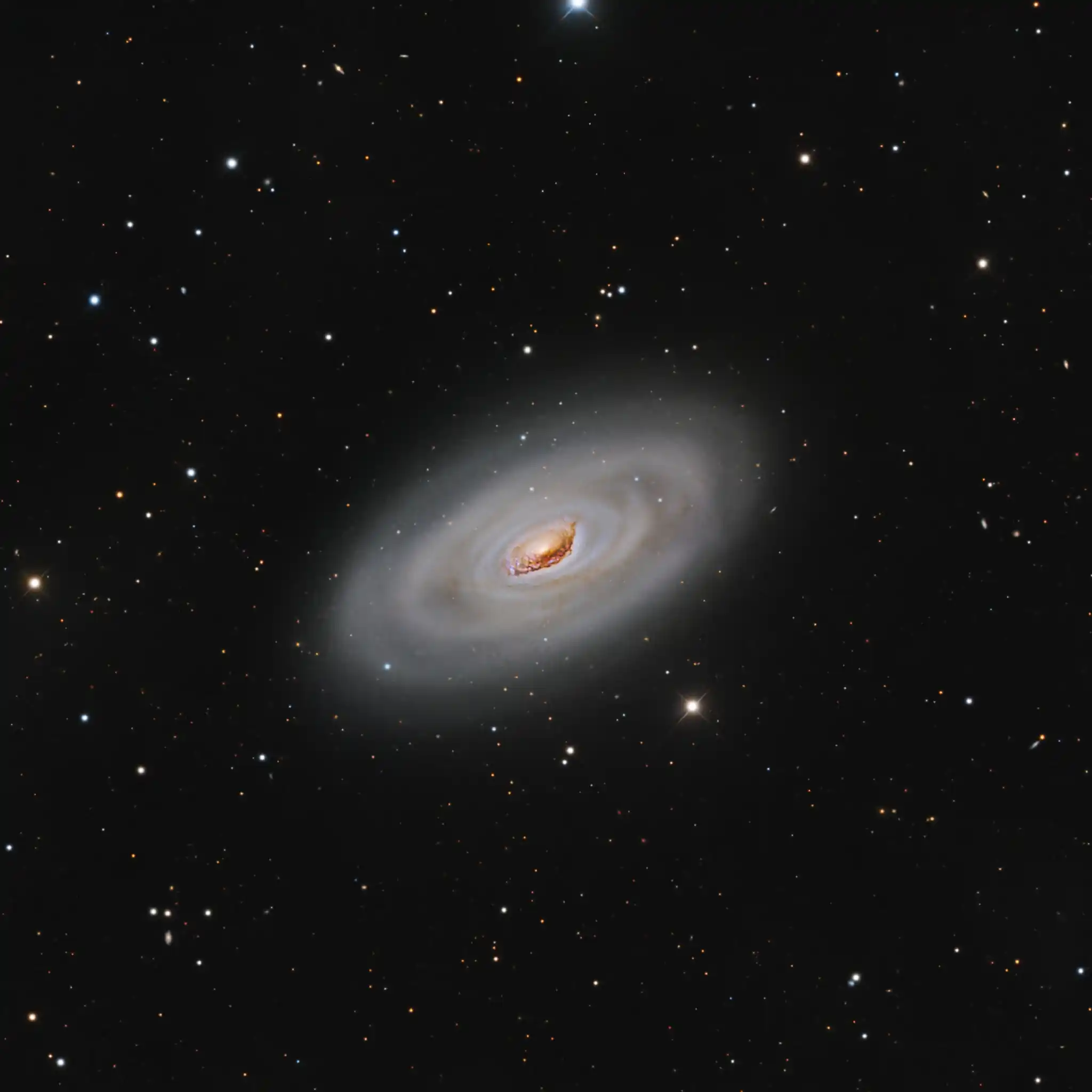
M64 - Black Eye Galaxy in Coma Berenices
Messier 64 (NGC 4826), often called the “Black Eye” or “Evil Eye” Galaxy, is a spiral galaxy in the constellation Coma Berenices located about 17 million light-years from Earth. A prominent dust lane arcs across the bright nucleus, giving the galaxy its nickname. What makes M64 especially fascinating is that its outer gas disk appears to rotate in the opposite direction to its inner stars and gas — a feature believed to be the result of a merger or accretion event in its past. Discovered in 1779 Johann E. Bode — who only recognized it as a "small, nebulous star". A year later, Charles Messier came across the same object and listed it under number 64.
The structure of M 64 is very unusual. It has been classified by some as a Hubble type Sa and by others as an Sb - but somehow it doesn't fit into Hubble's simple scheme. The Revised Morpholobical Galaxy Classification System is somewhat more detailed in this regard: outer ring, spiral without bars, inner ring and S-shape, level 'ab', luminosity class II-III ... or in short: (R)SA(rs)ab II- III.
This image highlights the dramatic dust lane cutting through the central bulge, the dense star-forming regions in the inner disk, and the faint, extended outer halo. Captured over 7 hours of LRGB integration using the SPA-2-CCD system at Telescope Live’s Spanish site.
Sources:
wikipedia.org
science.nasa.gov
www.astronomy.com
www.messier-objects.com
www.constellation-guide.com
deepskycorner.ch
Data credit: Telescope.Live
M64
5 credit
- Type of target............................................................................................................................Galaxy
- Camera............................................................................................................................FLI PL16803
- Target coordinates............................................................................................................................RA 194.1821 Dec 21.68266
- Hemisphere............................................................................................................................Northern
- Telescope location............................................................................................................................Spain
- Transient event............................................................................................................................No
- Observed on............................................................................................................................11 Mar 2021 - 03 Feb 2022
Filter | Avg Exp (s) | Total Exposure | Subframes |
|---|---|---|---|
| Red | 643 | 2h30m | 14 |
| Green | 600 | 2h20m | 14 |
| Blue | 600 | 2h20m | 14 |
| Luminance | 554 | 2h | 13 |