22 Nov 2025
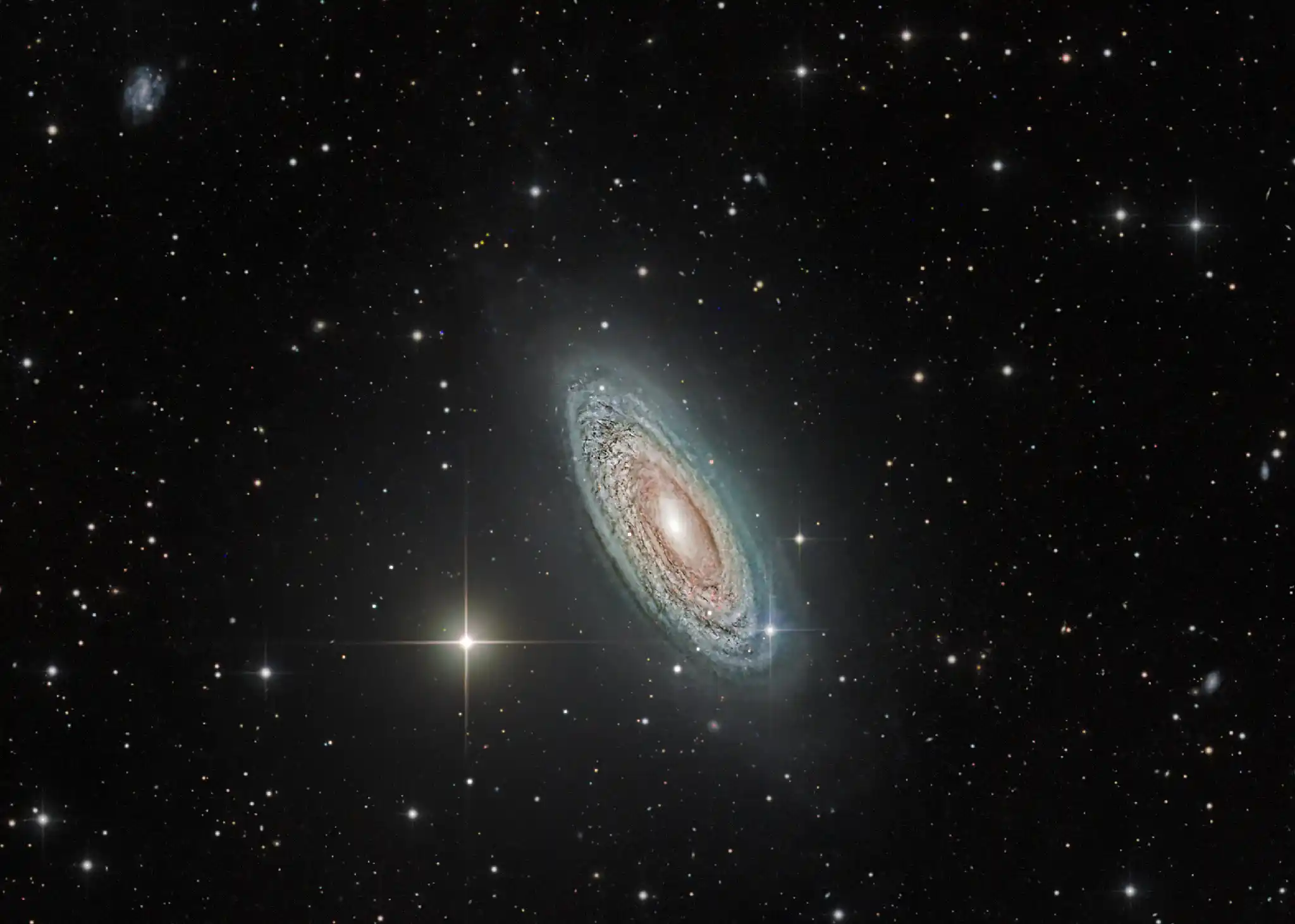
NGC2841 in LRGB
NGC 2841 is a captivating spiral galaxy located approximately 46 million light-years away in the constellation Ursa Major. First discovered by the German-born British astronomer William Herschel on March 9, 1788, this galaxy has since intrigued astronomers and astrophysicists with its distinctive features and unique structure.
Characterized by its tightly wound spiral arms and a relatively small central bulge, NGC 2841 is classified as a flocculent spiral galaxy. This classification implies that its spiral arms are patchy and less defined compared to the grand-design spiral galaxies, which have more pronounced and well-structured arms. Despite their obscurity, these spiral arms harbor a significant amount of star formation activity, contributing to the creation of new stars and influencing the galaxy’s evolution.
NGC 2841 spans approximately 150,000 light-years in diameter, making it slightly larger than our Milky Way galaxy. However, unlike many other spiral galaxies, NGC 2841 has a relatively low incidence of star-forming regions. This could be attributed to the presence of an array of older stars within its structure. The galaxy’s central bulge is notably home to a substantial population of old stars, hinting at a rich history of galactic processes and interactions.
One of the most intriguing aspects of NGC 2841 is its active galactic nucleus, which suggests the presence of a supermassive black hole at its core. Observations indicate that this black hole is likely influencing the dynamics and movement of surrounding stars and interstellar matter.
NGC 2841
20 credit
- Type of target............................................................................................................................Galaxy
- Camera............................................................................................................................FLI Proline PL16803
- Target coordinates............................................................................................................................RA 140.5112 Dec 50.9766
- Hemisphere............................................................................................................................Northern
- Telescope location............................................................................................................................United States of America
- Transient event............................................................................................................................No
- Observed on............................................................................................................................15 Feb 2023 - 23 Mar 2023
Filter | Avg Exp (s) | Total Exposure | Subframes |
|---|---|---|---|
| Luminance | 1705 | 9h | 19 |
| Red | 758 | 4h | 19 |
| Green | 800 | 4h | 18 |
| Blue | 800 | 4h | 18 |
| Halpha | 1133 | 5h40m | 18 |