16 Dec 2025
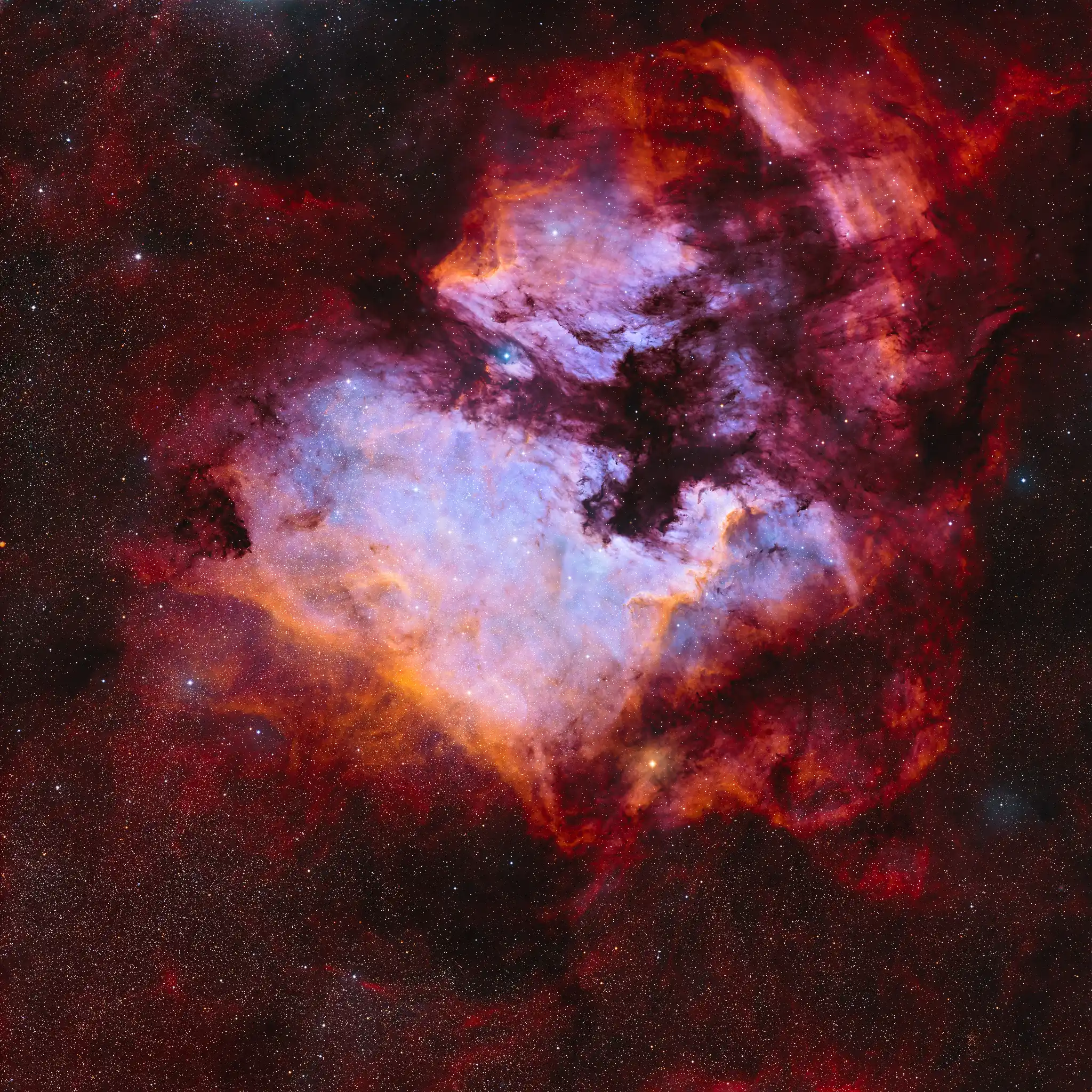
NGC 7000 - North America Nebula in Cygnus
NGC 7000, better known as the North America Nebula, is a vast H II emission region located in the constellation Cygnus at a distance of roughly 2,500–3,000 light-years. Part of the larger W80 complex together with the Pelican Nebula (IC 5070), it is illuminated primarily by energetic radiation from hot, young stars embedded within the Cygnus star-forming region, most notably the O-type star thought to be hidden behind dense foreground dust. The nebula’s familiar continental outline is sculpted by complex dust lanes that obscure and divide the glowing hydrogen gas, creating striking contrast between bright emission and dark absorption regions.
The nebula is extraordinarily rich in structure. Dense molecular clouds and dust ridges form well-known features such as the “Gulf of Mexico,” while extended filaments and faint veils of emission trace ionization fronts where stellar radiation erodes the surrounding gas. In addition to hydrogen, sulfur and oxygen emission reveal shock-excited regions, subtle temperature variations, and layered depth within the cloud. These structures mark sites of ongoing star formation, where gravity, radiation pressure, and stellar winds continuously reshape the interstellar medium on scales of many light-years.
This image is based on an exceptionally deep 98 hours of total integration combining SHO narrowband data with RGB stars, acquired from Telescope Live’s SPA-1 and SPA-3 CCD systems. Final image is an HOO composite with SII blended to provide golden highlights. RGB data were used to restore natural star colors and preserve the rich Cygnus star field.
NGC 7000
21 credit
- Type of target............................................................................................................................Emission Nebula
- Camera............................................................................................................................FLI PL16083
- Target coordinates............................................................................................................................RA 313.8053 Dec 43.90161
- Hemisphere............................................................................................................................Northern
- Telescope location............................................................................................................................Spain
- Transient event............................................................................................................................No
- Observed on............................................................................................................................15 Sept 2020 - 12 Dec 2021
Filter | Avg Exp (s) | Total Exposure | Subframes |
|---|---|---|---|
| Halpha | 618 | 11h40m | 68 |
| OIII | 600 | 11h20m | 68 |
| SII | 582 | 11h | 68 |