02 Feb 2026
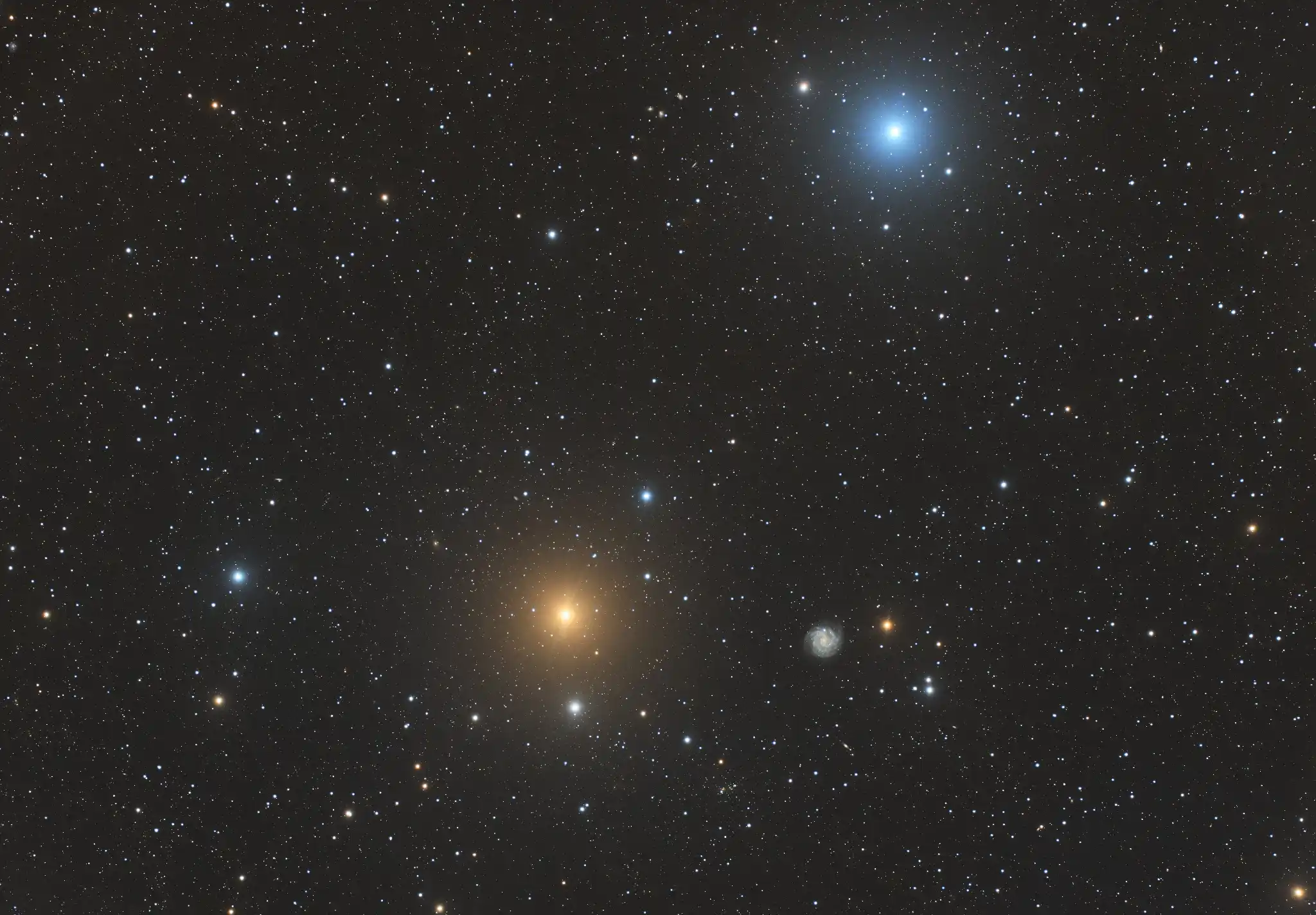
μ UMa, λ UMa and NGC 3184
One of the hind paws of the Great Bear is marked by 2 bright stars - μ Ursae Majoris and λ Ursae Majoris. These are also among the bright stars in the constellation on Ursa Major, shining at apparent magnitudes +3,06 and +3,45.
μ Ursae Majoris – Tania Australis – is a double (possibly triple) star system located 230 light-years away. The main star is an evolved red giant of spectral type M0IIIab. In this stage, it has expanded to a radius 75 time larger than our Sun’s and has a mass 6,3 times bigger. It is more than 1000 times brighter than the Sun and it has cooled down to a temperature of 3900 K. Tania Australis is special because it has almost the exact same metallicity as the Sun. Its companion was found only through spectral analysis and few of its properties are known. Another low-mass component with the same proper motion is most likely part of this system, but the separation is much bigger, at 3900 AU (0,06 light-years).
λ Ursae Majoris – Tania Borealis – is much closer to the Sun, located 138 light-years away. It is an A2IV main sequence star which has around 30 million years left before evolving into a red giant, similar to μ Ursae Majoris. It is a hot star, with a surface temperature of 9280 K. Its mass and radius are 2,3 times bigger than the Sun’s.
Forming a rectangular triangle with the 2 stars, we find the majestic galaxy NGC 3184. It is nicknamed the Little Pinwheel Galaxy, being similar in appearance as Messier 101. Two of its HII regions have their own NGC designations – 3180 and 3181. The galactic arms are symmetrical and are abundant in heavy elements. 6 supernovae have been observed in NGC 3184, the most recent one in 2016. The galaxy resides almost 40 million light-years away.
Mu Ursae Majoris
5 credit
- Type of target............................................................................................................................Asterism
- Camera............................................................................................................................QHY 600M
- Target coordinates............................................................................................................................RA 155.656 Dec 41.4946
- Hemisphere............................................................................................................................Northern
- Telescope location............................................................................................................................Spain
- Transient event............................................................................................................................No
- Observed on............................................................................................................................25 Mar 2023 - 28 Mar 2023
Filter | Avg Exp (s) | Total Exposure | Subframes |
|---|---|---|---|
| Blue | 300 | 1h55m | 23 |
| Green | 300 | 1h55m | 23 |
| Red | 300 | 1h55m | 23 |
| Luminance | 300 | 1h55m | 23 |