02 Feb 2026
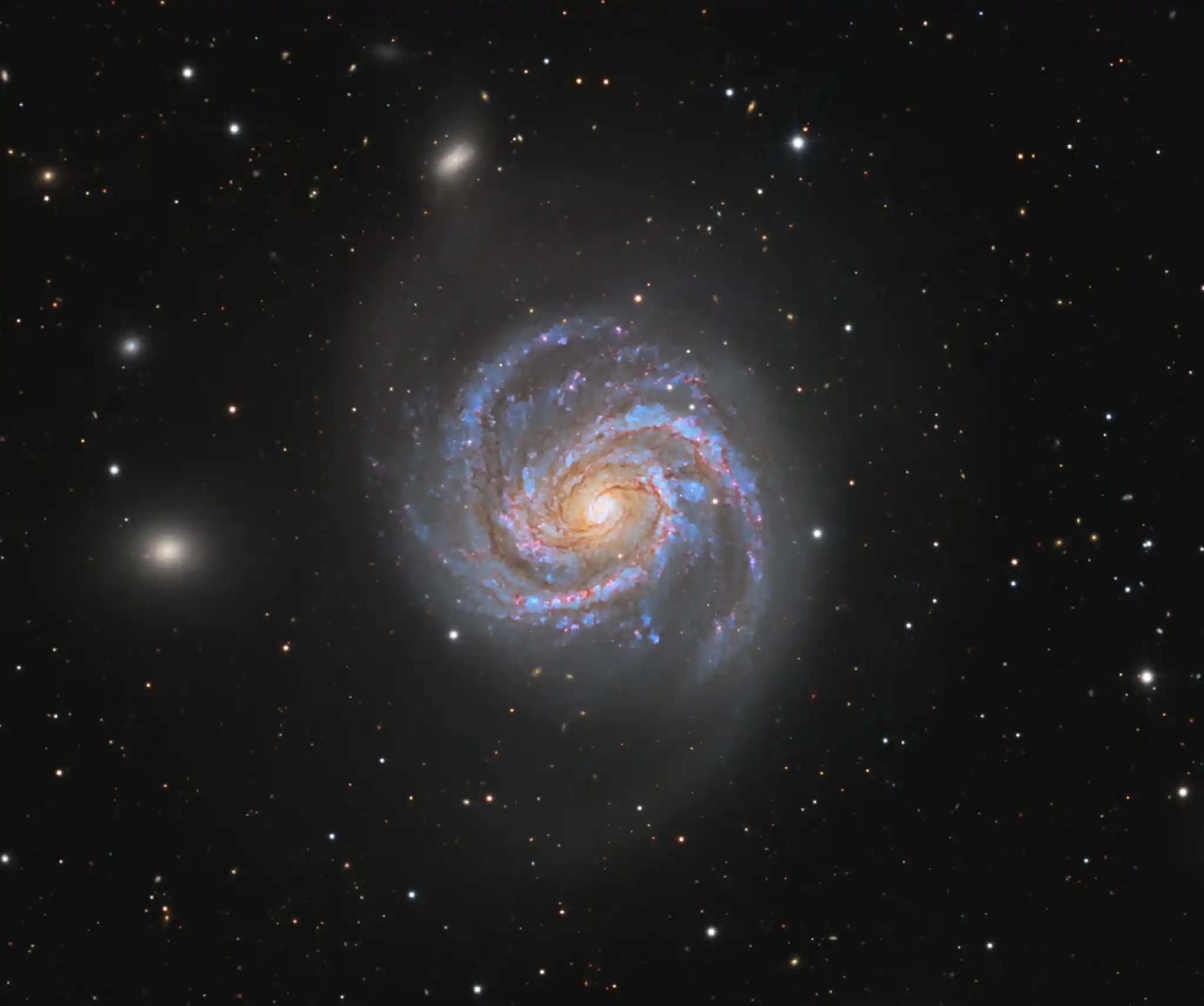
Messier 100 - Grand Design Spiral Galaxy in Coma Berenices
Messier 100 (NGC 4321) is a classic grand-design spiral galaxy located in the constellation Coma Berenices, at a distance of roughly 55–60 million light-years. It is one of the brightest and most prominent spiral members of the Virgo Cluster and is classified as an SAB(s)bc galaxy, meaning it hosts a weak central bar and two well-defined, symmetric spiral arms. These arms are rich in dust lanes and star-forming regions, giving M100 a textbook spiral appearance when viewed nearly face-on.
The spiral structure of M100 is dominated by density waves that organize gas and dust into narrow lanes where star formation is actively triggered. Numerous bright H II regions trace these arms, while the inner disk shows complex dust features and evidence of gas inflow driven by the weak bar. The nucleus itself hosts circumnuclear star formation and ring-like structures on smaller scales, making M100 an important target for studies of spiral dynamics and starburst activity in cluster environments.
As a key Virgo Cluster galaxy, M100 has played an important role in extragalactic astronomy. Cepheid variable stars observed in M100 were used by the Hubble Space Telescope to help calibrate the extragalactic distance scale, contributing directly to more precise measurements of the Hubble constant. Despite residing in a dense cluster, M100 retains a remarkably well-ordered spiral pattern, suggesting that its internal dynamics currently dominate over environmental disruption.
This image was acquired using Telescope Live’s CHI-1-CMOS system, with 10 hours and 25 minutes of LRGB integration.
M100
5 credit
- Type of target............................................................................................................................Galaxy
- Camera............................................................................................................................QHY 600M
- Target coordinates............................................................................................................................RA 185.72891 Dec 15.8223
- Hemisphere............................................................................................................................Southern
- Telescope location............................................................................................................................Chile
- Transient event............................................................................................................................No
- Observed on............................................................................................................................18 Mar 2024 - 07 Apr 2024
Filter | Avg Exp (s) | Total Exposure | Subframes |
|---|---|---|---|
| Luminance | 315 | 1h45m | 20 |
| Red | 315 | 1h45m | 20 |
| Green | 300 | 1h35m | 19 |
| Blue | 268 | 1h25m | 19 |