02 Feb 2026
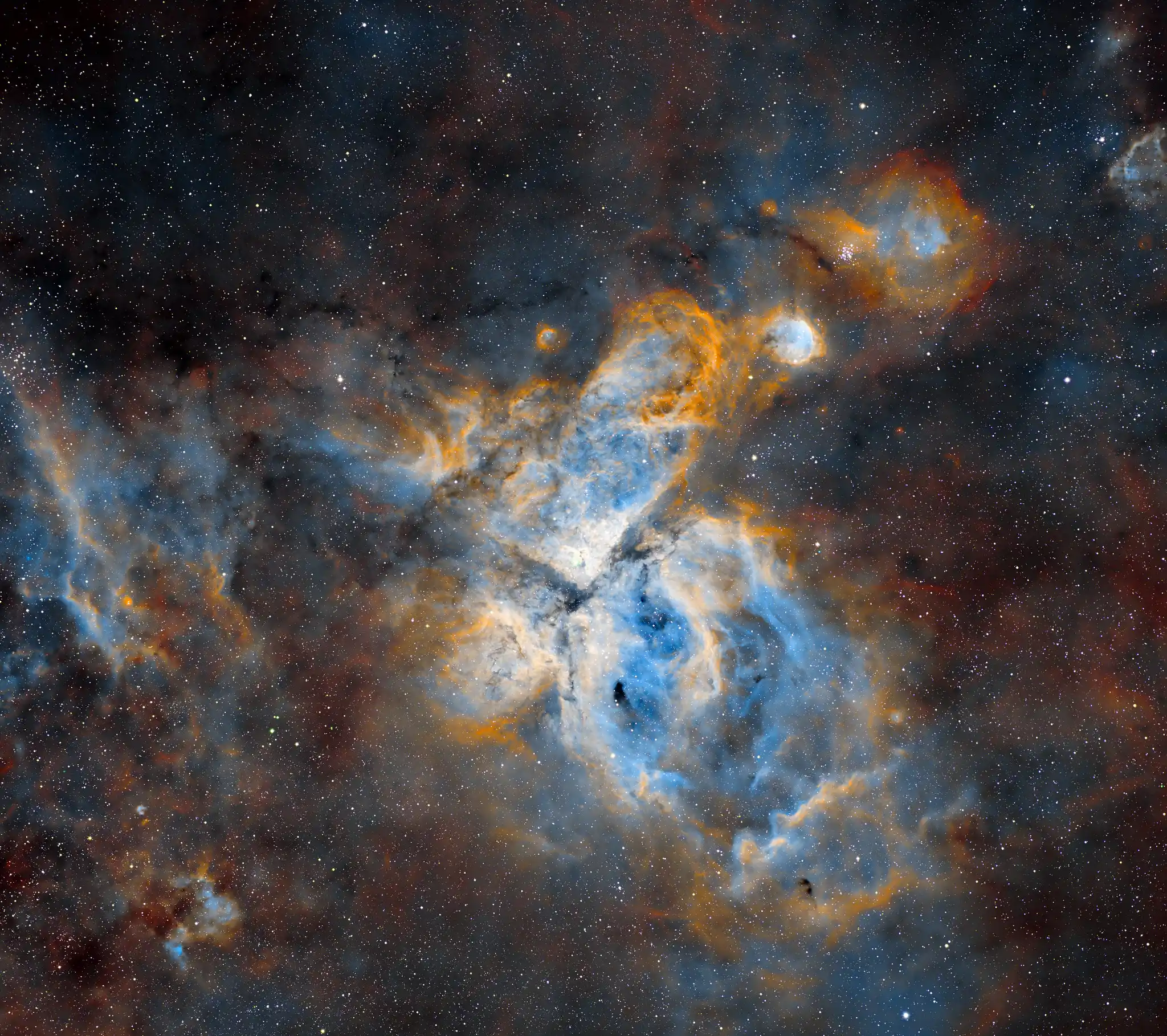
The Eta Carinae Nebula (NGC 3372)
The Eta Carinae Nebula (NGC 3372) is a is a large, complex area of bright and dark nebulosity in the constellation Carina. It is located in the Carina–Sagittarius Arm of the Milky Way galaxy.
This object is only visible in the southern hemisphere.
The previous image, in this album, is an LRGB image of the nebula. An RGB image has a mapping that closely corresponds to the colors in our visual perception.
This image, on the other hand, is a narrowband image. Ionized gases in this nebula produce three prominent emissions: Hydrogen Alpha (656.3 nm), Sulfur II (672 nm) and Oxygen III (500.7 nm).
A formula is used to assign pixel values to RGB channels. The purpose is to more closely emulate the classic Hubble Palette. The specific palette I used is the Foraxx Palette.
(PixInsight Forum)
The color mapping, for this image, is as follows:
Red: (OIII^~OIII) * SII + ~(OIII^~OIII) * Ha
Green: ((OIII*Ha)^~(OIII*Ha))*Ha + ~((OIII*Ha)^~(OIII*Ha))*OIII
Blue: OIII
Bottom line, this mapping communicates the composition of different regions in the nebula. It does not represent the way the nebula appears to our eyes.
Image processed by Andrew Macica, original data from Telescope Live.
Imaging Details:
Observatory: Heaven's Mirror Observatory, Yass, Australia
Telescope: Takahashi FSQ-106ED
Aperture: 106 mm (4.17 inches), f/3.6
Focal Length: 382 mm (with 0.73x focal reducer)
Camera: FLI ProLine PL16803 CCD
Filters: SII, Ha, OIII (SHO)
Total Exposure: 21 hours 21 minutes
Image Processing: PixInsight 1.8.9-3 Ripley (x64);
BlurXTerminator, NoiseXTerminator, StarXTerminator (RC Astro);
Adobe Photoshop 25.12.1;
Adobe Lightroom Classic 14.2
Instruction on PixInsight from Adam Block Studios.
The Eta Carinae Nebula (NGC 3372) is a is a large, complex area of bright and dark nebulosity in the constellation Carina. It is located in the Carina–Sagittarius Arm of the Milky Way galaxy.
This object is only visible in the southern hemisphere.
The previous image, in this album, is an LRGB image of the nebula. An RGB image has a mapping that closely corresponds to the colors in our visual perception.
This image, on the other hand, is a narrowband image. Ionized gases in this nebula produce three prominent emissions: Hydrogen Alpha (656.3 nm), Sulfur II (672 nm) and Oxygen III (500.7 nm).
A formula is used to assign pixel values to RGB channels. The purpose is to more closely emulate the classic Hubble Palette. The specific palette I used is the Foraxx Palette.
(PixInsight Forum)
The color mapping, for this image, is as follows:
Red: (OIII^~OIII) * SII + ~(OIII^~OIII) * Ha
Green: ((OIII*Ha)^~(OIII*Ha))*Ha + ~((OIII*Ha)^~(OIII*Ha))*OIII
Blue: OIII
Bottom line, this mapping communicates the composition of different regions in the nebula. It does not represent the way the nebula appears to our eyes.
Image processed by Andrew Macica, original data from Telescope Live.
Imaging Details:
Observatory: Heaven's Mirror Observatory, Yass, Australia
Telescope: Takahashi FSQ-106ED
Aperture: 106 mm (4.17 inches), f/3.6
Focal Length: 382 mm (with 0.73x focal reducer)
Camera: FLI ProLine PL16803 CCD
Filters: SII, Ha, OIII (SHO)
Total Exposure: 21 hours 21 minutes
Image Processing: PixInsight 1.8.9-3 Ripley (x64);
BlurXTerminator, NoiseXTerminator, StarXTerminator (RC Astro);
Adobe Photoshop 25.12.1;
Adobe Lightroom Classic 14.2
Instruction on PixInsight from Adam Block Studios.
NGC 3372
27 credit
- Type of target............................................................................................................................Emission Nebula
- Camera............................................................................................................................FLI PL16803
- Target coordinates............................................................................................................................RA 161.2593 Dec -59.6999
- Hemisphere............................................................................................................................Southern
- Telescope location............................................................................................................................Australia
- Transient event............................................................................................................................No
- Observed on............................................................................................................................20 Mar 2020 - 30 Mar 2022
Filter | Avg Exp (s) | Total Exposure | Subframes |
|---|---|---|---|
| Halpha | 298 | 10h40m | 129 |
| SII | 298 | 10h40m | 129 |
| OIII | 305 | 10h55m | 129 |