02 Feb 2026
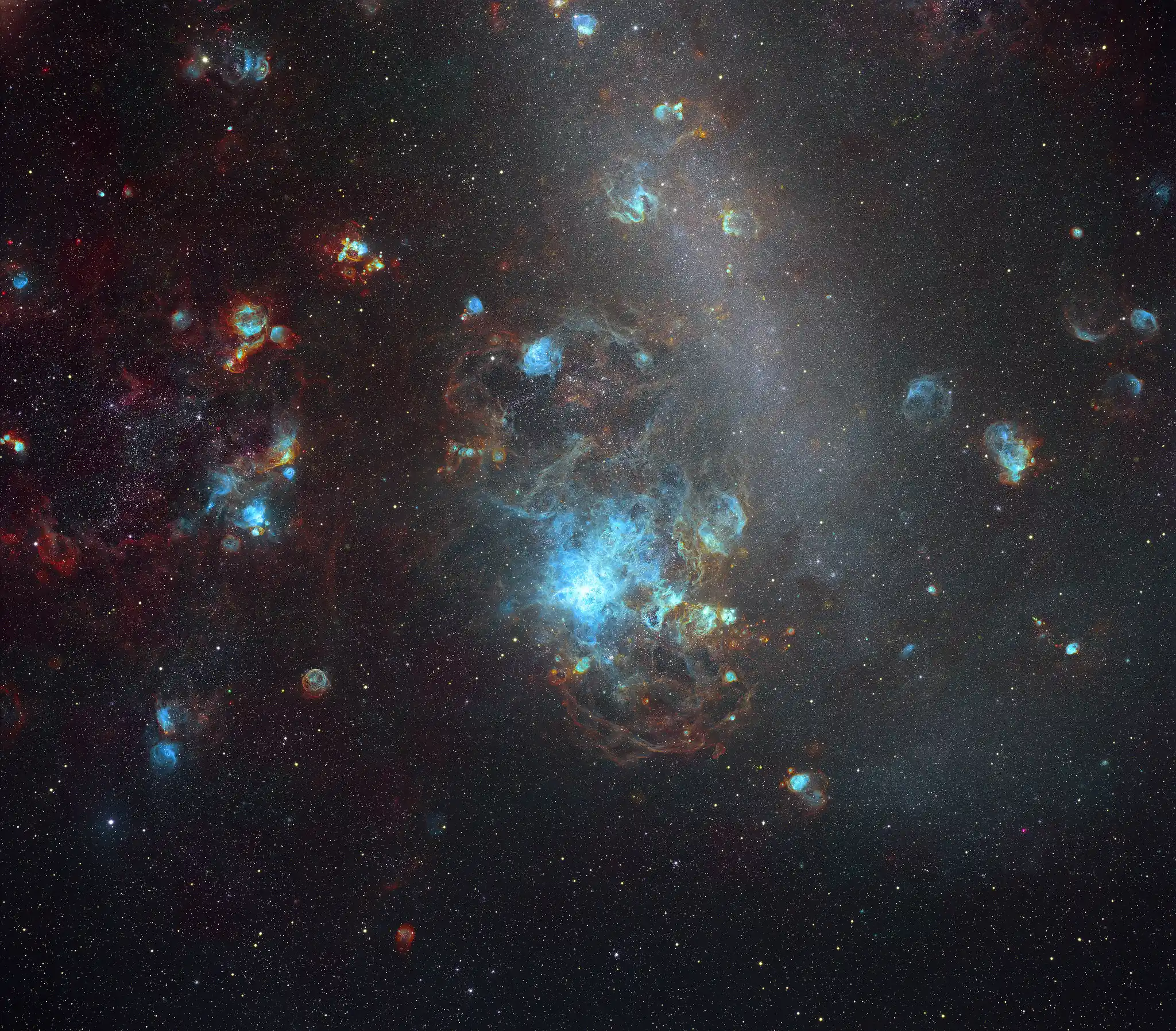
The Tarantula Nebula (NB)
The Tarantula Nebula is a massive star forming region in the dwarf galaxy the Large Magellanic Cloud (LMC). It can be seen in this image of the LMC (lower center), a satellite galaxy of the Milky Way. It consists of extensive hydrogen gas clouds (HII regions) that provide the ingredients for star formation. It is the home of the most massive stars ever seen (NASA).
The previous image, in this album, is an LRGB image. An RGB image has a mapping that closely corresponds to the colors in our visual perception.
This image, on the other hand, is a narrowband image. Ionized gases in this nebula produce three prominent emissions: Hydrogen Alpha (656.3 nm), Sulfur II (672 nm) and Oxygen III (500.7 nm).
A formula is used to assign pixel values to RGB channels. The purpose is to more closely emulate the classic Hubble Palette. The specific palette I used is the Foraxx Palette.
(PixInsight Forum)
The color mapping, for this image, is as follows:
Red: (OIII^~OIII) * SII + ~(OIII^~OIII) * Ha
Green: ((OIII*Ha)^~(OIII*Ha))*Ha + ~((OIII*Ha)^~(OIII*Ha))*OIII
Blue: OIII
Bottom line, this mapping communicates the composition of different regions in the nebula. It does not represent the way the nebula appears to our eyes.
Image processed by Andrew Macica, original data from Telescope Live.
Imaging Details:
Observatory: Heaven's Mirror Observatory, Yass, Australia
Telescope: Takahashi FSQ-106ED
Aperture: 106 mm (4.17 inches), f/3.6
Focal Length: 382 mm (with 0.73x focal reducer)
Camera: FLI ProLine PL16803 CCD
Filters: SII, Ha, OIII (SHO)
Total Exposure: 4 hours 0 minutes
Image Processing: PixInsight 1.8.9-3 Ripley (x64);
BlurXTerminator, NoiseXTerminator, StarXTerminator (RC Astro);
Adobe Photoshop 25.12.1;
Adobe Lightroom Classic 14.2
Instruction on PixInsight from Adam Block Studios.
NGC 2070
3 credit
- Type of target............................................................................................................................Emission Nebula
- Camera............................................................................................................................FLI PL16803
- Target coordinates............................................................................................................................RA 84.65 Dec -69.08639
- Hemisphere............................................................................................................................Southern
- Telescope location............................................................................................................................Australia
- Transient event............................................................................................................................No
- Observed on............................................................................................................................09 Nov 2020 - 18 Feb 2021
Filter | Avg Exp (s) | Total Exposure | Subframes |
|---|---|---|---|
| Halpha | 300 | 1h20m | 16 |
| OIII | 300 | 1h20m | 16 |
| SII | 300 | 1h20m | 16 |