03 Feb 2026
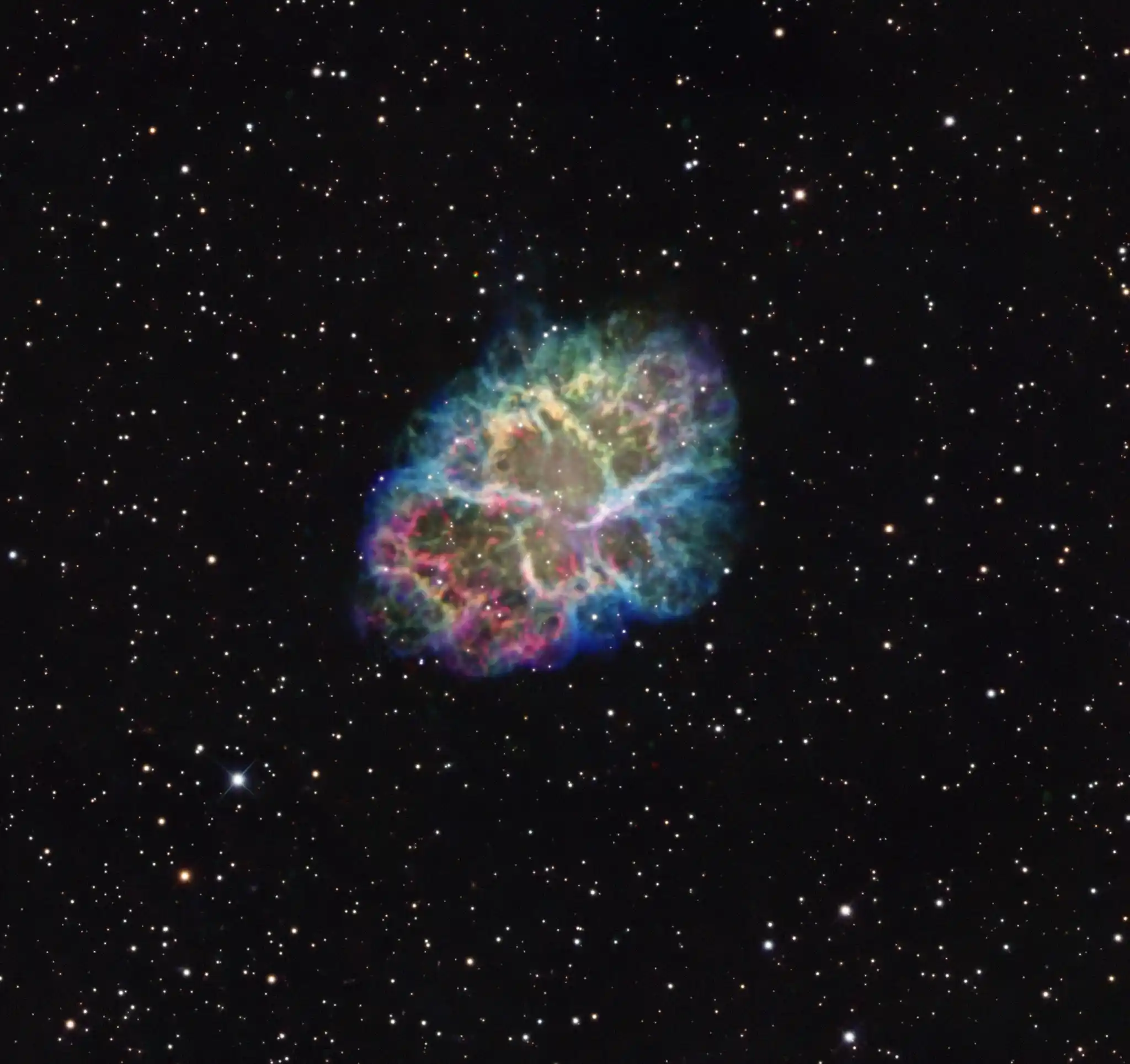
Messier 1, Supernova Remnant
Messier 1 is a supernova remnant in the constellation Taurus. (TheSky, Software Bisque)
In 1054, Chinese astronomers took notice of a “guest star” that was, for nearly a month, visible in the daytime sky. The “guest star” they observed was actually a supernova explosion, which gave rise to the Crab Nebula, a six-light-year-wide remnant of the violent event. (NASA)
Visible in the image and embedded at the center of the nebula is a rapidly spinning neutron star (the ultra-dense core of the exploded star. (NASA)
This image is a narrowband image. Ionized gases in this nebula produce three prominent emissions: Hydrogen Alpha (656.3 nm), Sulfur II (672 nm) and Oxygen III (500.7 nm). I used the Hubble Palette to map these emissions to RGB image channels. These are as follows:
Red: Sulfur II (672 nm)
Green: Hydrogen Alpha (656.3 nm)
Blue: Oxygen III (500.7 nm)
Bottom line, this mapping communicates the composition of different regions in the nebula. It does not represent the way the nebula appears to our eyes.
Image processed by Andrew F. Macica, original data from Telescope Live.
Imaging Details:
Observatory: Oria, Spain
Telescope: Officina Stellare 700 RC
Aperture: 700 mm (27.5 inches), f/8
Focal Length: 5600 mm
Camera: FLI ProLine PL16803 CCD
Filters: LRGB
Total Exposure: 16 hours 34 min.
Image Processing:
PixInsight 1.8.9-3 Ripley (x64);
BlurXTerminator, NoiseXTerminator, StarXTerminator (RC Astro);
Adobe Photoshop 25.12.4;
Adobe Lightroom Classic 15.1.1
Instruction on PixInsight from Adam Block Studios.
M1
16 credit
- Type of target............................................................................................................................Supernova Remnant
- Camera............................................................................................................................FLI PL16803
- Target coordinates............................................................................................................................RA 83.6331 Dec 22.0145
- Hemisphere............................................................................................................................Northern
- Telescope location............................................................................................................................Spain
- Transient event............................................................................................................................No
- Observed on............................................................................................................................24 Oct 2019 - 06 Nov 2021
Filter | Avg Exp (s) | Total Exposure | Subframes |
|---|---|---|---|
| Halpha | 149 | 6h52m | 166 |
| SII | 107 | 4h56m | 166 |
| OIII | 104 | 4h46m | 165 |