05 Feb 2026
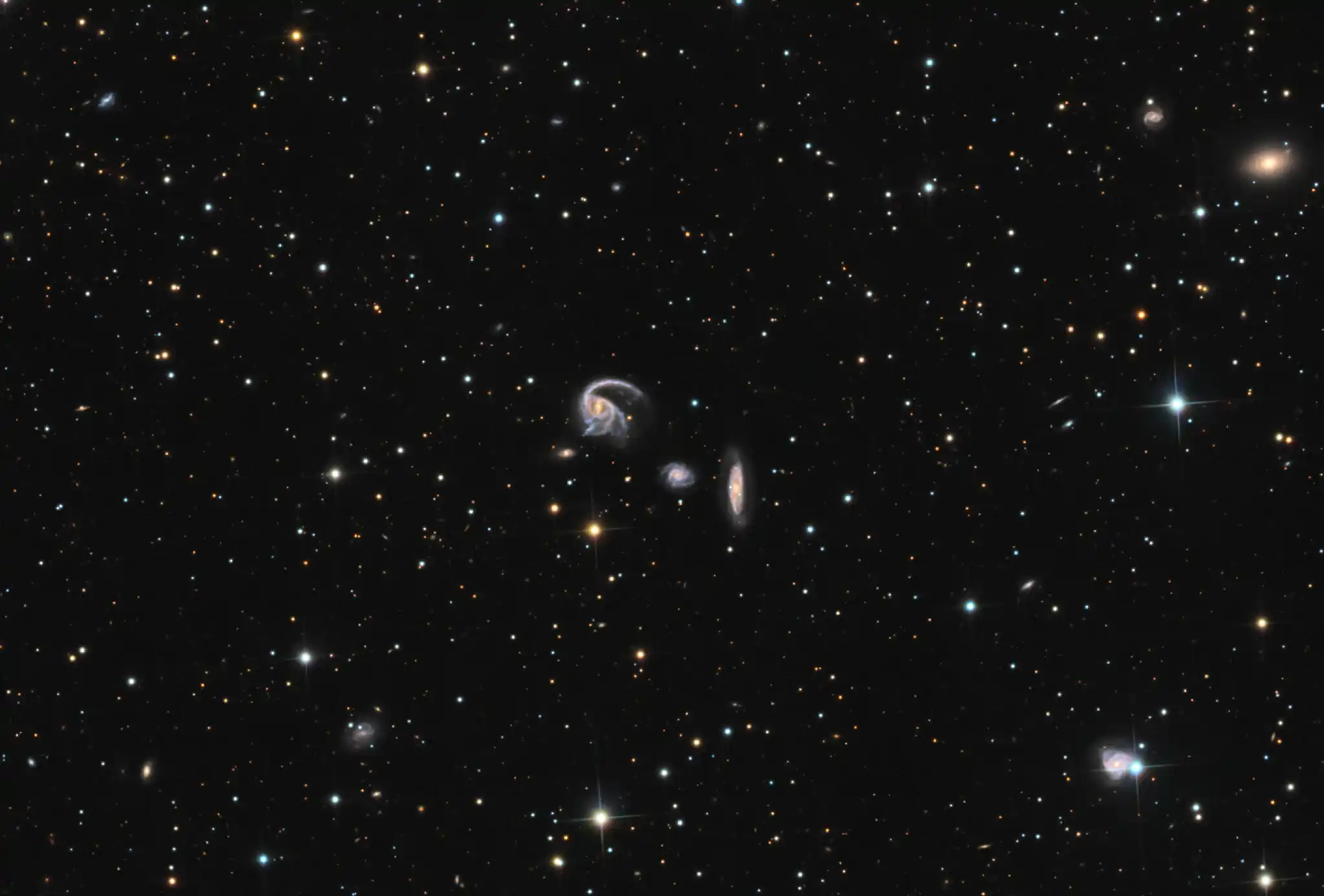
HCG 63 - Compact Galaxy Group in Centaurus
Hickson Compact Group 63 (HCG 63) is a tight little gathering of galaxies in Centaurus that looks, at first glance, like a simple quartet—but the more you read, the more you realize it’s a slightly trickier scene. In Paul Hickson’s original compact-group sense, these systems are singled out because they pack multiple galaxies into a very small patch of sky, creating an environment where close encounters and gravitational “harassment” are common. In the case of HCG 63, the commonly listed members are ESO 443-37, ESO 381-50, PGC 44979, and PGC 44959, all clustered around the same compact field that makes this target such a classic deep-sky challenge.
What’s especially interesting about HCG 63 is that not all of the “four” are necessarily true siblings at the same distance. A kinematic and morphological study reported in the Argentine astronomy bulletin literature concludes that HCG 63A does not belong to the group, and that the physically associated system is primarily the B, C, and D galaxies—a result that fits the general idea that some compact groups include chance alignments mixed in with real associations. That same work notes signs of interaction in both morphology and velocity structure among the associated members, which is exactly the kind of slow-motion disturbance compact groups are known for. Even in purely visual terms, it’s a field that reads like a gravitational conversation: subtle asymmetries, uneven halos, and the sense that these galaxies are close enough to tug on one another over long timescales.
For scale, one of the key galaxies in the field—PGC 44965 / ESO 381-50—has a published host recession velocity of 5695 km/s, placing the system at roughly a few hundred million light-years away in a standard Hubble-flow estimate. That distance context helps explain why HCG 63 rewards long integration: the galaxies are small, the surface brightness is modest, and the most satisfying details are often the faint outer structure rather than the bright cores alone.
This image is based on 5.5 hours of LRGB integration captured with Telescope Live’s CHI-1-CMOS system.
Hickson 63
4 credit
- Type of target............................................................................................................................Group of Galaxies
- Camera............................................................................................................................QHY 600M
- Target coordinates............................................................................................................................RA 195.5 Dec -32.7667
- Hemisphere............................................................................................................................Southern
- Telescope location............................................................................................................................Chile
- Transient event............................................................................................................................No
- Observed on............................................................................................................................17 Apr 2023 - 14 Jun 2023
Filter | Avg Exp (s) | Total Exposure | Subframes |
|---|---|---|---|
| Luminance | 318 | 1h30m | 17 |
| Green | 265 | 1h15m | 17 |
| Red | 338 | 1h30m | 16 |
| Blue | 281 | 1h15m | 16 |