09 Feb 2026
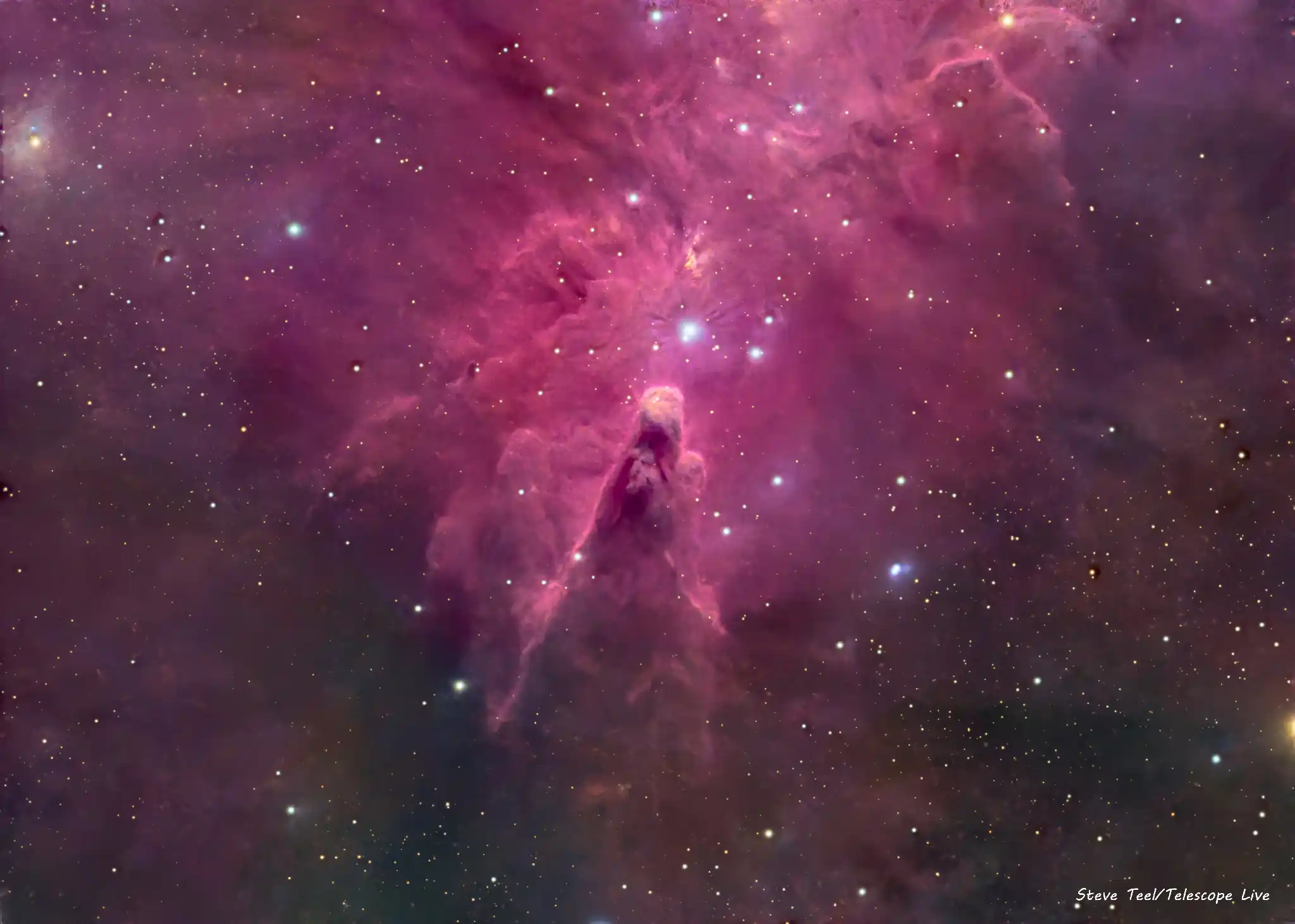
LDN1613, the Cone Nebula feature of NGC2264
Processed using APP, PixInsight with SPFC/MGC, SPCC, BXT, NXT, SXT, MAS, StarReduction, GHS, and Affinity Photo 2.
The high quality of this data makes it possible to examine a couple of interesting astronomical issues. It would be tempting to dismiss the radial spike-like pattern surrounding HD48787 here as an optical artifact and try to suppress it. However, there may be an alternate astrophysical explanation. The star is obviously imbedding in an HII region of varying density. If there are nearby randomly-scattered smallish concentrations and if the star system is emitting enough radiation, then we would see a radial pattern of light and dark just like this. Notice that the "spikes" actually begin at varying distances from the star. Either this is an effect of deconvolved artifact combined with noise-reduction or it's an indication of randomly spaced concentrations of matter.
Secondly, at the stretch level of this particular image, it is clear that in addition to the obvious larger-scale billowy detail of the plasma, there is a lot of smaller-scale cumulo-cirrus-appearing detail. With lower degrees of stretch this could be mistaken for mid-level noise and suppressed. This particular stretch was achieved with a decidedly non-Herculean application of MAS which is itself inherently conservative, so there is little reason to suspect that the billowy patterns are not real.
Issues like these are best settled by comparing more photos that explore the limits of the quality of the data.
Cone Nebula
10 credit
- Type of target............................................................................................................................Star-forming Regions
- Camera............................................................................................................................ASI2600MC Pro
- Target coordinates............................................................................................................................RA 100.25 Dec 9.8831
- Hemisphere............................................................................................................................Northern
- Telescope location............................................................................................................................United States of America
- Transient event............................................................................................................................No
- Observed on............................................................................................................................18 Dec 2025 - 22 Dec 2025
Filter | Avg Exp (s) | Total Exposure | Subframes |
|---|---|---|---|
| Luminance | 44 | 2h | 164 |