27 Feb 2026
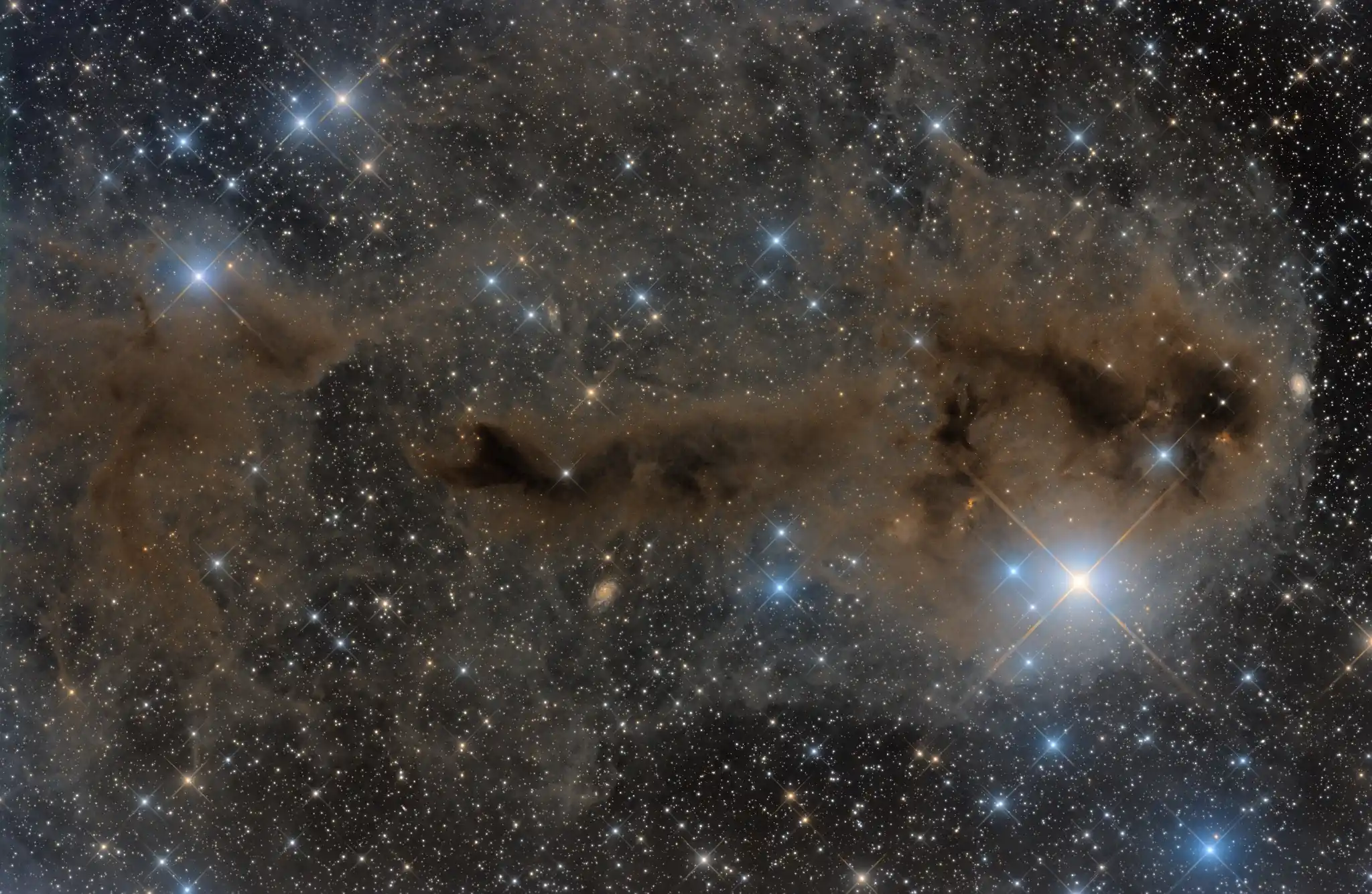
LDN 1251
Lynds Dark Nebula 1251—often nicknamed “The Rotten Fish Nebula”—is a dusty star-forming cloud in Cepheus, part of the nearby Cepheus Flare complex that lies above the Milky Way’s plane. Its official designation, LDN 1251, comes from Beverly T. Lynds’ 1962 Catalogue of Dark Nebulae, compiled by visually inspecting red/blue Palomar Observatory Sky Atlas plates.
The unusual “rotten fish” moniker is community-grown, inspired by the object’s fish-like silhouette in wide-field photographs. The nickname has since shown up in mainstream outreach, including NASA’s Astronomy Picture of the Day. Distance estimates converge around 1000–1100 light-years (Gaia-based studies place L1251 near 1110 light-years).
Historically, LDN 1251 wasn’t “discovered” as a bright nebula but systematically cataloged in 1962 when Lynds introduced the LDN numbering and opacity classes for dark clouds. From the 1990s onward, L1251 became an intensely observed laboratory for low-mass star formation. Optical star counts and spectroscopy established a distance of 300–330 pc for the cloud and revealed its elongated “head–tail” structure.
With the Spitzer “Cores to Disks” legacy survey, astronomers resolved embedded young stellar objects (YSOs) and flows in its subregions—commonly labeled L1251A, L1251B, and L1251C—including compact protostellar groups, jets and molecular outflows, and the reddish knots of Herbig–Haro objects. These studies show a cloud actively turning dust and gas into stars, with different pockets caught at different evolutionary stages.
Several papers even note a bow-shock-like front on the cloud’s eastern side—evidence that L1251 may be plowing through surrounding gas at roughly Mach 2—which helps explain that “fish swimming through space” impression.
Images with long integration time also reveal distant background galaxies peeking through the less opaque regions, a striking contrast with the nearby, star-forming dust. One can be seen near the snout of the fish. This is the small spiral UGC 12160 (PGC 69472), which is estimated to be 50-60 million light-years away. It also hosted the Type II supernova SN 1995X, which was discovered on August 3, 1995. From the snout, drift slightly toward the right and above the darker mid-body to pick up PGC 166755, a compact, tilted spiral that many imagers can resolve.
LDN 1251 - Rotten Fish Nebula LRGB
10 credit
- Type of target............................................................................................................................Dark Nebula
- Camera............................................................................................................................PLAYER ONE MONO 571
- Target coordinates............................................................................................................................RA 339 Dec 75.2667
- Hemisphere............................................................................................................................Northern
- Telescope location............................................................................................................................Italy
- Transient event............................................................................................................................No
- Observed on............................................................................................................................31 Jul 2025 - 30 Aug 2025
Filter | Avg Exp (s) | Total Exposure | Subframes |
|---|---|---|---|
| Luminance | 290 | 4h50m | 60 |
| Red | 300 | 4h55m | 59 |
| Green | 305 | 5h | 59 |
| Blue | 305 | 5h | 59 |