27 Nov 2026
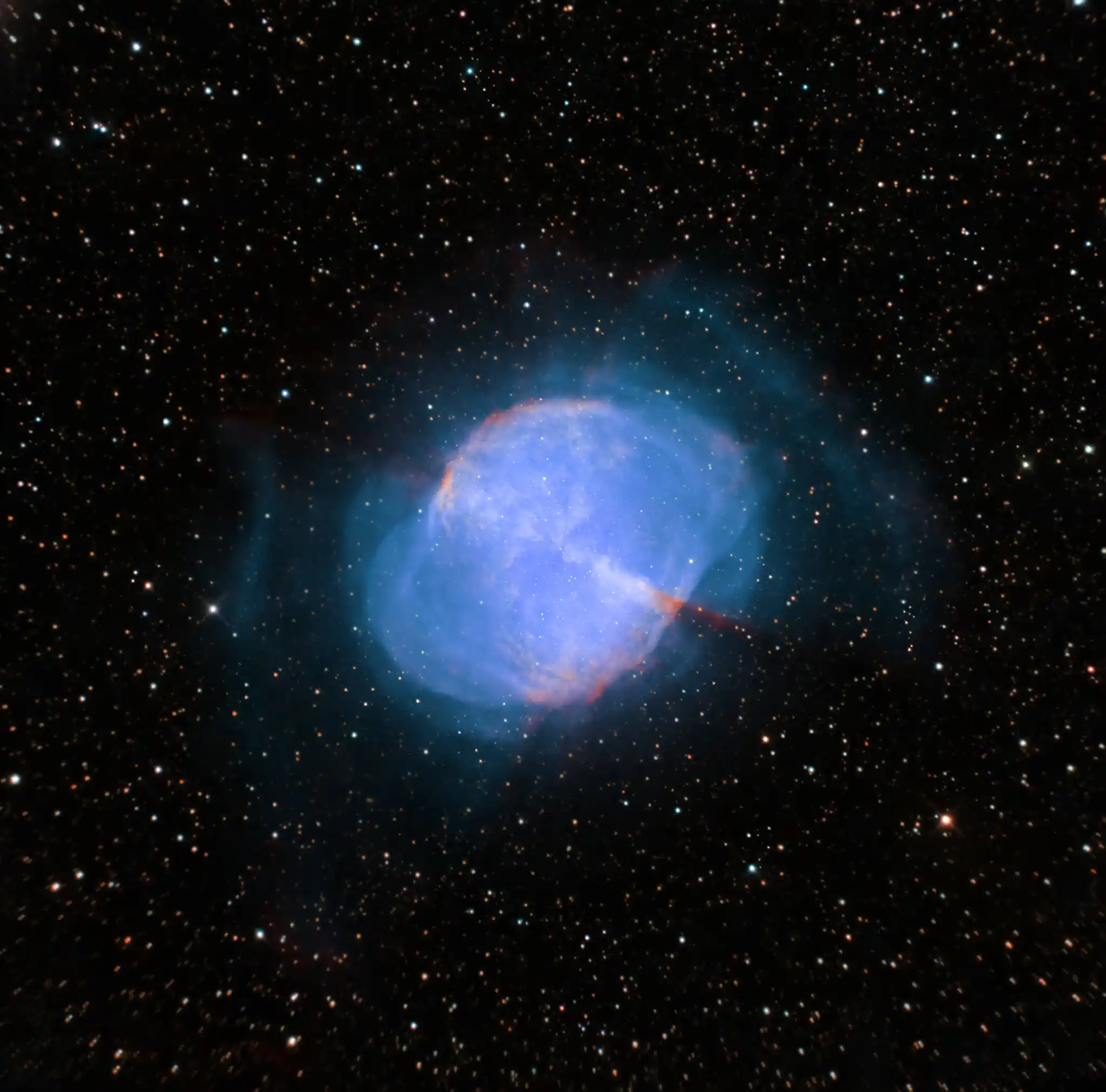
The Dumbbell Nebula
Messier 27 (M27), also known as the Dumbbell Nebula, is a planetary nebula in Vulpecula. The Dumbbell Nebula is large in size and quite bright, which makes it a popular object among amateur astronomers. It can be seen in binoculars and small telescopes.
The nebula covers an area of 8 by 5.6 arc minutes of the apparent sky and has a linear radius of 1.44 light years. Its faint halo stretches out to more than 15 arc minutes. M27 lies at an approximate distance of 1,360 light years, or 417 parsecs, from Earth and has an apparent magnitude of 7.5. It has the designation NGC 6853 in the New General Catalogue. GoStargazing
Messier 27 is the second brightest planetary nebula in the sky, second only to the Helix Nebula in Aquarius, and probably the easiest one to observe because it has a higher surface brightness. (messier-objects.com)
This image is a narrowband image. Ionized gases in this nebula produce three prominent emissions: Hydrogen Alpha (656.3 nm), Sulfur II (672 nm) and Oxygen III (500.7 nm). I used the Seti Astro Realistic 2 Palette to map these emissions to RGB image channels.
Bottom line, this mapping communicates the composition of different regions in the nebula. The mapping does represent a close approximation to the way the nebula appears to our eyes.
Image processed by Andrew F. Macica, original data from Telescope Live.
M27
15 credit
- Type of target............................................................................................................................Planetary Nebula
- Camera............................................................................................................................FLI PL16803
- Target coordinates............................................................................................................................RA 299.9015 Dec 22.7212
- Hemisphere............................................................................................................................Northern
- Telescope location............................................................................................................................Spain
- Transient event............................................................................................................................No
- Observed on............................................................................................................................18 Aug 2019 - 12 May 2022
Filter | Avg Exp (s) | Total Exposure | Subframes |
|---|---|---|---|
| Halpha | 138 | 2h50m | 74 |
| OIII | 320 | 6h35m | 74 |
| SII | 470 | 9h40m | 74 |