21 Oct 2023
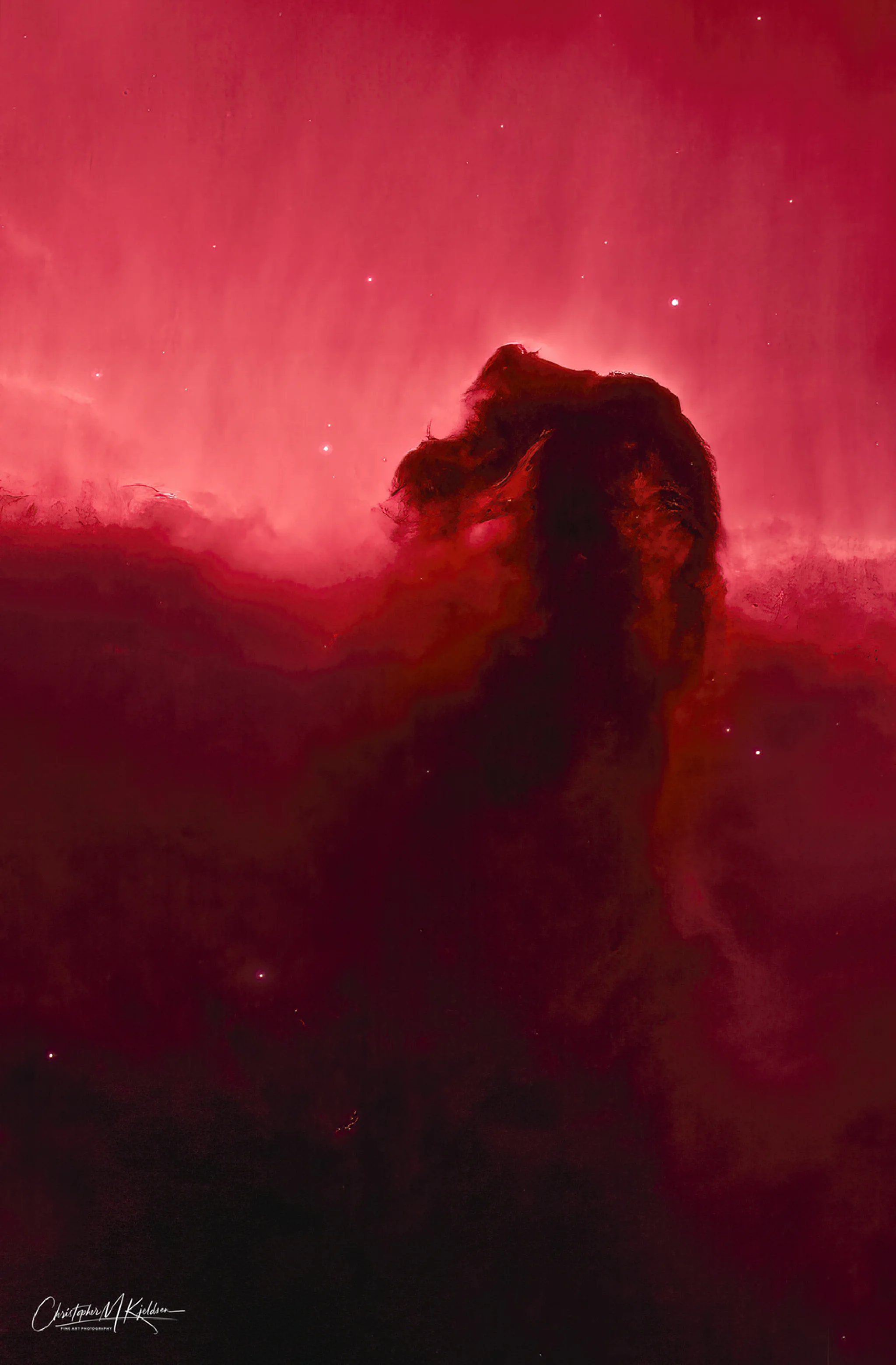
THE HORSEHEAD NEBULA CLOSEUP
I rann this image again with a tight cropp and some additional sharpening. I kina like it close.
The Horsehead Nebula, B33, is the dark nebula in front of the bright red emission nebula IC 434.
The Horsehead Nebula (also known as Barnard 33) is a small dark nebula in the constellation Orion. The nebula is located just to the south of Alnitak, the easternmost star of Orion's Belt, and is part of the much larger Orion molecular cloud complex. The nebula was first recorded in 1888 by Scottish astronomer Williamina Fleming on a photographic plate taken at the Harvard College Observatory.
The Horsehead Nebula is approximately 1,375 light-years from Earth. It is one of the most identifiable nebulae because of its resemblance to a horse's head. The darkness of the Horsehead is caused mostly by thick dust blocking the light of stars behind it. The visible dark nebula emerging from the gaseous complex is an active site of the formation of "low-mass" stars. Bright spots in the Horsehead Nebula's base are young stars just in the process of forming.
Along with the Orion Nebula, these nebulae near the Horsehead are part of a very large complex that is a stellar nursery where stars are forming out of the dust and gas. Located about 1,500 light years away, this complex is the closest star forming region to our own solar system.
Color images reveal a deep-red color that originates from ionized hydrogen gas predominantly behind the nebula (IC434) and caused by the nearby bright star Sigma Orionis. Magnetic fields channel the gases, leaving the nebula into streams, shown as foreground streaks against the background glow. A glowing strip of hydrogen gas marks the edge of the enormous cloud, and the densities of nearby stars are noticeably different on either side.
B33
12 credit
- Type of target............................................................................................................................Dark Nebula
- Camera............................................................................................................................QHY 600M
- Target coordinates............................................................................................................................RA 85.2695 Dec -2.4968
- Hemisphere............................................................................................................................Southern
- Telescope location............................................................................................................................Chile
- Transient event............................................................................................................................No
- Observed on............................................................................................................................31 Aug 2023 - 01 Oct 2023
Filter | Avg Exp (s) | Total Exposure | Subframes |
|---|---|---|---|
| Halpha | 304 | 5h55m | 70 |
| SII | 304 | 5h50m | 69 |
| OIII | 291 | 5h35m | 69 |