15 Nov 2024
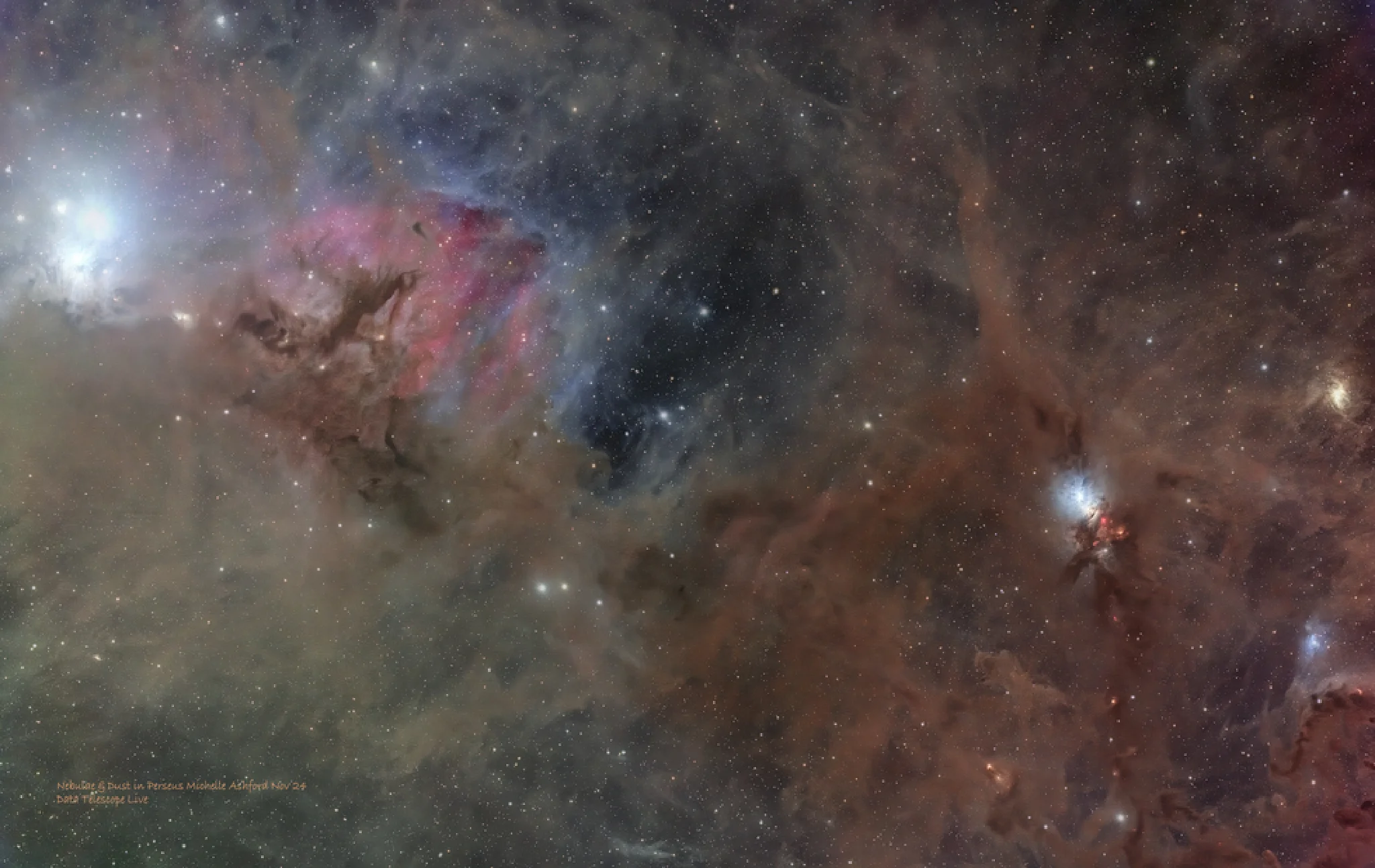
Nebulae and Dust in Perseus
This main image shows the nebulae IC 348 and NGC 1333, star forming regions found in the OB2 molecular cloud in the constellation of Perseus. These are two rich and very interesting objects located approx. 1,000 light years fro Earth. They are quite diverse nebulae which I found quite tricky to process effectively together so I also divided the original into separate images, which reveals a little more of the detail in the individual objects (both of these are included).
IC 348 (also known as LBN 758) is a 2 million year old open star cluster of roughly 400 stars surrounded by the reflection nebula vdB 19 (also known as Cederblad 20). It was in this star cluster that scientists discovered 3 low mass brown dwarfs (smaller than Jupiter) in 2009, indicative of the young age of the group. The light is scattered by clouds of dust ordering the reflection nebula
Below the star cluster is a dark cloud of dust (Barnard 4), which extends off to the right into the reddish area of the image. The large reddish nebula that glows behind the dust is known as NDN 1470.
NGC 1333, also known as the Embryo Nebula, is a bright reflection nebula first discovered by Eduard Schonfeld in 1855. The presence of emission-line stars and Herbig-Haro objects established NGC 1333 as a young region of very active star formation. These Herbig-Haro objects form when ionised material ejected from young stars collides with the surrounding cloud. These objects take their names from George Herbig and Guillermo Haro who first described them over 50 years ago. Reports suggest that there could be around 45 of these objects associated with this nebula, they are a relatively brief cosmic light show as they only last a few thousand years.
IC 1848
6 credit
- Type of target............................................................................................................................Emission Nebula
- Camera............................................................................................................................QHY 600M
- Target coordinates............................................................................................................................RA 42.855 Dec 60.4189
- Hemisphere............................................................................................................................Northern
- Telescope location............................................................................................................................Spain
- Transient event............................................................................................................................No
- Observed on............................................................................................................................14 Nov 2023 - 23 Nov 2023
Filter | Avg Exp (s) | Total Exposure | Subframes |
|---|---|---|---|
| Halpha | 309 | 2h50m | 33 |
| OIII | 282 | 2h35m | 33 |
| SII | 309 | 2h50m | 33 |