14 Sept 2022
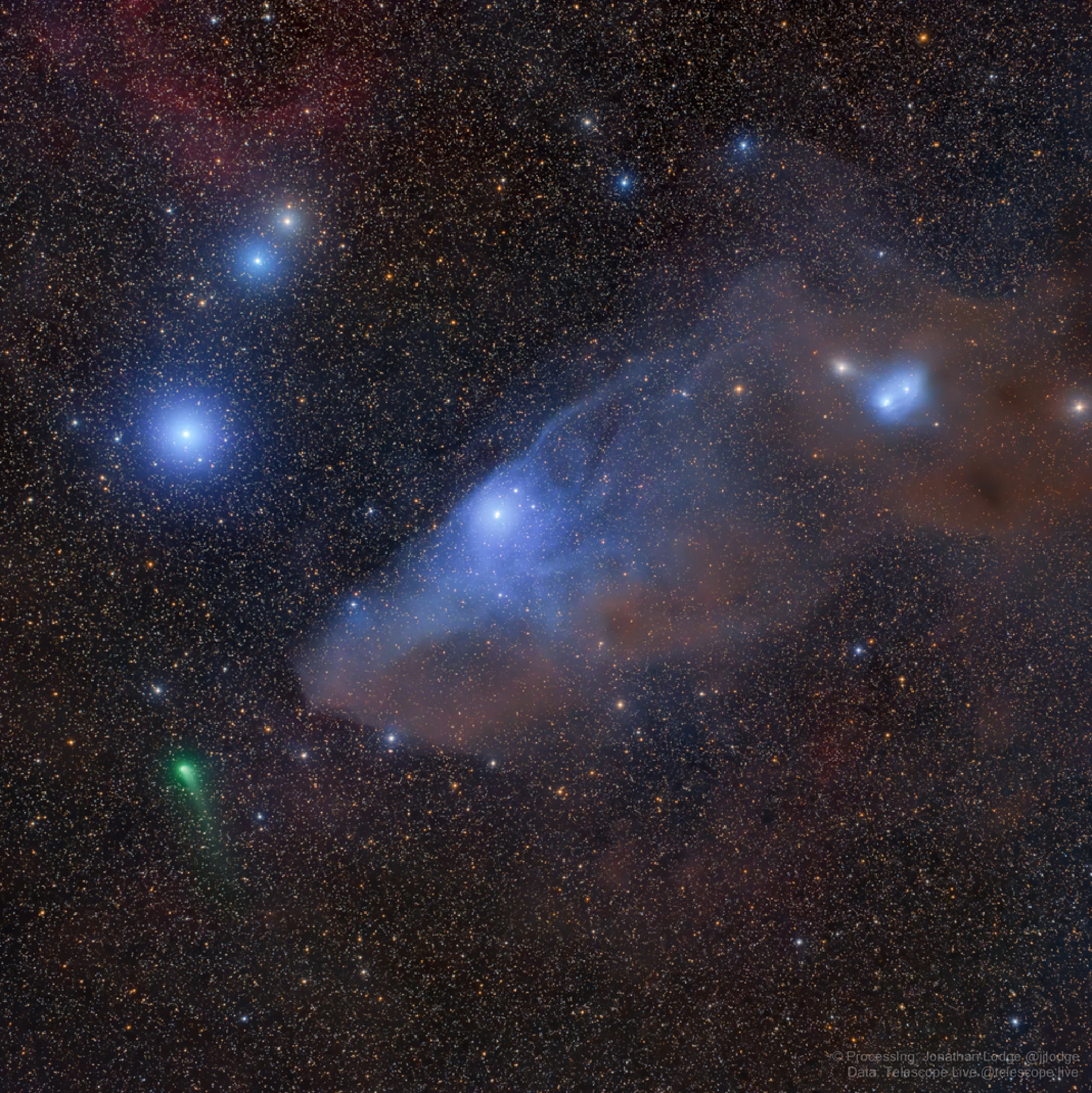
The Blue Horsehead Nebula IC 4592 and Comet C/2017 K2
The other Horsehead Nebula, much less well known than the one in Orion.
The main part of the molecular cloud complex here is a reflection nebula catalogued as IC 4592. Reflection nebulas are actually made up of very fine dust that normally appears dark but can look quite blue when reflecting the light of energetic nearby stars. In this case, the source of much of the reflected light is a star at the eye of the horse. That star is part of Nu Scorpii, one of the brighter star systems toward the constellation of the Scorpion (Scorpius). A second reflection nebula dubbed IC 4601 is visible surrounding two stars to the right of the image center.
C/2017 K2 (PanSTARRS) [green object, bottom left of the image] is an Oort cloud comet with an inbound hyperbolic orbit, discovered in May 2017 at a distance beyond the orbit of Saturn when it was 16 AU (2.4 billion km) from the Sun.
The comet is record breaking because it is already becoming active at such a distance. Only Comet Hale–Bopp produced such a show from that distance with a similar nucleus. However, this comet will not be as visible as Hale–Bopp was in 1997 in part because it does not come nearly as close to the Sun. Astronomers had never seen an active inbound comet this far out, where sunlight is 1/225th its brightness as seen from Earth. Temperatures, correspondingly -262 °C in the Oort cloud. However, as it was approaching the Sun at a distance of 16 AU at discovery, a mix of ancient ices on the surface containing oxygen, nitrogen, carbon dioxide and carbon monoxide began to sublimate and shed the dust frozen into it. This material expands into a vast 130,000 km (81,000 mi) wide halo of dust, called a coma, enveloping the solid nucleus.
IC 4592
15 credit
- Type of target............................................................................................................................Reflection Nebula
- Camera............................................................................................................................FLI PL16803
- Target coordinates............................................................................................................................RA 243.25 Dec -19.3
- Hemisphere............................................................................................................................Southern
- Telescope location............................................................................................................................Australia
- Transient event............................................................................................................................No
- Observed on............................................................................................................................17 Apr 2020 - 22 Aug 2022
Filter | Avg Exp (s) | Total Exposure | Subframes |
|---|---|---|---|
| Luminance | 327 | 5h27m | 60 |
| Red | 195 | 3h15m | 60 |
| Green | 214 | 3h30m | 59 |
| Blue | 488 | 8h | 59 |