11 May 2022
Tulip Nebula and Cygnus X-1
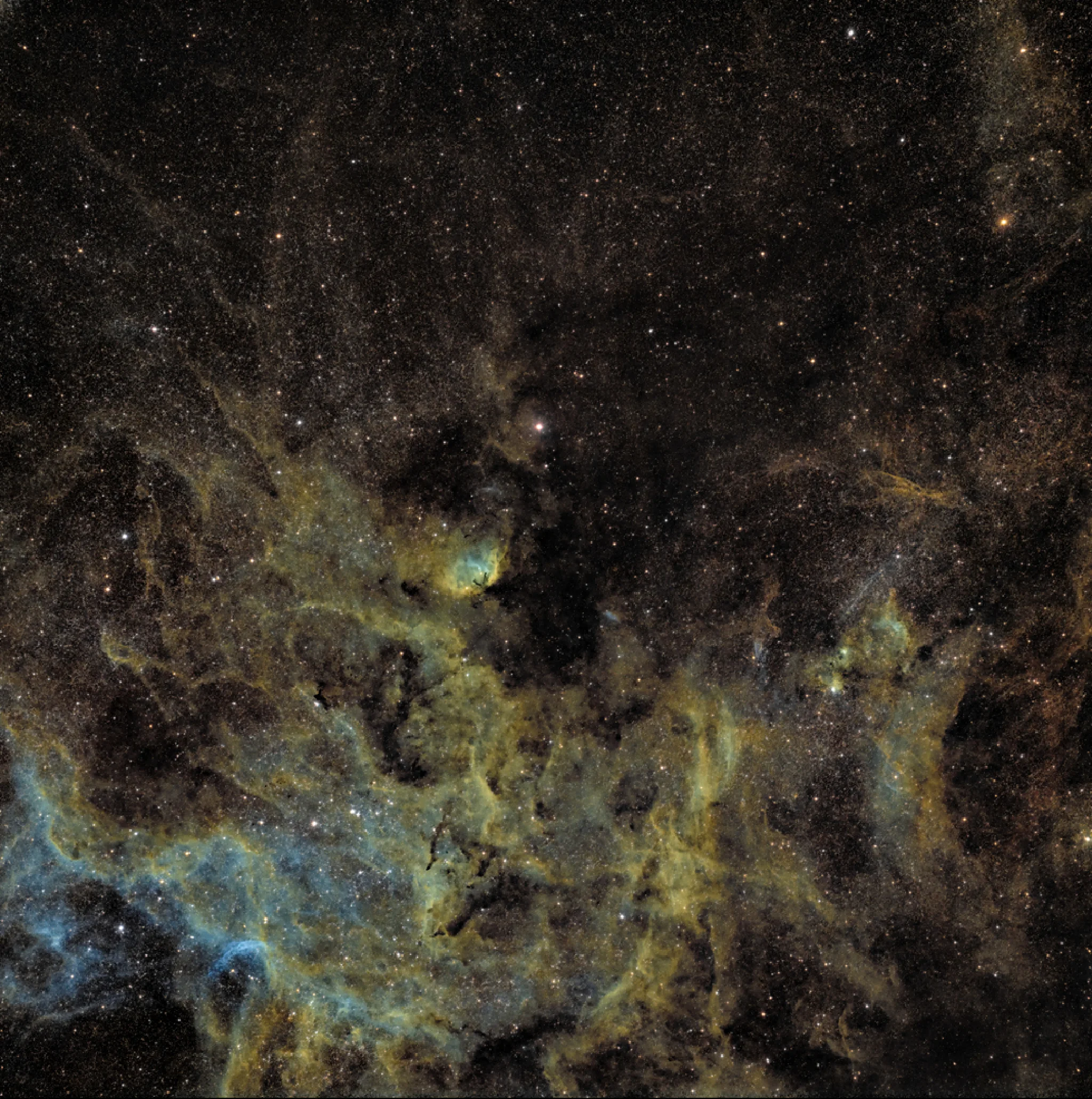
The Tulip Nebula, or Sharpless 101 (Sh2-101) - here in the center of this widefield SHO-image - is an emission nebula located in the constellation Cygnus. It lies at a distance of about 6,000 lightyears from Earth.
Located nearby is Cygnus X-1, an X-ray source discovered in 1964, which is generally believed to be the site of a black hole. It is orbited by a blue supergiant star HDE 226868 that is Cygnus X-1's companion star. The star betrays the existence of the black hole because it is being whipped around an object every 5.6 days at a radius of 0.2 AU. The black hole is also consuming the companion star, which feeds a spinning accretion disk around the black hole resulting in relativistic jets of high energy particles being emitted perpendicular to the accretion disk. One of these jets is impacting a denser region of the interstellar medium forming a glowing curved bow shock (or shock front).
This widefield SHO-image of the Sh2-101 region was acquired with SPA-1 (Takahashi FSQ-106 ED refractor). Data from 4 one click observations (Ced 173)
Total integration time 240 minutes.
8 subs of 600s with each narrowband filter (SII, Ha and OIII)
LBN 168
10 credit
- Type of target............................................................................................................................Emission Nebula
- Camera............................................................................................................................FLI PL16083
- Target coordinates............................................................................................................................RA 299.9792 Dec 35.2667
- Hemisphere............................................................................................................................Northern
- Telescope location............................................................................................................................Spain
- Transient event............................................................................................................................No
- Observed on............................................................................................................................07 Oct 2020 - 29 Nov 2022
Filter | Avg Exp (s) | Total Exposure | Subframes |
|---|---|---|---|
| Halpha | 620 | 5h10m | 30 |
| SII | 600 | 4h50m | 29 |
| OIII | 579 | 4h40m | 29 |