22 Nov 2023
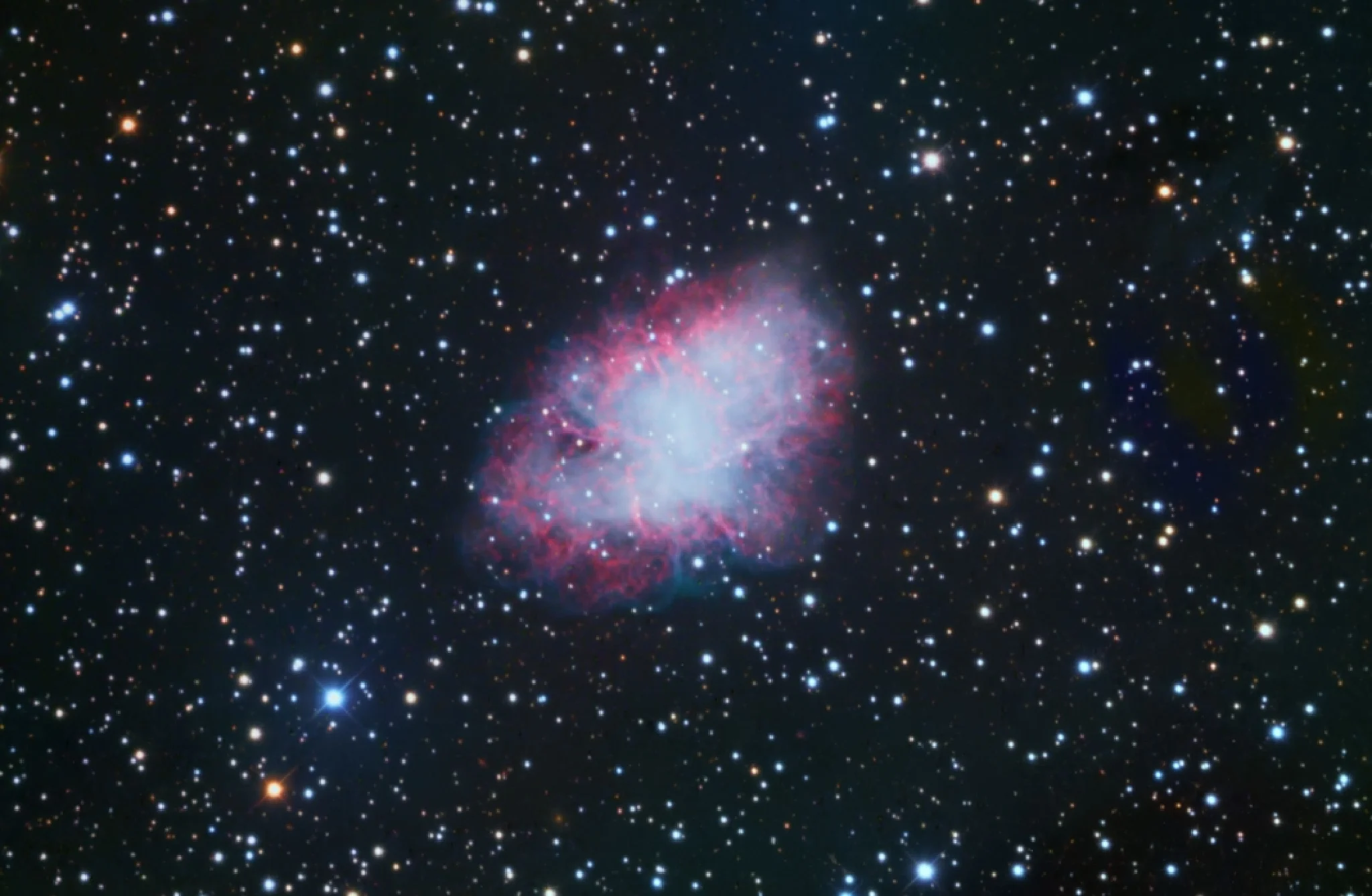
M 1 - Crab Nebula
The Crab Nebula (also known as the Crab Nebula or by the catalog acronyms M 1 and NGC 1952) is a supernova remnant visible in the constellation Taurus. Discovered in 1731 by John Bevis, the nebula is the first object in the catalog of astronomical objects published by Charles Messier in 1774.
The nebula, now more than six light years across, is formed by the expanding gases expelled during the explosion of Supernova 1054; the gases are expanding at a speed of 1500 km/s and have a total mass of approximately 4.6±1.8 M⊙. The supernova that produced it was observed for the first time on July 4, 1054 and was recorded by Chinese and Arab astronomers of the time; its brightness was such that the apparent magnitude of the event was between −7 and −4.5, making it visible to the naked eye during the day, surpassing the apparent brightness of Venus. The Crab Nebula is located about 6500 kilometers from the solar system; therefore the event that produced it actually occurred 6,500 years before 1054, that is, approximately 5400 BC.
At the center of the nebula is the Crab pulsar (also known as PSR B0531+21), a neutron star with a diameter of approximately 28-30 kilometers, discovered in 1968: it was the first observation of an association between pulsars and remnants supernova, a fundamental discovery for the interpretation of pulsars as neutron stars.
The Crab Nebula is often used as a calibration in X-ray astronomy: it is very bright in this band, and its flux is stable, with the exception of the pulsar itself: the latter in fact provides a strong periodic signal that can be used to control the timings of X-ray sensors. In X-ray astronomy, "Crab" and "milliCrab" are sometimes used as flux units. Very few X-ray sources have a brightness greater than 1 Crab.
M1
4 credit
- Type of target............................................................................................................................Supernova Remnant
- Camera............................................................................................................................QHY 600M
- Target coordinates............................................................................................................................RA 83.6288 Dec 22.0147
- Hemisphere............................................................................................................................Northern
- Telescope location............................................................................................................................Spain
- Transient event............................................................................................................................No
- Observed on............................................................................................................................12 Sept 2023 - 18 Oct 2023
Filter | Avg Exp (s) | Total Exposure | Subframes |
|---|---|---|---|
| Luminance | 286 | 1h40m | 21 |
| Red | 300 | 1h40m | 20 |
| Green | 300 | 1h40m | 20 |
| Blue | 315 | 1h45m | 20 |