12 Jan 2021
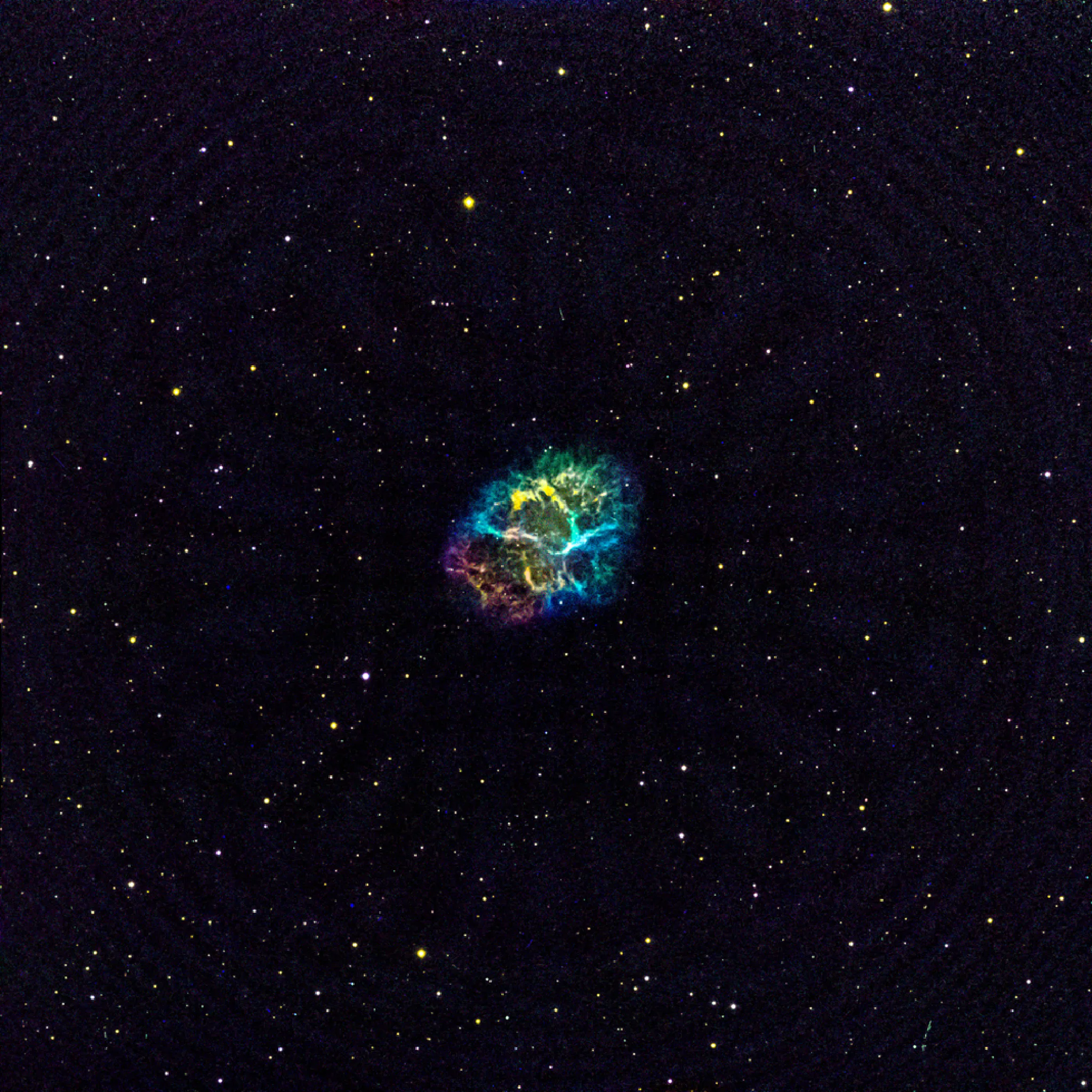
Crab Nebula - One Click
Crab Nebula - One Click
The Crab Nebula (catalogue designations M1, NGC 1952, Taurus A) is a supernova remnant and pulsar wind nebula in the constellation of Taurus. The common name comes from William Parsons, 3rd Earl of Rosse, who observed the object in 1840 using a 36-inch telescope and produced a drawing that looked somewhat like a crab. The nebula was discovered by English astronomer John Bevis in 1731, and it corresponds with a bright supernova recorded by Chinese astronomers in 1054. The nebula was the first astronomical object identified that corresponds with a historical supernova explosion.
At an apparent magnitude of 8.4, comparable to that of Saturn's moon Titan, it is not visible to the naked eye but can be made out using binoculars under favourable conditions. The nebula lies in the Perseus Arm of the Milky Way galaxy, at a distance of about 2.0 kiloparsecs (6,500 ly) from Earth. It has a diameter of 3.4 parsecs (11 ly), corresponding to an apparent diameter of some 7 arcminutes, and is expanding at a rate of about 1,500 kilometres per second (930 mi/s), or 0.5% of the speed of light.
At the center of the nebula lies the Crab Pulsar, a neutron star 28–30 kilometres (17–19 mi) across with a spin rate of 30.2 times per second, which emits pulses of radiation from gamma rays to radio waves. At X-ray and gamma ray energies above 30 keV, the Crab Nebula is generally the brightest persistent gamma-ray source in the sky, with measured flux extending to above 10 TeV. The nebula's radiation allows detailed study of celestial bodies that occult it. In the 1950s and 1960s, the Sun's corona was mapped from observations of the Crab Nebula's radio waves passing through it, and in 2003, the thickness of the atmosphere of Saturn's moon Titan was measured as it blocked out X-rays from the nebula. ~Wikipedia
M1
4 credit
- Type of target............................................................................................................................Supernova Remnant
- Camera............................................................................................................................FLI ProLine PL9000
- Target coordinates............................................................................................................................RA 83.6331 Dec 22.0145
- Hemisphere............................................................................................................................Southern
- Telescope location............................................................................................................................Chile
- Transient event............................................................................................................................No
- Observed on............................................................................................................................28 Sept 2019 - 14 Dec 2022
Filter | Avg Exp (s) | Total Exposure | Subframes |
|---|---|---|---|
| Luminance | 57 | 22m | 23 |
| Green | 42 | 16m | 23 |
| Red | 44 | 16m | 22 |
| Blue | 44 | 16m | 22 |
| Halpha | 573 | 3h30m | 22 |