21 Jul 2023
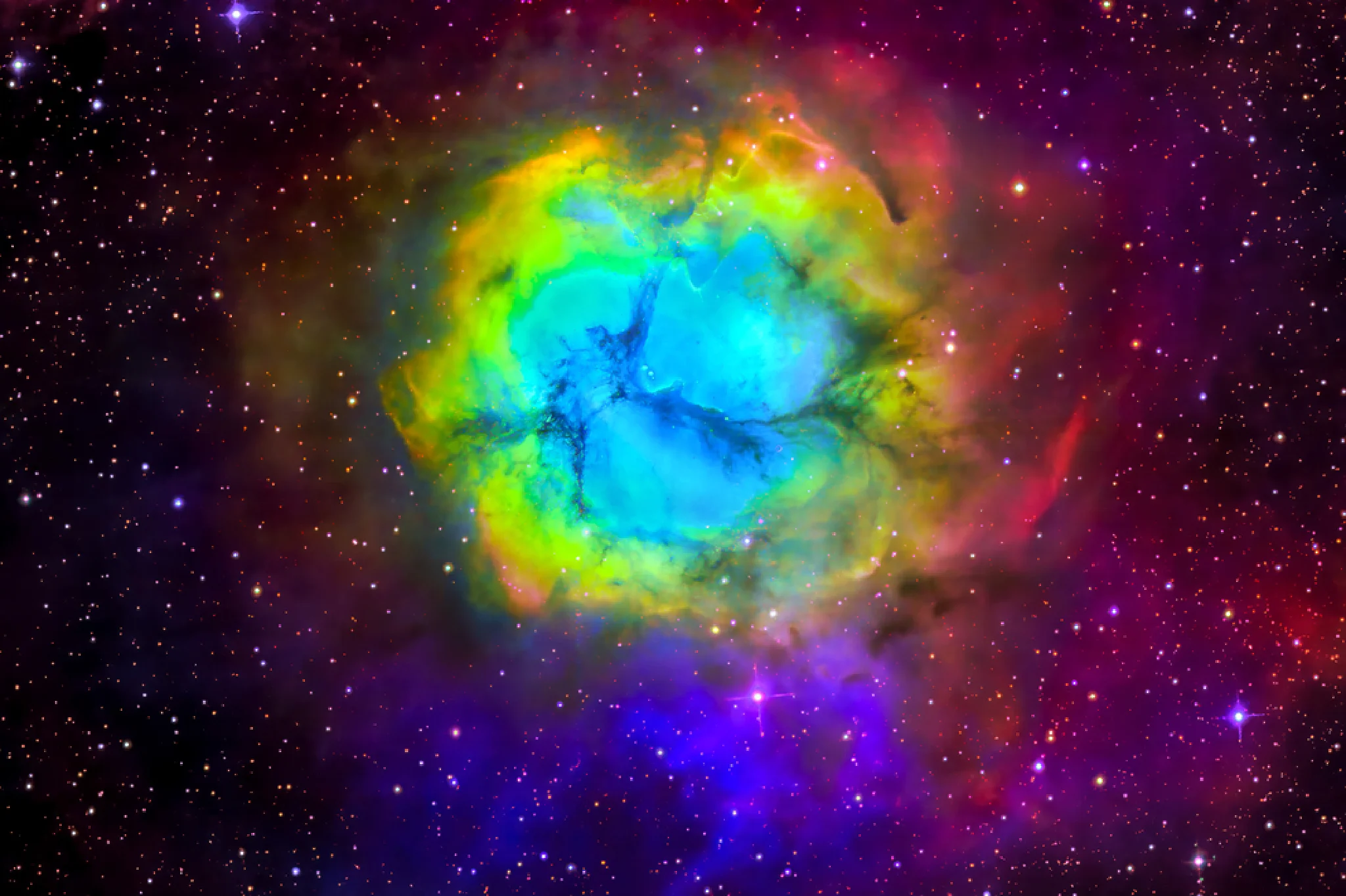
NGC 6514 / M20 - Trifid Nebula, 2nd take, different palette
This is my second take on the M20, with different colors than before, and smoother (less details) in the core. I've still boosted lots of the outside shadowy details, which most of the time are not represented well in photos of Trifid Nebula (as people often focus just on the main center part).
This time around most of the post processing was done in Photoshop and not StarTools, straight from the PixInsight output. Topaz Photo AI still helped with details and resolution.
As I said in my previous post, I like some green and I think this version of M20, false color or not, shows that green has a good place in astrophotography, even if not really emitted as wavelength too much by nebulas in real life.
The Trifid Nebula (catalogued as Messier 20 or M20 and as NGC 6514) is an H II region in the north-west of Sagittarius in a star-forming region in the Milky Way's Scutum-Centaurus Arm. It was discovered by Charles Messier on June 5, 1764. Its name means 'three-lobe'. The object is an unusual combination of an open cluster of stars, an emission nebula (the relatively dense, reddish-pink portion), a reflection nebula (the mainly NNE blue portion), and a dark nebula (the apparent 'gaps' in the former that cause the trifurcated appearance, also designated Barnard 85) [Wiki]
M20
3 credit
- Type of target............................................................................................................................Emission Nebula
- Camera............................................................................................................................QHY 600M
- Target coordinates............................................................................................................................RA 270.6038 Dec -23.0018
- Hemisphere............................................................................................................................Southern
- Telescope location............................................................................................................................Chile
- Transient event............................................................................................................................No
- Observed on............................................................................................................................16 Jun 2023 - 25 Oct 2023
Filter | Avg Exp (s) | Total Exposure | Subframes |
|---|---|---|---|
| Halpha | 1000 | 2h30m | 9 |
| Blue | 200 | 30m | 9 |
| Luminance | 100 | 15m | 9 |
| Red | 100 | 15m | 9 |
| Green | 100 | 15m | 9 |