14 Jan 2021
Tarantula and LMC
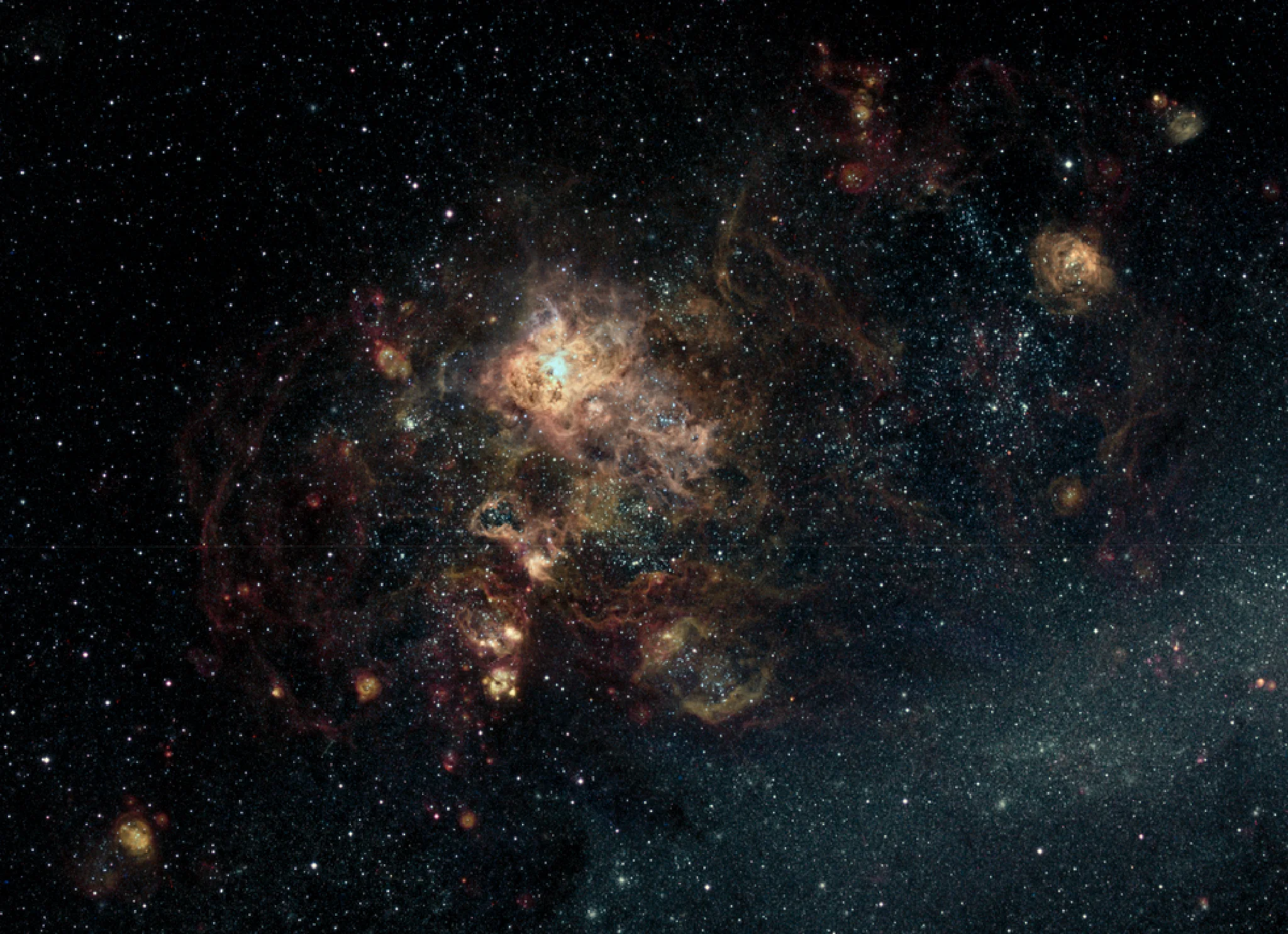
Tarantula Nebula and part of the Large Magellanic Cloud
The Tarantula Nebula is more than a thousand light-years in diameter, a giant star forming region within our nearby satellite galaxy the Large Magellanic Cloud, about 180 thousand light-years away. It's located in the southern constellation Dorado. The largest, most violent star forming region known in the whole Local Group of galaxies.
There is a young cluster of massive stars in the centre of the Tarantula which is responsible for intense radiation, stellar winds and supernova shocks. It energizes the nebular glow and shapes the spidery filaments. Around the Tarantula are other star forming regions with young star clusters, filaments, and blown-out bubble-shaped clouds. In fact, the frame includes the site of the closest supernova in modern times, SN 1987A, right of center. If Tarantula Nebula was closer, say 1,500 light-years distant like the local star forming Orion Nebula, it would take up half the sky!
Telescope.Live, Takahashi FSQ-106ED to photograph this magnificent object. One of my most favourite so far amongst the images I have acquired using Telescope.Live robotic telescopes.
Observation details
HAlpha - 2x300
OIII - 2x300
SII- 2x300
Red - 2x300
Green - 2x300
Blue- 2x300
PixInsight - PixMath Combination
Red - 0.1*Red + 0.9*HAlpha
Green - 0.1*Green + 0.9*OIII
Blue - 0.4*Blue + 0.6*SII
Porcessing: PixInsight, GIMP and DeepSkyStacker
Photographed on 05 Jan 2021
Telescope.Live, Heaven's Mirror
Observatory, Australia
Telescope: Takahashi FSQ-106ED
Aperture: 106 mm
Focal Length: 382 mm
F-ratio: 3.6 (with 0.73x focal reducer)
Camera: FLI PL16083
Pixel Size: 9 μm
Pixel Array: 4096 x 4096
Pixel Resolution: 4.74 arcsec/pixel
Cooling: -25 degrees
Filters: Astrodon LRGB 2GEN, Ha (3nm), SII (3nm), OIII (3nm);
M42
6 credit
- Type of target............................................................................................................................Emission Nebula
- Camera............................................................................................................................FLI PL16803
- Target coordinates............................................................................................................................RA 83.8221 Dec -5.3911
- Hemisphere............................................................................................................................Southern
- Telescope location............................................................................................................................Australia
- Transient event............................................................................................................................No
- Observed on............................................................................................................................25 Jan 2020 - 12 Dec 2021
Filter | Avg Exp (s) | Total Exposure | Subframes |
|---|---|---|---|
| Halpha | 54 | 1h46m | 118 |
| Luminance | 26 | 51m | 118 |
| Red | 37 | 1h12m | 117 |
| Blue | 23 | 45m | 117 |
| Green | 24 | 46m | 117 |