14 Jun 2022
NGC 6559
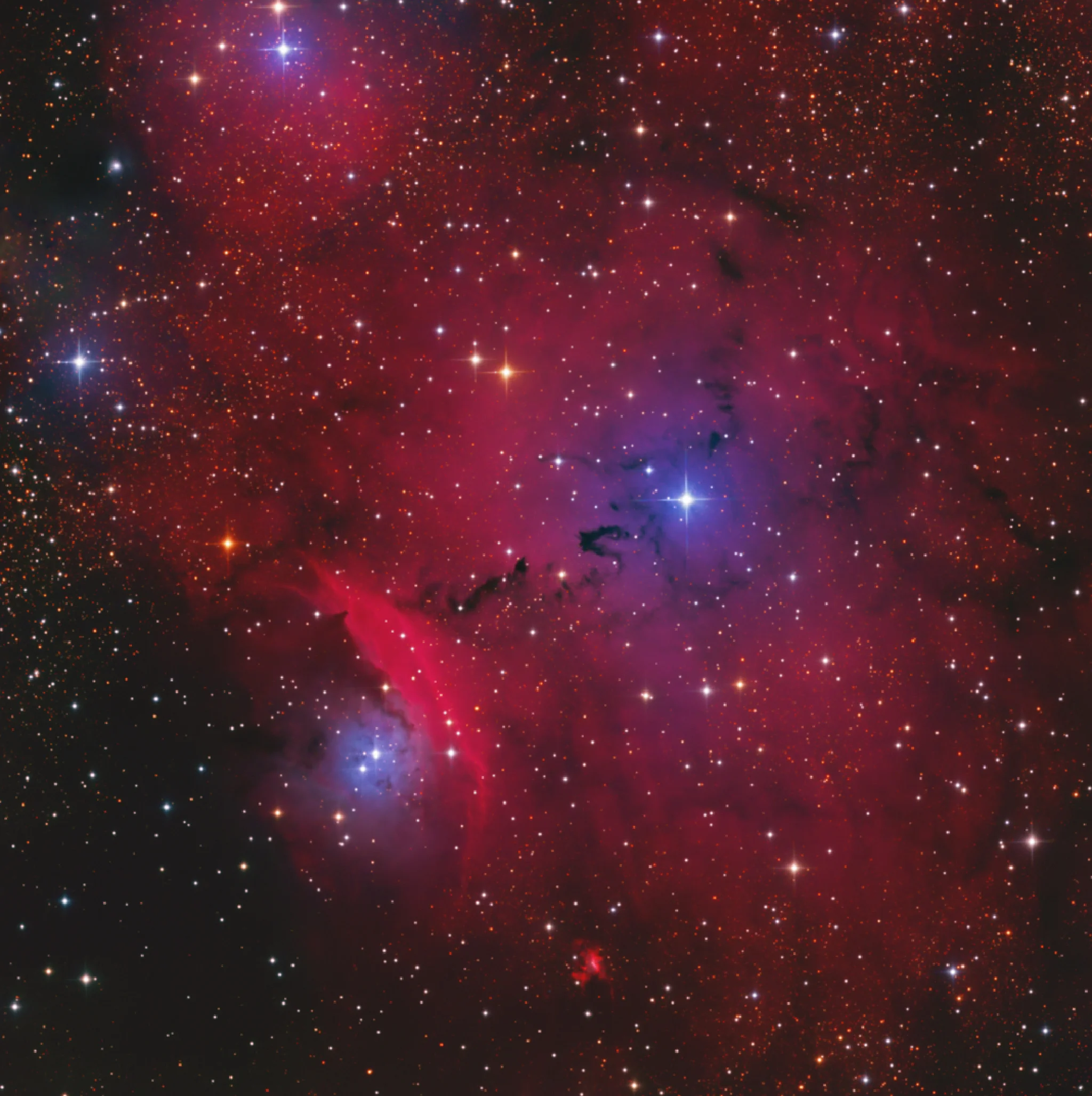
NGC 6559 is a cloud of gas and dust located at a distance of about 5000 light-years from Earth, in the constellation of Sagittarius (The Archer). The glowing region is a relatively small object, just a few light-years across, in contrast to the one hundred light-years and more spanned by its famous neighbour, the Lagoon Nebula (Messier 8).
The gas in the clouds of NGC 6559, mainly hydrogen, is the raw material for star formation. When a region inside this nebula gathers enough matter, it starts to collapse under its own gravity. The centre of the cloud grows ever denser and hotter, until thermonuclear fusion begins and a star is born. The hydrogen atoms combine to form helium atoms, releasing energy that makes the star shine.
These brilliant hot young stars born out of the cloud energise the hydrogen gas still present around them in the nebula. The gas then re-emits this energy, producing the glowing threadlike red cloud seen near the centre of the image.
But NGC 6559 is not just made out of hydrogen gas. It also contains solid particles of dust, made of heavier elements, such as carbon, iron or silicon. The bluish patch next to the red emission nebula shows the light from the recently formed stars being scattered — reflected in many different directions — by the microscopic particles in the nebula. Known to astronomers as a reflection nebula, this type of object usually appears blue because the scattering is more efficient for these shorter wavelengths of light.
In regions where it is very dense, the dust completely blocks the light behind it, as is the case for the dark isolated patches and sinuous lanes to the bottom left-hand side and right-hand side of the image. To look through the clouds at what lies behind, astronomers would need to observe the nebula using longer wavelengths that would not be absorbed.
The Milky Way fills the background of the image with countless yellowish older stars. Some of them appear fainter and redder because of the dust in NGC 6559. (Source: Eso.org)
M8
1 credit
- Type of target............................................................................................................................Emission Nebula
- Camera............................................................................................................................FLI ProLine PL9000
- Target coordinates............................................................................................................................RA 270.9042 Dec -24.38331
- Hemisphere............................................................................................................................Southern
- Telescope location............................................................................................................................Chile
- Transient event............................................................................................................................No
- Observed on............................................................................................................................21 Oct 2020 - 26 Oct 2020
Filter | Avg Exp (s) | Total Exposure | Subframes |
|---|---|---|---|
| Halpha | 180 | 24m | 8 |
| SII | 180 | 24m | 8 |
| OIII | 180 | 24m | 8 |