31 Dec 2023
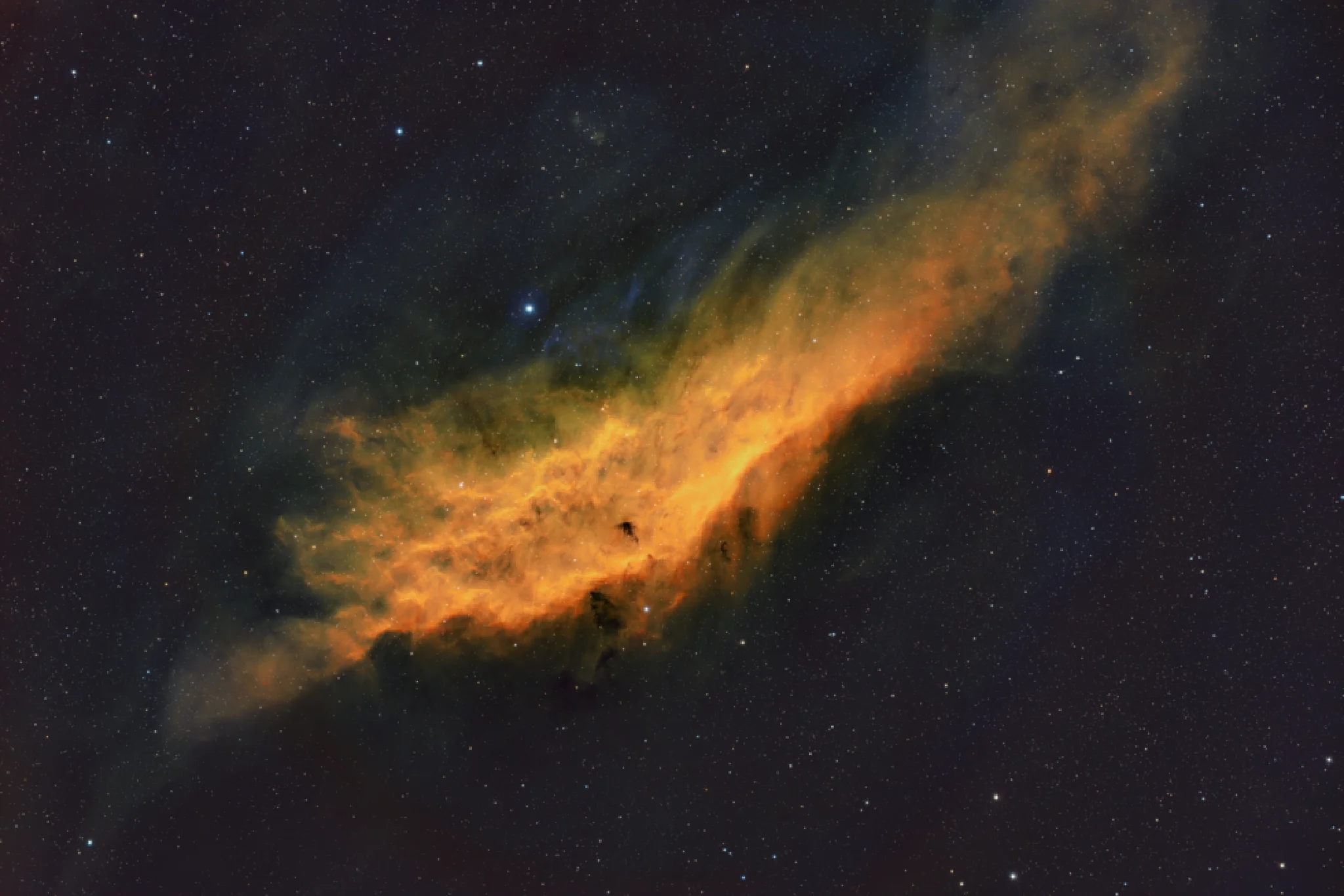
NGC 1499 California Nebula in SHO
This is a Telescope Live dataset project, acquired by the SPA-1 CMOS (Takahashi 106FSQ refractor in Spain).
I did have to eliminate about 1/3rd of the frames due to clouds, but still had enough to work with, total integration time is approx 4.5 hrs (a little less). It needs much more to get more of the faint Oiii component as there are some intriguing structure in the faint Oiii.
The Oiii structure can be seen as a faint veil surrounding the more visible California Nebula. The Oiii stucture just above the nebula in this image seems like a ghostly rider, including two faint eyes in its 'head'.
Those 'eyes' are the mystery since they do not get identified in any of the plate solving routines I've put the images through, or in the TSX or Stellarium planetarium software that I've used to search the region. Since the 'eyes' appear primarily in Oiii, is it possible these features haven't been noted before (seems unlikely...).
I created a Lum mask from the Ha master to enhance some of the detail in the 'finished' image. GraXpert, BXT, SXT, and NXT all contributed to both improved results and reduced workload, these tools should be in everyone's toolbox.
The PNG version was still close to 73mb in size - one of the downfalls of working with data from full frame astronomy cameras is the size of the image files.
From Wikipedia:
The California Nebula (NGC 1499/Sh2-220) is an emission nebula located in the constellation Perseus. Its name comes from its resemblance to the outline of the US State of California in long exposure photographs. It is almost 2.5° long on the sky and, because of its very low surface brightness, it is extremely difficult to observe visually. It can be observed with a Hα filter (isolates the Hα line at 656 nm) or Hβ filter (isolates the Hβ line at 486 nm) in a rich-field telescope under dark skies.
It lies at a distance of about 1,000 light years from Earth. Its fluorescence is due to excitation of the Hβ line in the nebula by the nearby prodigiously energetic O7 star, Xi Persei (also known as Menkib).
The California Nebula was discovered by E. E. Barnard in 1884.By coincidence, the California Nebula transits in the zenith in central California as the latitude matches the declination of the object.
NGC 1499
8 credit
- Type of target............................................................................................................................Emission Nebula
- Camera............................................................................................................................QHY 600M
- Target coordinates............................................................................................................................RA 60.825 Dec 36.4167
- Hemisphere............................................................................................................................Northern
- Telescope location............................................................................................................................Spain
- Transient event............................................................................................................................No
- Observed on............................................................................................................................02 Aug 2023 - 21 Dec 2024
Filter | Avg Exp (s) | Total Exposure | Subframes |
|---|---|---|---|
| Halpha | 836 | 6h30m | 28 |
| Red | 171 | 1h20m | 28 |
| Green | 171 | 1h20m | 28 |
| Blue | 178 | 1h20m | 27 |
| Luminance | 133 | 1h | 27 |