04 Jan 2025
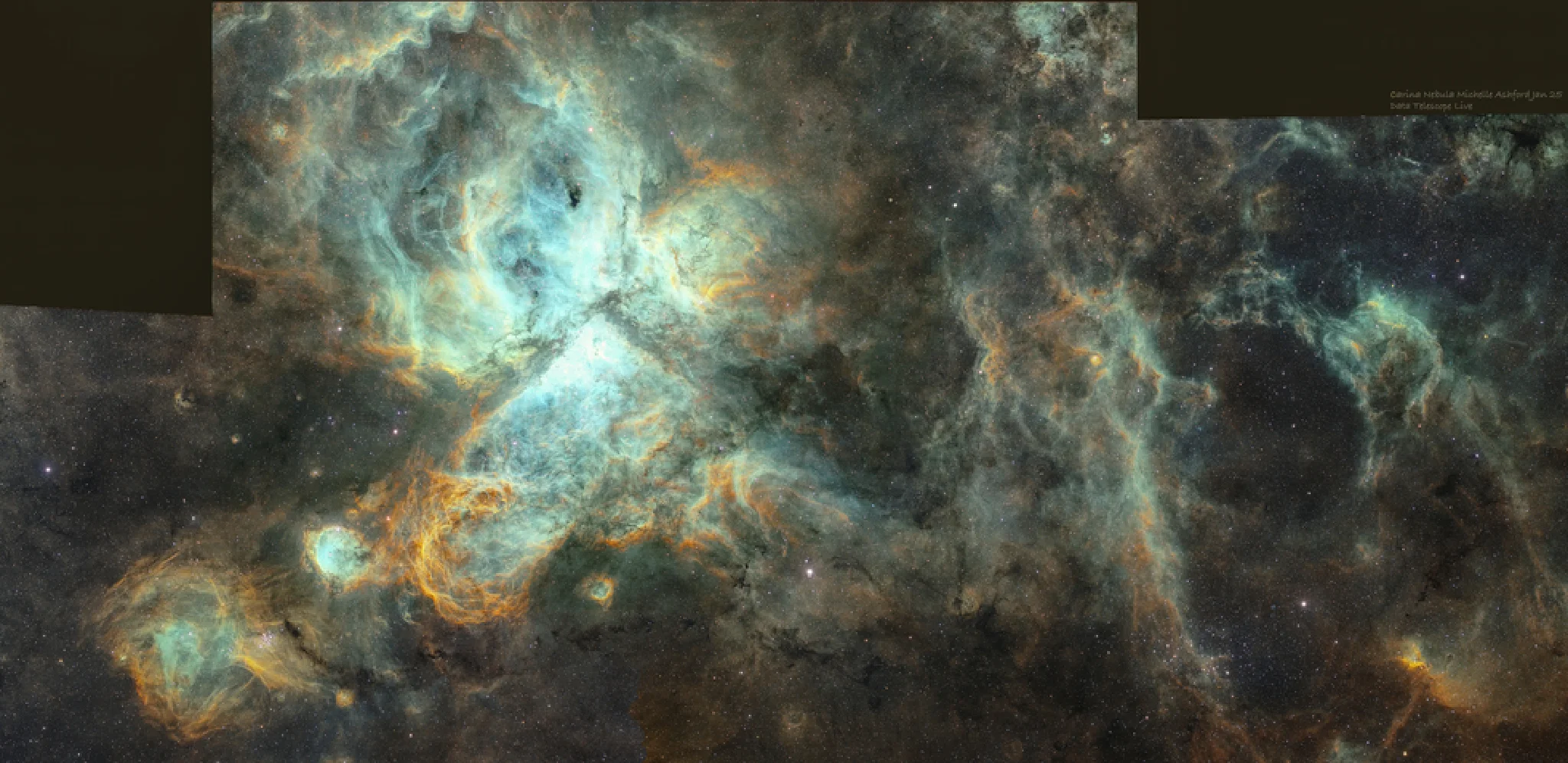
Carina Nebula Mosaic
The great thing about mosaics is an understanding how seemingly isolated objects are so closely related to each other. This mosaic uses 3 separate datasets - Eta Carina East, West and NGC 3503 captured using AUS-2-CMOS.
Among the DSO’s in this image include:
Starting at bottom left of the image a faint emission nebula - Loden 153, as yet I have found out very little about this object, but on the right hand side of this is the more famous open cluster, NGC 3293. Also known as the Gem Cluster it was discovered by Nicolas-Louis de Lacaille in 1751 and is approx. 8000 light years from Earth. It consists of more than 100 stars brighter than 14th magnitude in a 10 arc minute field.
This star cluster is associated with the next object, the open cluster NGC 3324. Both are fairly young, at around 12 million years. NGC 3324 is also associated with the emission nebula IC 2599, known as the Gabriela Mistral Nebula.
Next we come across the massive Carina Nebula, NGC 3372. This nebula is one of the largest diffuse nebulae visible, four times larger and brighter than the M42. It is located in the Carina-Sagittarius arm of the milky Way, approx. 8.500 lightyears from Earth.
Next in line is NGC 3503, an emission nebula with embedded star cluster discovered by John Herschel in 1834.
The final object is NGC 3572, also referred to as the Southern Tadpoles Nebula, an area of glowing gas and dark dust clouds along side the young stars. Dense streamers of material within the nebula, eroded by Stelllar winds and radiation, trailing away from three energetic young stars are likely sites of ongoing star formation with shapes reminiscent of the ‘tadpoles’ in IC 410.
NGC 3372
7 credit
- Type of target............................................................................................................................Emission Nebula
- Camera............................................................................................................................QHY 600M
- Target coordinates............................................................................................................................RA 161.2593 Dec -59.6999
- Hemisphere............................................................................................................................Southern
- Telescope location............................................................................................................................Australia
- Transient event............................................................................................................................No
- Observed on............................................................................................................................10 Nov 2023 - 15 Dec 2024
Filter | Avg Exp (s) | Total Exposure | Subframes |
|---|---|---|---|
| Luminance | 104 | 45m | 26 |
| Red | 92 | 40m | 26 |
| Green | 92 | 40m | 26 |
| Blue | 92 | 40m | 26 |
| Halpha | 1119 | 8h5m | 26 |