Wallpaper author:
Debojit Chakrabarty
31 Aug 2021
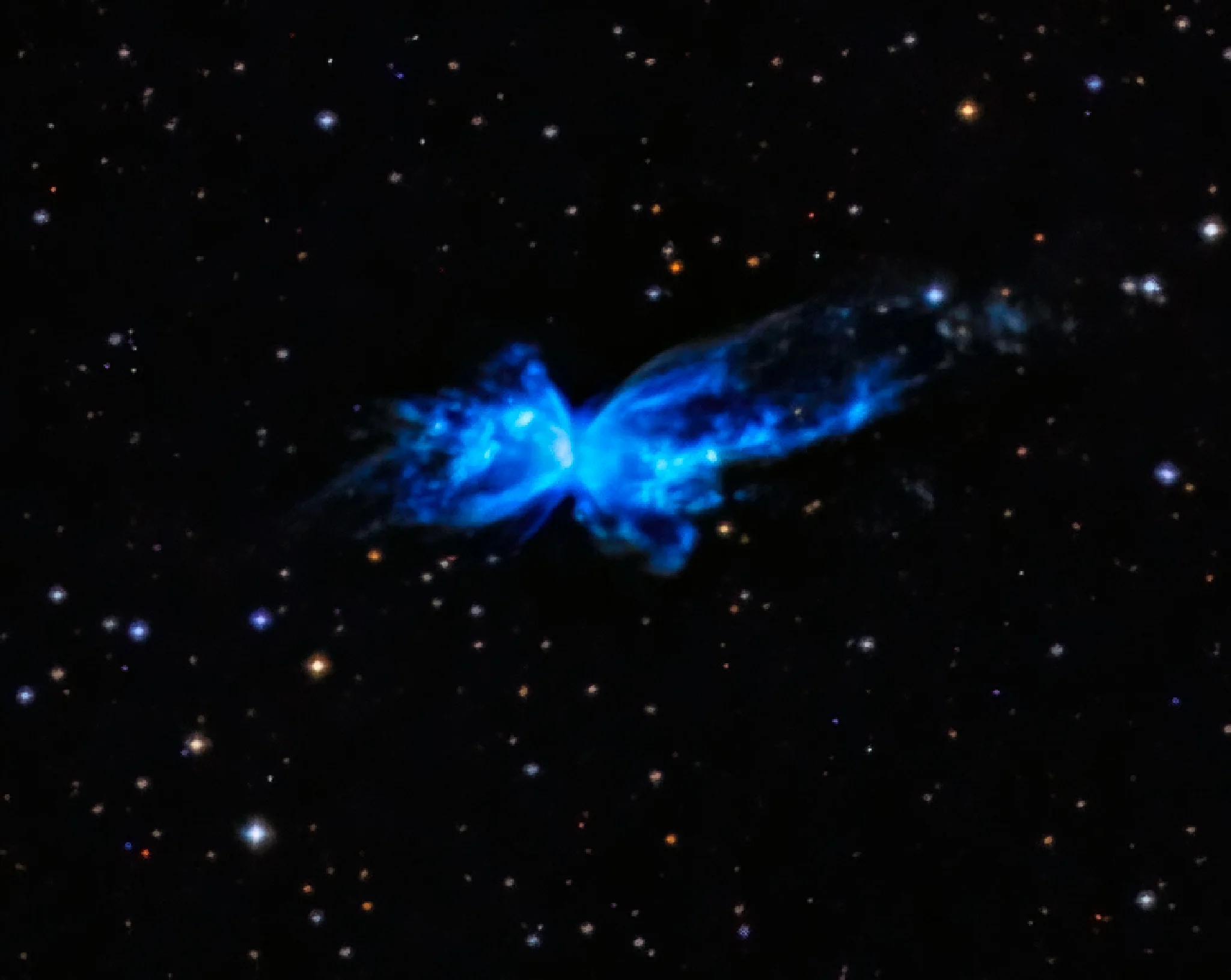
NGC6302
Can stars, like caterpillars, transform themselves into butterflies? No, but in the case of the Butterfly Nebula -- it sure looks like it. Though its wingspan covers over 3 light-years and its estimated surface temperature exceeds 200,000 degrees, C, the dying central star of NGC 6302, the featured planetary nebula, has become exceptionally hot, shining brightly in visible and ultraviolet light but hidden from direct view by a dense torus of dust. NGC 6302 lies about 4,000 light-years away in the arachnologically correct constellation of the Scorpion (Scorpius). Planetary nebulas evolve from the outer atmospheres of stars like our Sun but usually fade in about 20,000 years.
Dataset from which the image was processed
NGC 6302
10 credit
- Type of target............................................................................................................................Planetary Nebula
- Camera............................................................................................................................FLI ProLine PL9000
- Target coordinates............................................................................................................................RA 258.4347 Dec -37.10304
- Hemisphere............................................................................................................................Southern
- Telescope location............................................................................................................................Chile
- Transient event............................................................................................................................No
- Observed on............................................................................................................................26 Jul 2021 - 08 Sept 2022
Filter | Avg Exp (s) | Total Exposure | Subframes |
|---|---|---|---|
| Halpha | 600 | 5h | 30 |
| OIII | 600 | 5h | 30 |
| SII | 600 | 5h | 30 |