28 Aug 2022
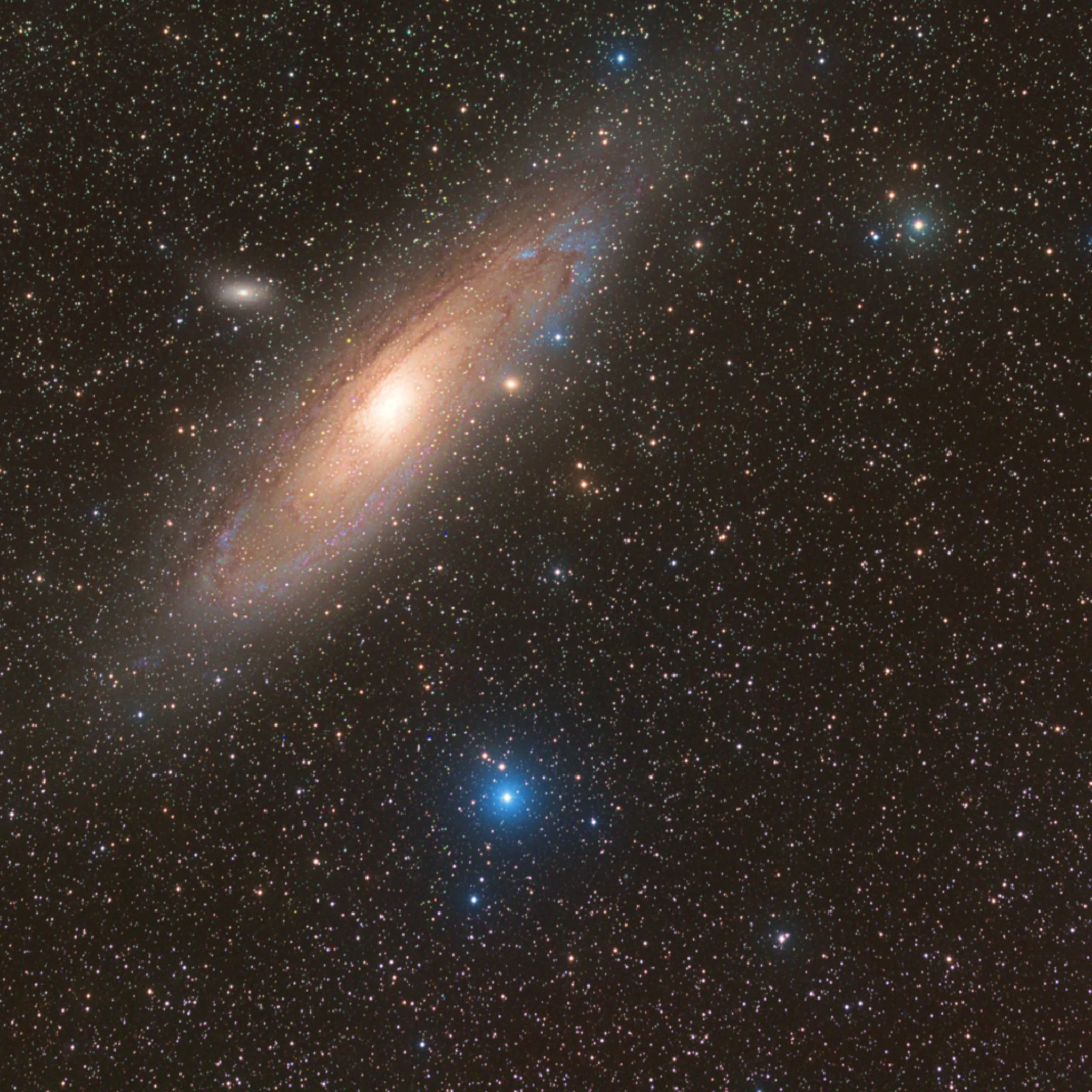
Closing in on The Andromeda Galaxy
The nearest large galaxy to Earth - seen in a brand-new image
The Andromeda Galaxy, a massive family of stars found than two-and-a-half million light years from Earth, is hurtling toward our galaxy at a breakneck speed. Following the inevitable collision in around four billion years, neither Andromeda nor The Milky Way will ever be the same.
The Andromeda Galaxy is the most-distant object visible without the aid of a telescope, meaning this “smudge of light in the sky” has been known since ancient times. The earliest known reference to Andromeda comes from The Book of Fixed Stars, written in 964 CE by Persian astronomer Abd al-rahman al-Sufi.
However, Andromeda would not be recognized as a galaxy apart from The Milky Way until the 20th Century. That realization would alter our understanding of the Cosmos forever.
Central regions of this galaxy are rich with cooler, yellowish stars, while a spiral arm filled with young, blue stars and star forming regions is seen toward the right.
Vast dust lanes are easily visible in this composite image, blocking out light from stars behind these intricate lanes of dust.
The Great Debate in the 1920s pitted a pair of American astronomers — Harlow Shapley and Heber Curtis — against each other, in a quest to understand if this body, then known as the Andromeda Nebula, was located within the Milky Way, or if it lay beyond what was then thought to be our lone island Universe. Once it was shown that countless galaxies lay beyond our own, astronomers began to understand the immenseness of the Universe.
Even at speeds fast enough to travel around the world at the Equator seven and a half times in a single second, light seen in this image traveled through space since around the time human ancestors around the world first started fashioning stone tools.
Image recorded on the evening of 24 August, using the 10cm SPA-3 Telescope from Telescope Live. Composed from 8 red, green, blue, and luminance images recorded over 80 minutes. One-click observation, FLI PL16083 camera, processed in Astro Pixel Processor and BeFunky.
Andromeda Galaxy
15 credit
- Type of target............................................................................................................................Galaxy
- Camera............................................................................................................................FLI PL16083
- Target coordinates............................................................................................................................RA 10.6846 Dec 41.2689
- Hemisphere............................................................................................................................Northern
- Telescope location............................................................................................................................Spain
- Transient event............................................................................................................................No
- Observed on............................................................................................................................31 May 2020 - 18 Oct 2022
Filter | Avg Exp (s) | Total Exposure | Subframes |
|---|---|---|---|
| Luminance | 135 | 14h24m | 384 |
| Red | 192 | 20h27m | 383 |
| Green | 169 | 18h | 383 |
| Blue | 203 | 21h33m | 383 |
| Halpha | 100 | 10h36m | 383 |