15 Jul 2025
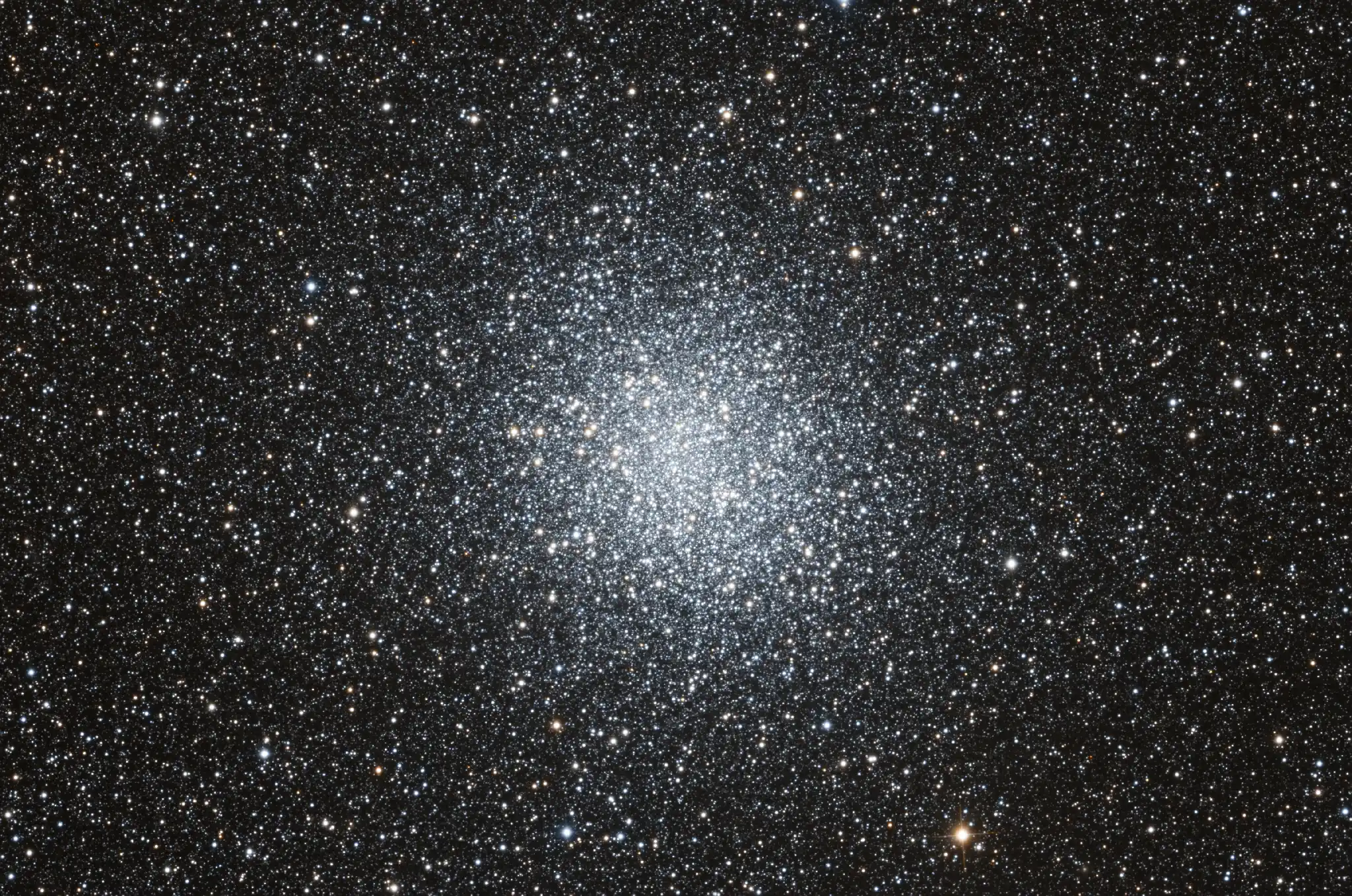
Messier 22 - Great Sagittarius Cluster
Messier 22 – the Great Sagittarius Cluster – is an elliptical globular cluster located near the galactic bulge and is one of the brightest globulars visible in the night sky, having an apparent magnitude of +5,1 – the only globulars brighter than Messier 22 are Omega Centauri and 47 Tucanae. It can be found NE of Lambda Sagittarii (known as Kaus Borealis), the northern most star in the “Teapot” asterism.
M22 was one of the first globulars to be discovered, in 1665 by Abraham Ihle and it was included in Charles Messier's catalog of comet-like objects in 1764. Ihle, a German amateur astronomer, found the cluster by accident, while observing Saturn. It was one of the first globular clusters to be carefully studied – first by Harlow Shapley in 1930. He placed within it roughly 70.000 stars and found it had a dense core. Then Halton Arp and William G. Melbourne continued studies in 1959. Due to the large color spread of its red giant branch (RGB) sequence, akin to that in Omega Centauri, it became the object of intense scrutiny starting in 1977 with James E. Hesser et al.
M22 is one of the nearer globular clusters to Earth – at about 10.600 light-years away. Its diameter is 99 light-years, given its estimated distance. 32 variable stars have been recorded in M22. It is in front of part of the galactic bulge and is therefore useful for its microlensing effect on those background stars. M22 is one of only four globulars of our galaxy known to contain a planetary nebula – an object named GJJC1, which is only 6.000 years old. It was an object first noted of interest using the IRAS satellite by Fred Gillett and his associates in 1986, as a point like light source and its nature was found in 1989 by Gillett et al.
A collaborative study between the Very Large Array radio telescope in New Mexico and the Chandra X-ray Telescope discovered 2 black holes inside Messier 22, each having 10-20 solar masses. These imply that gravitational ejection of black holes from clusters is not as efficient as was previously thought, and leads to estimates of a total 5 to 100 black holes within M22.
Messier 22 is receding from us at 149 km/s. It has approximately 83.000 stars with a combined mass of 500.000 Suns.
M22
6 credit
- Type of target............................................................................................................................Globular Cluster
- Camera............................................................................................................................QHY 600M
- Target coordinates............................................................................................................................RA 279.0998 Dec -23.9048
- Hemisphere............................................................................................................................Southern
- Telescope location............................................................................................................................Chile
- Transient event............................................................................................................................No
- Observed on............................................................................................................................11 Aug 2023 - 16 Aug 2023
Filter | Avg Exp (s) | Total Exposure | Subframes |
|---|---|---|---|
| Luminance | 288 | 2h | 25 |
| Red | 300 | 2h | 24 |
| Green | 300 | 2h | 24 |
| Blue | 313 | 2h5m | 24 |