02 Aug 2025
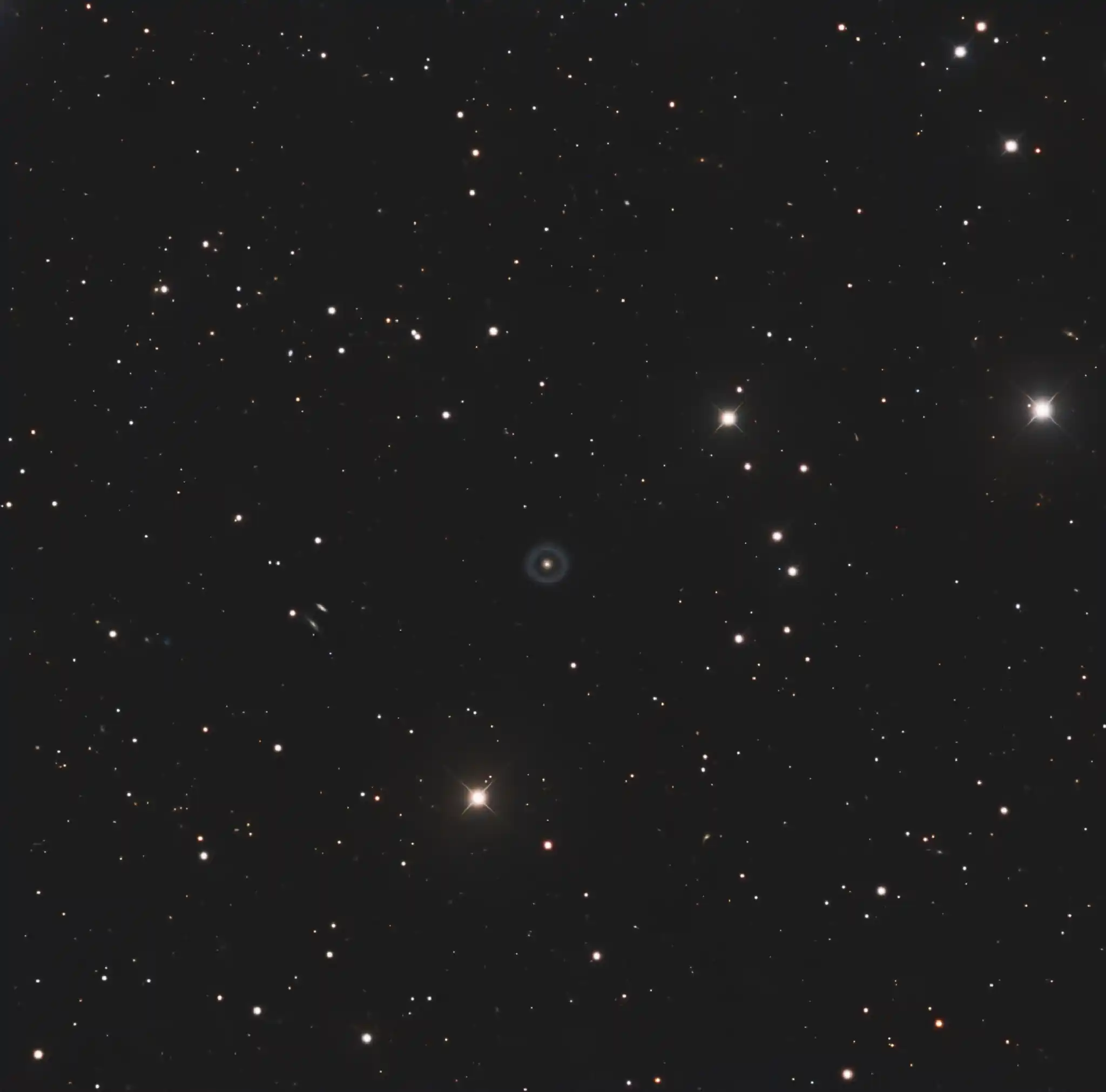
PGC 54559 - Hoag's Object - Ring Galaxy in Serpens Caput
Hoag’s Object is a rare, nearly perfect ring galaxy located in the constellation Serpens Caput. It lies approximately 600 million light-years (183 Mpc) from Earth and spans about 121,000 light-years across the ring, slightly larger than the Milky Way. Discovered in 1950 by American astronomer Arthur Allen Hoag, it initially resembled a planetary nebula, but Hoag quickly suggested it was instead an unusual galaxy. It became the prototype of the Hoag-type ring galaxies. Hoag’s Object consists of an older yellowish central spheroidal core, roughly 17,000 light-years in diameter, surrounded by a near-perfect circular ring populated by numerous young, blue, massive stars. The ring’s inner diameter is ~75,000 ly and outer ~121,000 ly. The gap between the core and ring appears largely empty, though a faint background ring galaxy is visible within it at about one o’clock in deep Hubble imagery.
The galaxy’s formation remains debated. It lacks evidence of a recent collisional intruder, suggesting classical collision-driven ring formation is unlikely. One hypothesis proposes cold gas accretion into a triaxial elliptical core several billion years ago, driving star formation in the ring. Alternative models involve bar instability in a former spiral structure, though evidence is limited.
The image was captured with the Officina Stellare 0.7 m RC telescope at Telescope Live facility in Spain, with 2 h 40 min of LRGB exposure time. The data presented multiple challenges - the scattered light and dust donuts artifacts had to be addressed with Clone Stamp tool.
To address low SNR in luminance data I created synthetic one by integrating all registered frames that were available. Low integration time caused gradients and severe noise across the image, because of this the final result is not of the best quality. Despite modest exposure time, I believe that it captures the iconic symmetry and color contrast of Hoag’s Object.
Sources:
wikipedia.org
science.nasa.gov
science.nasa.gov
academic.oup.com
constellation-guide.com
Data credit: Telescope Live
Hoag's Object
2 credit