03 Aug 2025
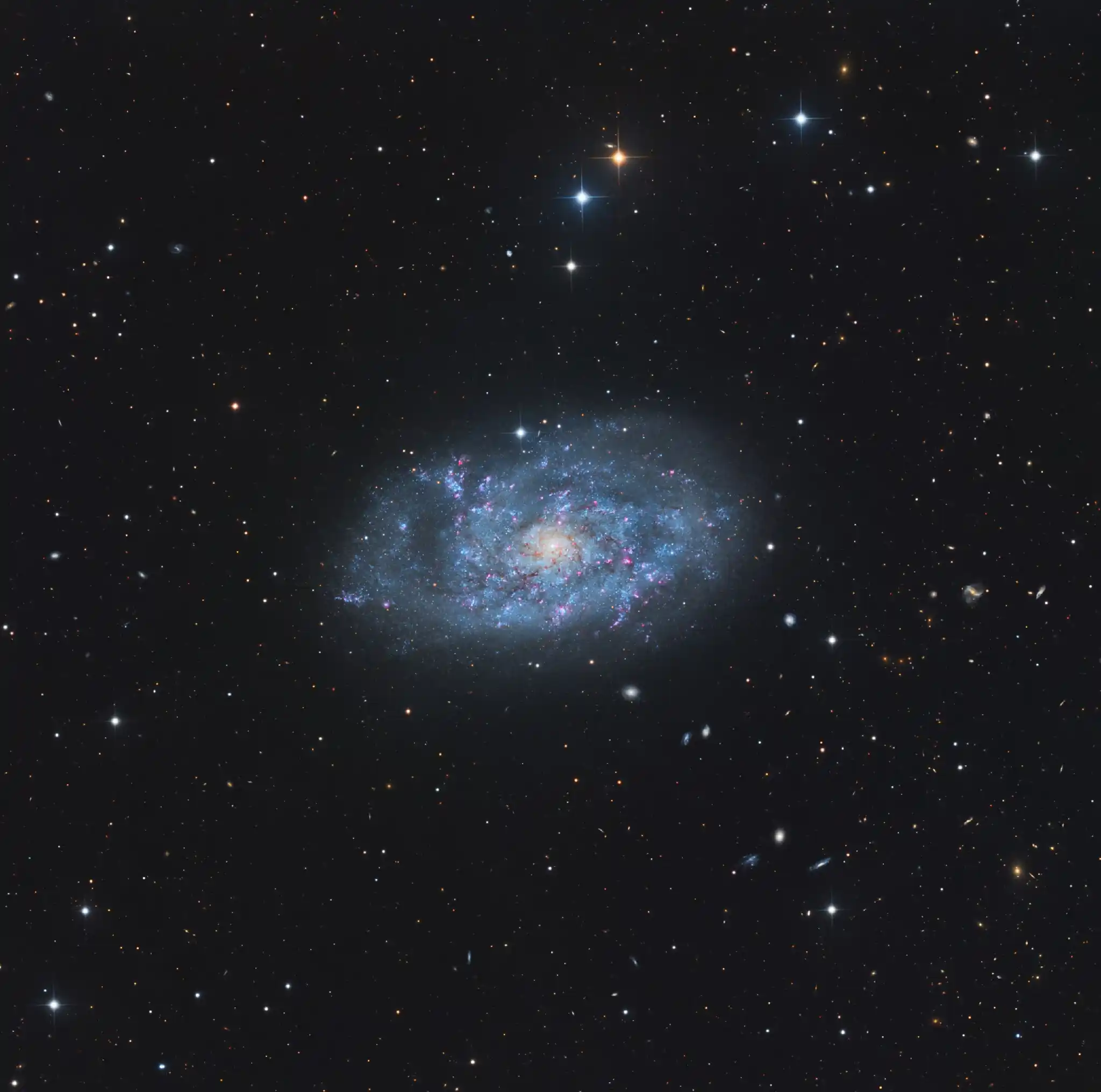
NGC 7793 - Bond's Galaxy - Flocculent Spiral Galaxy in Sculptor
NGC 7793, a flocculent spiral galaxy of morphological type SA(s)d, located in the southern constellation Sculptor at a distance of approximately 12.2 million light‑years (~3.7 Mpc) from Earth. It subtends roughly 9.3′ × 6.3′ on the sky, which corresponds to a physical diameter on the order of 50,000 light‑years. Its integrated visual magnitude is around 9.3 to 9.5, making it one of the brightest members of the nearby Sculptor Group. NGC 7793 is commonly known as Bond's Galaxy but was first recorded by the Scottish astronomer, James Dunlop, working in Paramatta, NSW, in 1826. The American astronomer, George Phillips Bond discovered it independently in 1850 from Cambridge, Massachusetts, without knowing of Dunlop’s prior record. It is also cataloged as ESO 349‑G 012, PGC 73049, MCG –06‑01‑009 and IRAS 23552‑3252.
Although it appears softly structured in visible light, NGC 7793 is dynamic under the hood. Its flocculent, or patchy, spiral arms are a hallmark of self‑propagating star formation rather than grand‑design spiral density waves. In 2008 supernova SN 2008bk - a Type II‑P event reaching about magnitude 12.5 - was observed within the galaxy, and its red‑supergiant progenitor had been imaged just a few hundred days before the explosion, a rarity in observational astronomy. More recently, deep archival Chandra and optical surveys have uncovered nearly 240 optical supernova remnants, of which five now have confirmed X‑ray counterparts, providing a rich laboratory for feedback studies in a relatively quiescent spiral galaxy.
NGC 7793 also hosts the famous ultraluminous X‑ray pulsar P13, which displays ≈0.42‑second coherent pulsations and orbits a B9Ia supergiant companion in about 64 days. This system was long thought to contain a black hole but is now known to be a neutron star accreting at super‑Eddington rates and driving enormous jets that inflate a 1,000‑light‑year bubble of hot gas in the outer arm - one of the most powerful microquasars known and uniquely placed in a galaxy disk rather than at its center.
Data captured by CHI-1-CCD telescope at El Sauce Observatory. Processing was rather smooth for this data, even though some satellite trails remained after WBPP and Telescope Live's calibration frames were out of date, leaving some nasty dust donuts. Light leakage artifacts present in the top left corner were addressed with Clone Stamp tool. To manage brightness of the galaxy, when stretching, I created 2 versions of the luminance data. One stretched using STF in a way that kept the background at 0.1 and the second one that's sole purpose was to have galaxy core hovering around 0.7 - 0.8. I then replaced the galaxy from the first luminance image with the second one using Pixel Math. The result allowed me to have easier control over color saturation and contrast later in the processing. I also experimented with Masked Stretch and applying HDRMT, but ultimately blending 2 different stretch versions produced best looking results.
Sources:
en.wikipedia.org
researchgate.net
arxiv.org
theskylive.com
astronomy.com
science.nasa.gov
Data Credit: Telescope.Live
NGC 7793
10 credit