01 Oct 2025
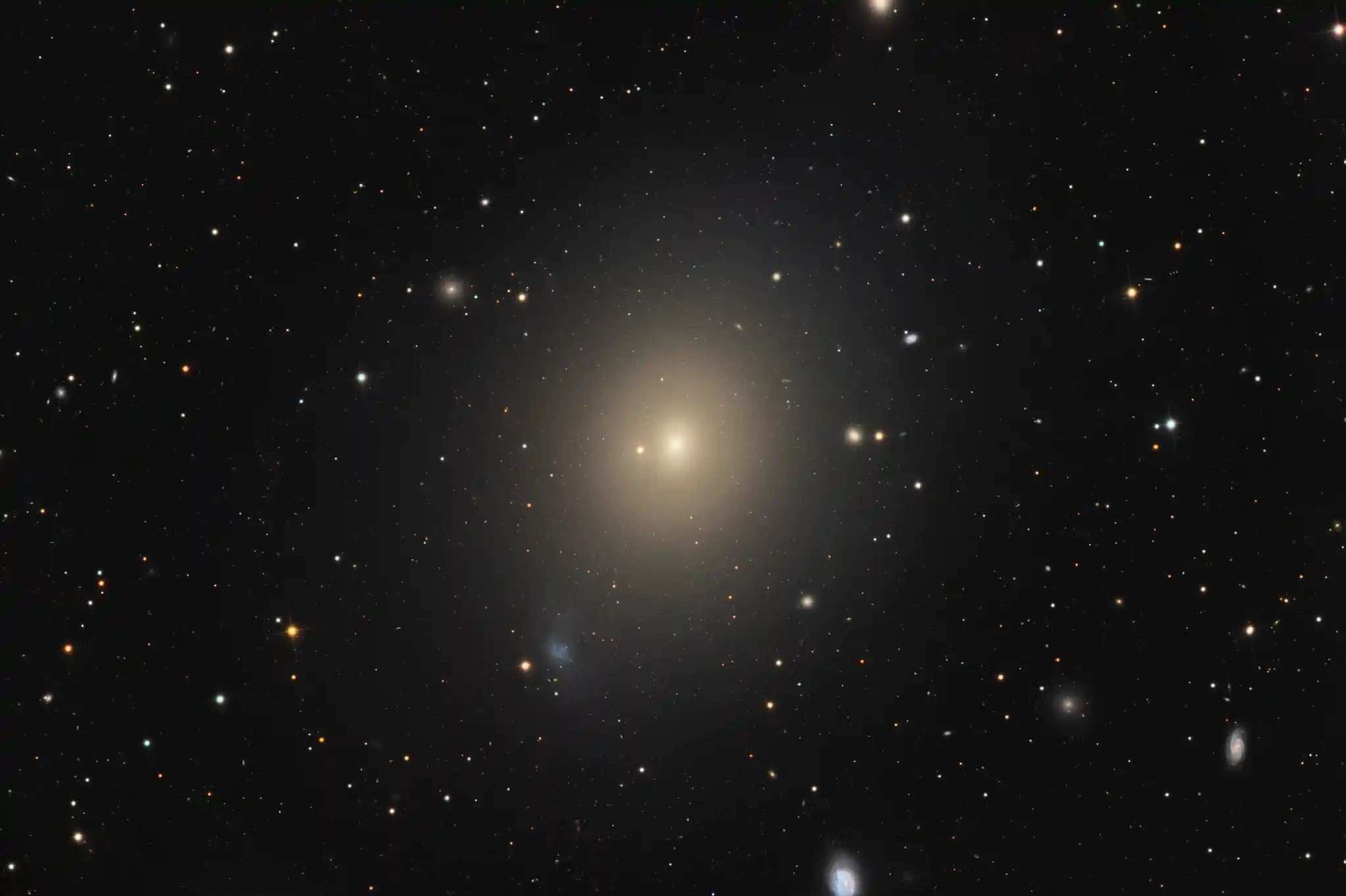
M49 / Arp 134 - Giant Elliptical Galaxy in Virgo
Messier 49 (NGC 4472, Arp 134) is a massive elliptical galaxy in the constellation Virgo, lying about 55.9 million light-years from us. It was the first member of the Virgo Cluster discovered, and it’s considered one of its brightest and most luminous galaxies. Its morphological classification is roughly E1 or E2, and it’s a LINER-type nucleus - meaning its core emits weak nuclear emission lines indicative of low-level activity. M49 hosts a rich system of globular clusters, with estimates of ~5,900 clusters orbiting it. Its outer halo is also interesting: planetary nebula surveys have traced its diffuse stellar light out to large radii, revealing that the halo and intragroup environment contribute to its extended profile. M49 is listed in Halton Arp’s Atlas of Peculiar Galaxies as Arp 134. Arp cataloged it under the category “Elliptical galaxies with nearby fragments” - essentially, he thought there were “fragments” or peculiar structures near the main galaxy that made it interesting as a “peculiar” elliptical. The “fragment” he referred to is actually a nearby galaxy - UGC 7636, seen in the image as a bluish blob below M49.
10-hour LRGB exposure from Telescope Live’s CHI-1-CMOS system. Despite the challenge of imaging an elliptical galaxy with low contrast features, this dataset brings out M49’s smooth light profile, faint halo extension, and many globular cluster candidates in the background and foreground. The dataset proved tricky due to the target’s brightness - satellite trail rejection did not perform well, leaving behind numerous artifacts. To overcome this, I adjusted the image integration settings in WBPP, opting for median integration instead of the usual average. This approach significantly reduced the residual trails and produced a much cleaner final masters.
Sources:
www.messier-objects.com
en.wikipedia.org
Data credit: Telescope.Live
M 49
10 credit