22 Oct 2025
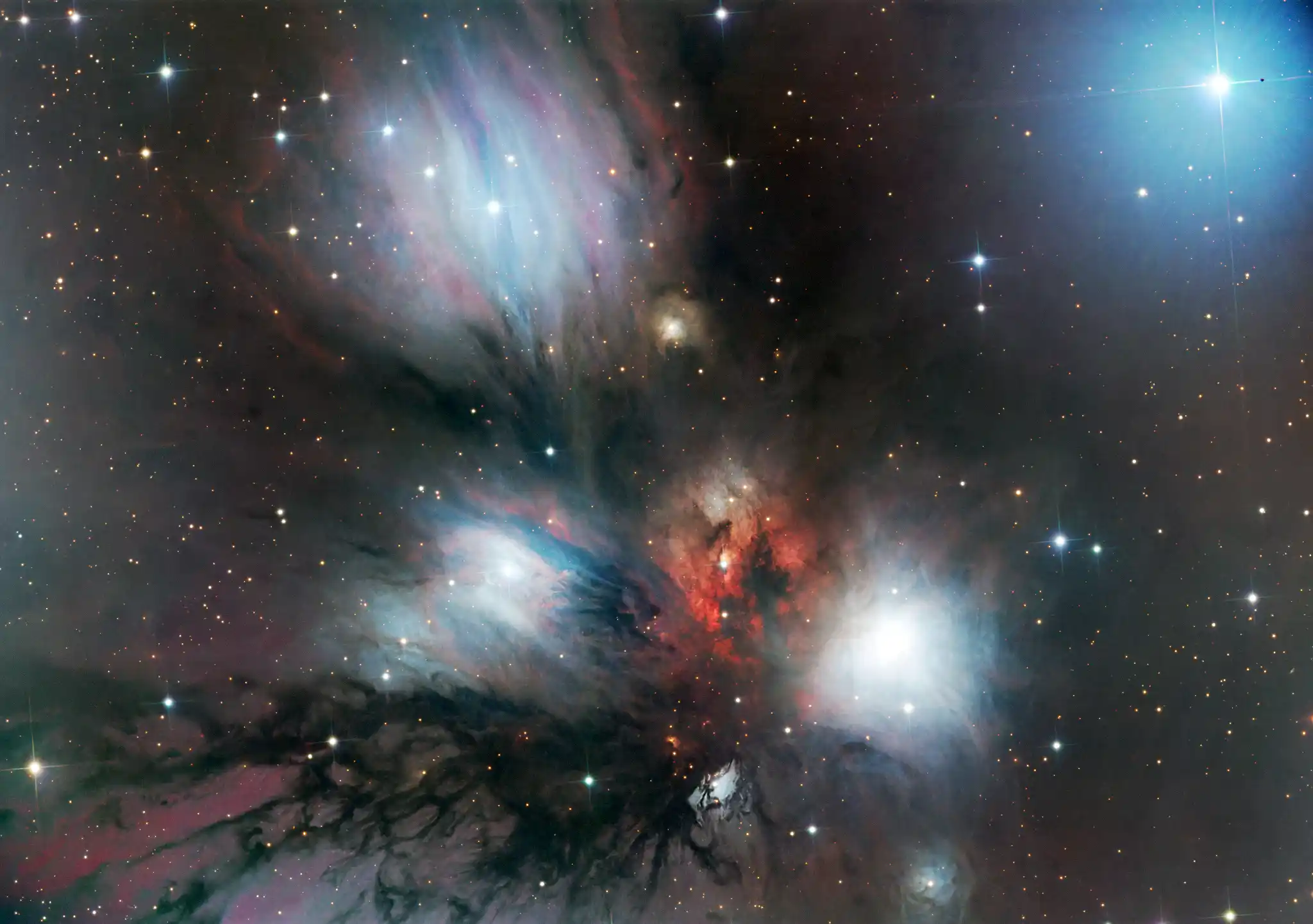
NGC 2170 - Angel nebula
NGC 2170 – The Angel Nebula in the Constellation Monoceros
I would like to share my recent processing of NGC 2170, a fascinating reflection nebula located in the constellation Monoceros (the Unicorn).
Also known as the Angel Nebula, NGC 2170 is the brightest member of a group associated with young, hot stars. It belongs to the vast molecular complex Monoceros R2, one of the most active and nearby star-forming regions to our Sun. The interstellar dust beautifully reflects the light of surrounding stars, creating a cosmic painting with hues ranging from the blue typical of reflection nebulae to the red glow of ionized hydrogen.
Technical acquisition details
Object: NGC 2170
Total integration time: 10 hours 15 minutes
30×300" BIN2 – Astrodon Luminance filter
30×300" BIN2 – Astrodon Red filter
30×300" BIN2 – Astrodon Green filter
30×300" BIN2 – Astrodon Blue filter
Telescope: Dall-Kirkham Planewave CDK24 (610 mm f/6.5, 3962 mm)
Camera: QHY 600M mono
Mount: Mathis 1000/1250 with absolute encoders
Remote location: Chile, Rio Hurtado Valley
Processing workflow
For each RGB channel, the frames were stacked with WBPP, followed by master registration, LinearFit, and RGB combination. Background neutralization, gradient correction, BlurXTerminator (correction only), and Spectrophotometric Color Calibration were then applied.
After noise reduction and star separation using StarXTerminator, I created a starless image and a star mask. The stars were enhanced using the SetiAstro Star-Stretch script for brightness and saturation boost, while the starless RGB image was stretched with Generalized Hyperbolic Stretch and fine-tuned with additional contrast and color adjustments.
For the luminance channel, I applied gradient correction, BlurXTerminator, NoiseXTerminator, and StarXTerminator, followed by Generalized Hyperbolic Stretch.
The starless LRGB images were merged, and the ScreenStar script was used to recombine the stars.
Final contrast and tonal adjustments were performed in GIMP and Darktable.
NGC 2170 stands as a remarkable example of how light and dust can blend together to form a scene of extraordinary elegance and harmony in the depths of the cosmos.
NGC 2170
7 credit