11 Nov 2025
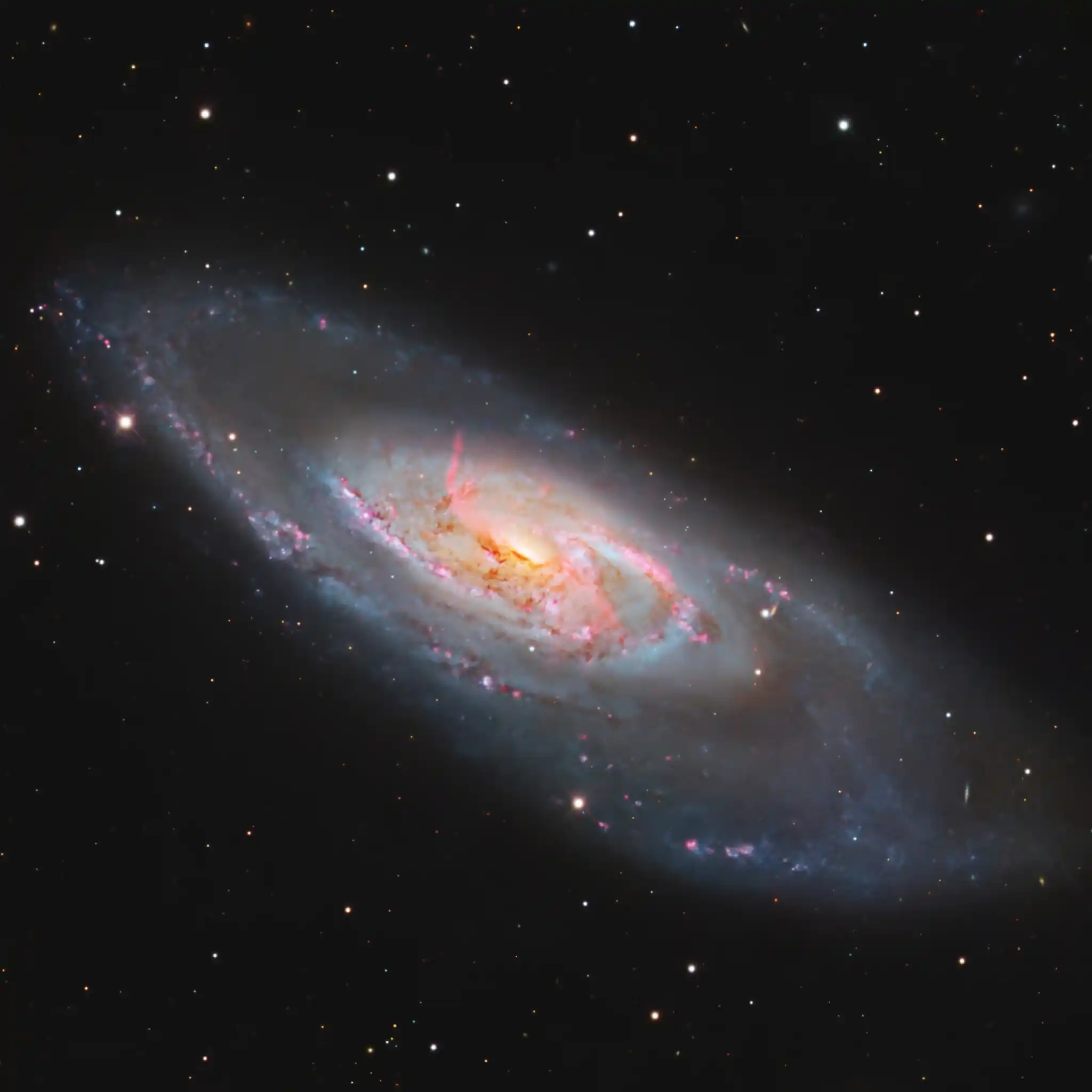
M106 - Megamaser Spiral Galaxy in Canes Venatici
Messier 106 (NGC 4258), located in the constellation Canes Venatici about 22–25 million light-years away, is one of the nearest and brightest Seyfert II galaxies. It hosts a supermassive black hole at its core that drives powerful jets emitting radio waves and X-rays. These energetic outflows produce “anomalous arms”—regions of hot gas and ionized hydrogen that differ from normal star-forming spiral arms. It is classified as SAB(s)bc, which means it’s an intermediate barred spiral galaxy with no ring, where the spiral arms emerge directly from the bar or nucleus and are moderately to loosely wound, with a relatively small central bulge.
The galaxy is also famous for its water vapor megamaser emission, detected from a rotating disk of molecular gas close to the nucleus (the equivalent of a laser operating in microwave instead of visible light and on a galactic scale) that is seen by the 22-GHz line of ortho-H2O that evidences dense and warm molecular gas. This phenomenon has provided one of the most accurate geometric distance measurements to a galaxy beyond the Milky Way.
In this image, the Hα regions trace the intense star-forming activity along the spiral arms, while the bright, active nucleus and delicate inner dust structures showcase the complex interplay between star formation and nuclear activity. The Hα also reveals one of the most striking features of M106: its extra pair of arms, seen here as red wisps of gas. Unlike the other arms, these two extra arms are made up of hot gas rather than stars. Astronomers attribute these ghostly arms to the supermassive black hole at the galaxy’s center. The extra arms appear to be an indirect result of the violent churning of matter around the black hole.
This image represents close to 12 hours of HaLRGB integration captured with Telescope Live’s SPA-2-CCD system. The dataset was composed of subframes taken at different exposure and focal lengths, which created significant stacking artifacts around the edges. To preserve image quality, the final composition was heavily cropped, framing the galaxy from edge to edge with very little surrounding background.
Additional Hα data was incorporated from the older Telescope Live 3 archive, which is unfortunately no longer accessible on the current Telescope Live 4 platform. Hopefully, the team will reintroduce legacy datasets like this in the future, as they remain an invaluable resource for reprocessing and scientific study.
Sources:
wikipedia.org
messier-objects.com
science.nasa.gov
deepskycorner.ch
Data credit: Telescope.Live
M106
5 credit