15 Nov 2025
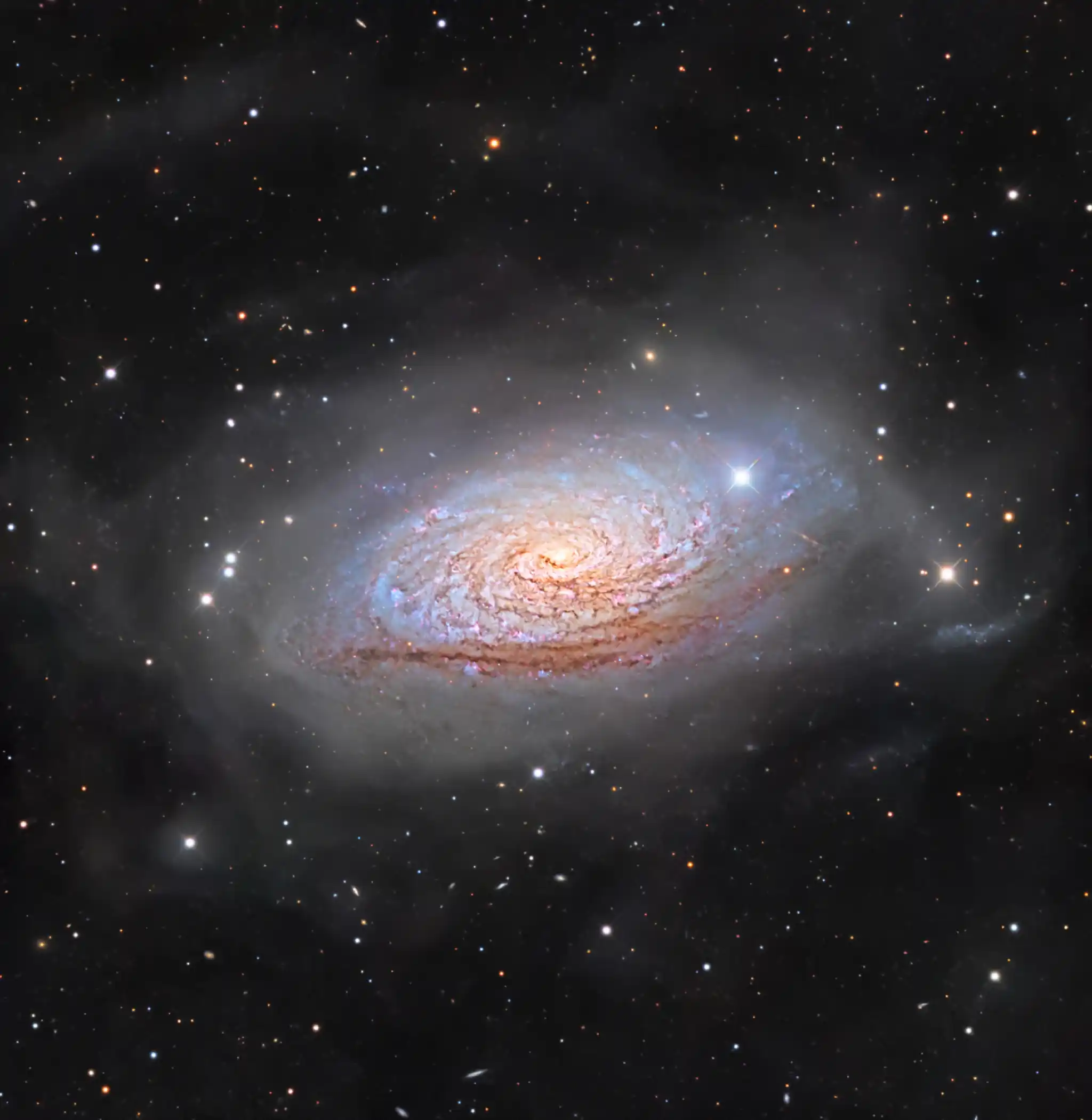
M63 - The Sunflower Galaxy with Tidal Loops in Canes Venatici
Messier 63 (NGC 5055), widely known as the Sunflower Galaxy, is a flocculent spiral galaxy located in the constellation Canes Venatici, approximately 29 million light-years away. Classified as SA(rs)bc, it features multiple patchy spiral arms that don’t form a single grand design structure but instead appear as short, disconnected segments rich in star-forming regions. Its nucleus has been identified as a low-ionization nuclear emission-line region (LINER), suggesting the presence of a mildly active supermassive black hole at the core.
Some of the most compelling features of M63 lie beyond its bright disk: a vast, faint stellar tidal loops and galactic halo that wrap partially around the galaxy. These stellar streams are remnants of a disrupted dwarf satellite galaxy captured and torn apart by M63’s gravitational field. This tidal structure, first detected in ultra-deep imaging, extends tens of thousands of light-years into the halo and offers direct visual evidence of hierarchical galaxy formation. Within the main disk, the galaxy's flocculent spiral arms shimmer with young clusters and glowing HII regions, while the central bulge remains smooth and yellowish due to the older stellar population.
Although visually serene, M63 is dynamically active. Its inner disk shows signs of differential rotation and warping, shaped both by internal evolution and past minor mergers. The galaxy’s overall asymmetry, faint outer shells, and the presence of extended HI gas suggest a complex history of interactions. Its stellar halo, revealed through long-integration imaging and enhanced stretching, provides a rare opportunity to observe a tidal stream in a galaxy so close to the Milky Way.
This image represents over 16 hours of LRGB integration acquired with Telescope Live’s legacy SPA-2 CCD setup, using an Officina Stellare RC 700 f/8 telescope and an FLI ProLine PL16803 camera. While I managed to resolve the northern loop with a bit of careful stretching and MMT enhancement, the southern portion of the galactic halo would need another few hours spent gathering luminance data to resolve properly.
Sources:
wikipedia.org
science.nasa.gov
constellation-guide.com
deepskycorner.ch
messier-objects.com
Data credit: Telescope.Live
M63
12 credit