29 Nov 2025
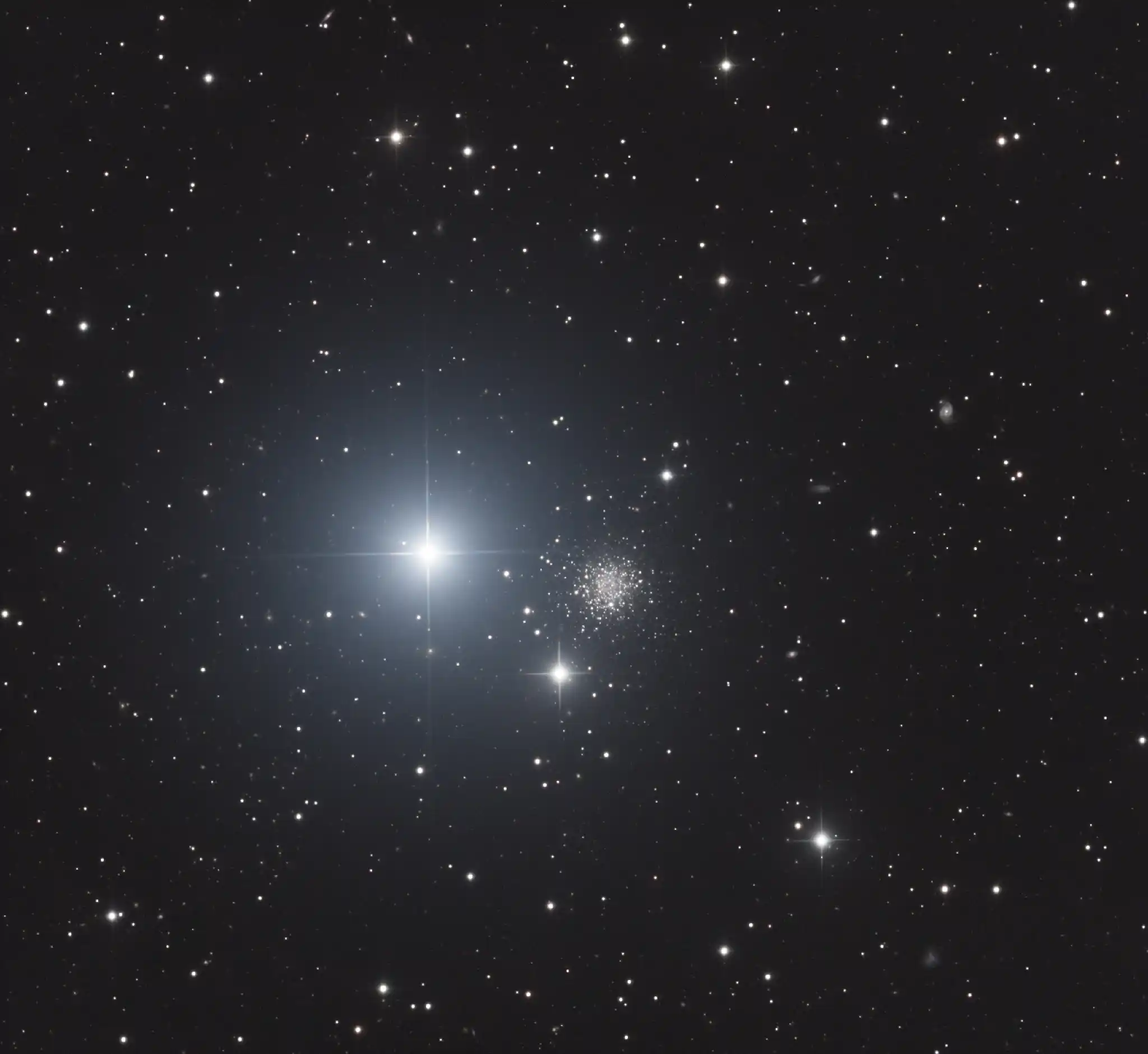
NGC 1466
NGC 1466 is a globular cluster in the southern constellation of Hydrus. It is located on the outskirts of the Large Magellanic Cloud, at a distance of 158.000 light-years from Earth. The object was discovered in 1834 by John Herschel. Visually, it is quite hard to observe, having an angular size of only 3’ and apparently located near the bright +7 magnitude star HD 24188.
NGC 1466 is an old cluster, as expected, with an age of 13,2 billion years. The cluster’s mass is around 140.000 solar masses. There is also a total of 49 RR Lyrae variable stars discovered so far. They are pulsating horizontal branch stars of spectral class A or F, with a mass of around half the Sun's. They are thought to have shed mass during the red-giant branch phase, and were once stars at around 0.8 solar masses. In contemporary astronomy, a period-luminosity relation makes them good standard candles for relatively nearby targets, especially within the Milky Way and Local Group.
NGC 1466
9 credit