07 Dec 2025
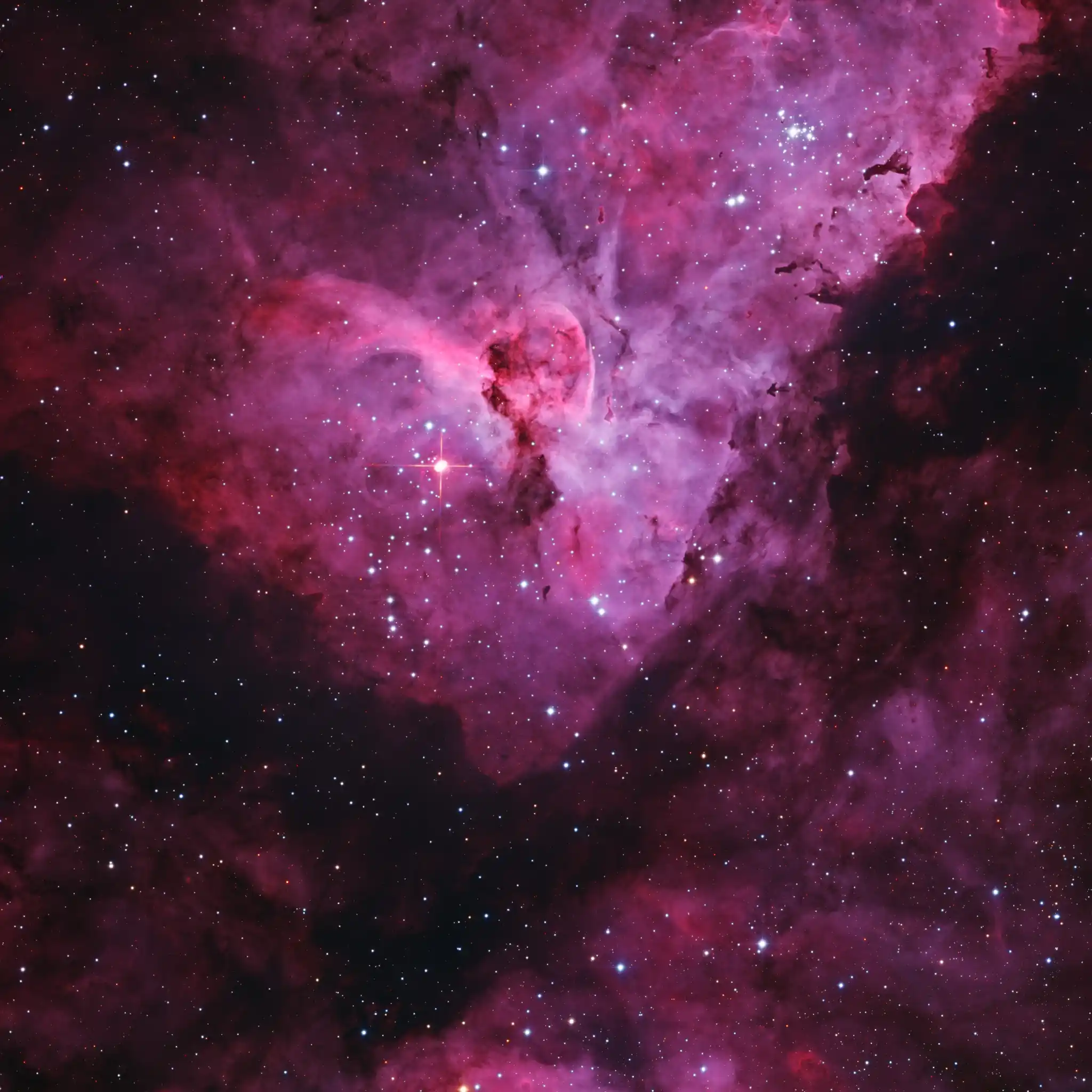
Eta Carinae Nebula
NGC 3372 — the Eta Carinae or Carina Nebula — is one of the largest and most spectacular H II regions in the southern sky, a vast star-forming complex located roughly 7,500–8,500 light-years from Earth. The field is dominated by the eruptive, luminous evolved star system Eta Carinae and its surrounding bipolar Homunculus Nebula, a dusty, reflection/emission nebula created by Eta Carinae’s 19th-century “Great Eruption.” The Homunculus is a compact, intensely bright mid-IR source embedded within the larger nebulosity and is responsible for much of the local dust illumination and sculpting.
Beyond the Homunculus the Carina Nebula is a rich tapestry of features: the Keyhole region with its dark silhouetted clouds and bright filaments, the towering “Mystic Mountain” pillars where newborn stars carve jets and outflows, numerous Bok globules and photo-evaporating fingers (including the well-studied “Defiant Finger”), and multiple Herbig–Haro objects such as HH 666 that trace protostellar jets piercing the surrounding gas. These structures illustrate ongoing, intense feedback from massive O- and Wolf-Rayet stars that both trigger and erode star formation across the complex. Hubble, Spitzer, and more recently Webb imaging have revealed the scale and fine detail of these interactions, showing pillars several light-years tall and compact star-forming clumps embedded in dense molecular gas.
The Homunculus nebula's center is lit by light from a bright central star, while the surrounding regions are expanding lobes of gas laced with filaments of dark dust. Jets bisect the lobes emanating from the central stars. Expanding debris includes streaming whiskers and bow shocks caused by collisions with previously existing material. Eta Car still undergoes unexpected outbursts, and its high mass and volatility make it a candidate to explode in a spectacular supernova sometime in the next few million years.
The final image is a two-panel mosaic assembled from 8 hours of LRGB integration from Telescope Live, with a complementary set of short 10-second LRGB+SHO subexposures collected specifically to capture the overexposed Homunculus (taken just before the Advanced Request functionality was discontinued). The 10-second frames were required because even short LRGB subexposures saturate the Homunculus’s core; despite their inclusion the Homunculus remained difficult to fully screen and is still somewhat overexposed in the final composition.
NGC 3372
11 credit