11 Dec 2025
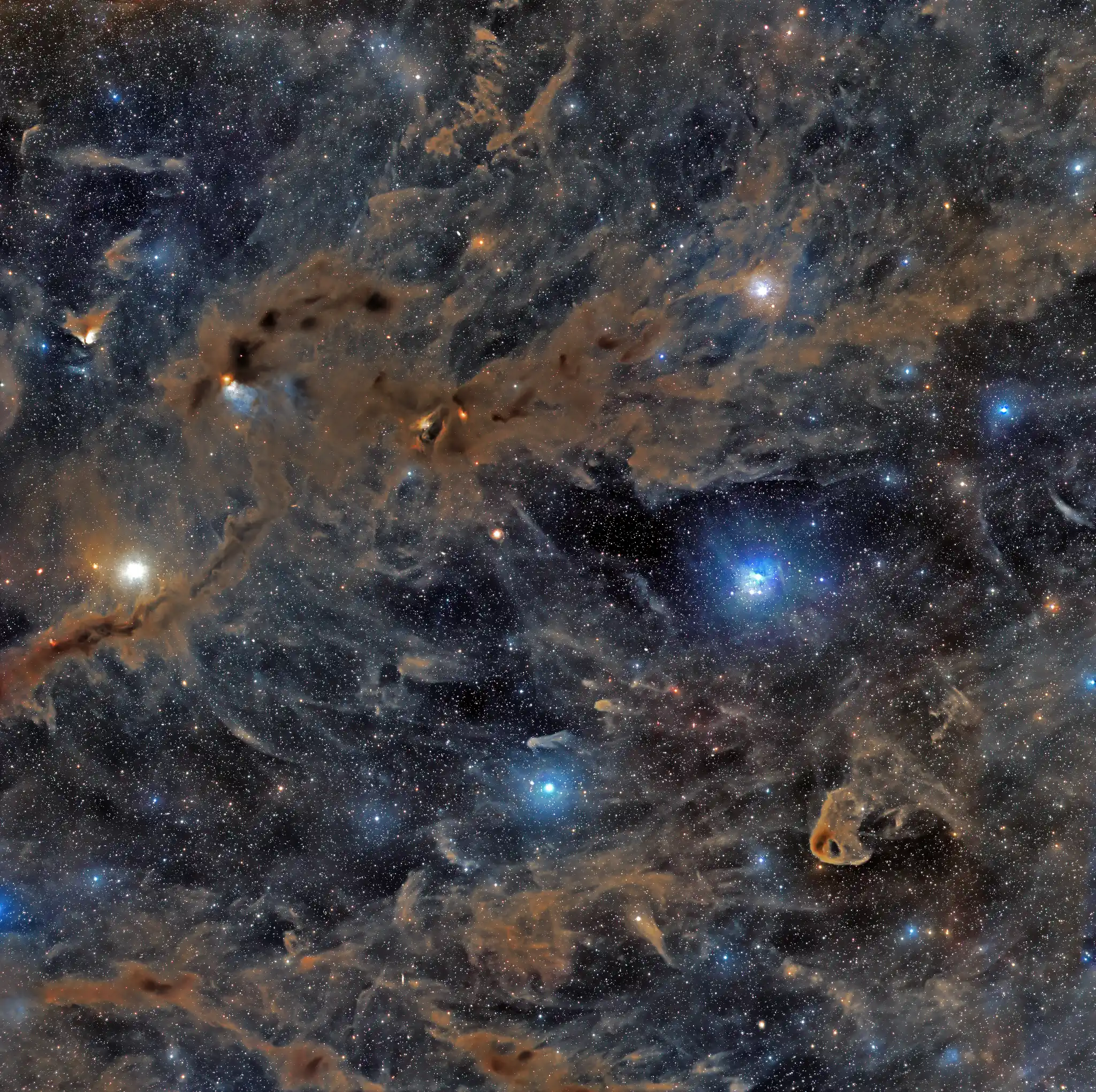
IC359 LRGB
IC 359 is a faint reflection nebula embedded in a broad field of high-latitude dust within Taurus. The region is dominated by galactic cirrus: diffuse interstellar dust illuminated by the integrated starlight of the Milky Way. The brown and grey filaments seen here trace extremely low-surface-brightness material, with several denser patches producing localized dark nebulae.
A small blue reflection nebula appears toward the right side of the field, where nearby stars scatter short-wavelength light off compact dust concentrations. The scene includes multiple overlapping dust layers, producing variations in color and opacity that reveal subtle structural differences across the cloud complex.
Designation: IC 359
Object Type: Reflection nebula (associated with diffuse galactic cirrus)
Constellation: Taurus
Right Ascension (J2000): ~04h 23m
Declination (J2000): ~+27° 30′
Distance: Estimated 300–500 light-years (foreground Taurus dust complex)
Physical Nature:
IC 359 is a faint reflection nebula embedded in high-latitude interstellar dust.
The region is part of the broader Taurus Molecular Cloud (TMC) environment, though IC 359 lies in a more diffuse, less dense subset of the cloud structures.
The nebula is illuminated by nearby field stars rather than a specific dominant source.
The surrounding area contains Integrated Flux Nebula (IFN)—extremely faint dust illuminated by the combined glow of the Milky Way.
Surface Brightness: Very low (requires deep integration to reveal structure)
Dominant Processes:
Reflection: Scattering of starlight off dust grains.
Extinction: Dense dust patches causing dark nebula absorption lanes.
Diffuse Scattering: Wide-field strands typical of IFN at high galactic latitude.
Size (Apparent):
IC 359 itself spans only a few arcminutes, but the surrounding IFN structures extend several degrees across Taurus.
Notable Features:
Blue reflection knots caused by shorter-wavelength scattering.
Brown/yellow dust filaments from carbon-rich grains.
Multi-layered line-of-sight dust giving varied opacity and structure.
Imaging Challenges:
Extremely faint IFN requires long total exposure times.
Strong need for flat-field accuracy and gradient control.
Benefits significantly from dark skies and widefield sensors.
IC 359
11 credit