18 Jan 2026
The Southern Triangulum: A Study in Hydrogen ❤️🌌
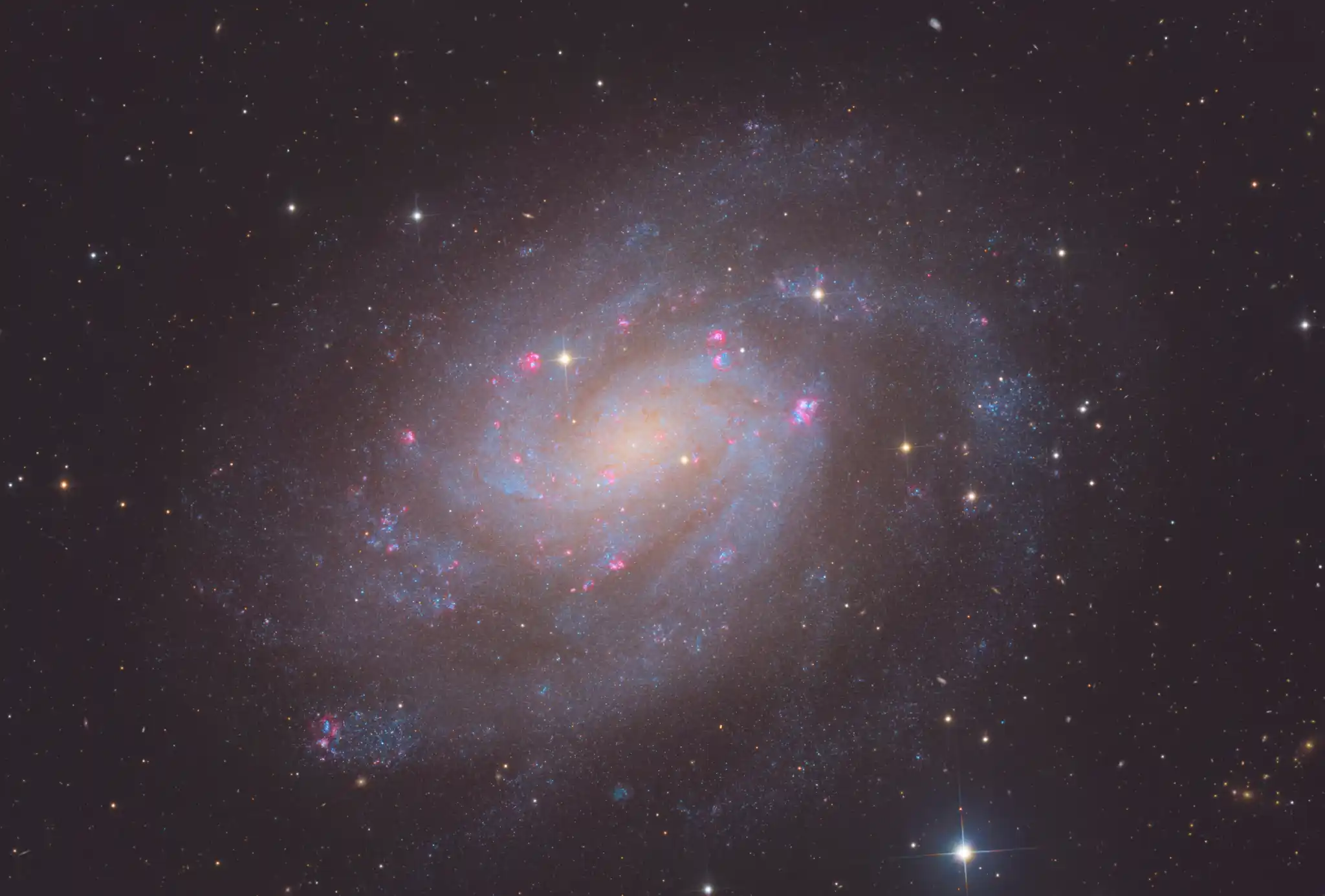
If Messier 33 (The Triangulum Galaxy) had a twin sister living in the Southern Hemisphere, it would be NGC 300.
Hanging in the constellation Sculptor about 6 million light-years away, this spiral doesn't have a dense, blinding core. Instead, it offers an open, transparent look into its structure—allowing us to resolve individual massive stars and vast cosmic nebulas.
🔭 The Astronomer’s Perspective: Look at the vibrant pink/red knots scattered across the blue spiral arms. These are giant H-II regions—clouds of ionized hydrogen gas where new stars are igniting. Because NGC 300 is so close (cosmically speaking), we can study these nurseries in incredible detail. It is one of the best laboratories we have for understanding how spiral galaxies evolve.
📸 The Astrophotographer’s Choice: When planning this shot on the Planewave CDK24, I made a deliberate choice. While I gathered about 1.5 hours each for the color channels, I spent over 6 hours capturing just the Hydrogen-Alpha (Ha) bandwidth.
Why? To make those star-forming regions "pop."
The Result: By blending this deep H-alpha data into the red and luminance channels during processing in PixInsight, the galaxy transforms from a simple spiral into a vibrant map of stellar creation.
👇 Discussion: This is often called the "Southern Triangulum" because of its resemblance to M33. For those who have shot both—which one do you find more photogenic?
Follow for more high-res deep sky: @ale_motta_astrofotografia
⚙️ Technical Data:
Object: NGC 300 (Spiral Galaxy)
Telescope: Planewave CDK24
Camera: QHY 600M
Filters: Astrodon LRGB + Ha (3nm/5nm)
Integration (Total ~13 Hours):
Ha: 76 x 300" (The heavy lifter!)
L: 21 x 300"
R: 21 x 300"
G: 20 x 300"
B: 18 x 300"
Date: June 17, 2023
Processing: PixInsight
#NGC300 #SculptorGalaxy #Planewave #CDK24 #QHY600 #Astrophotography #DeepSpace #Astronomy #Science #Universe #HydrogenAlpha #StarFormation #AleMottaAstrofotografia
NGC 300
9 credit