27 Jan 2026
My Favourite Super-star cluster
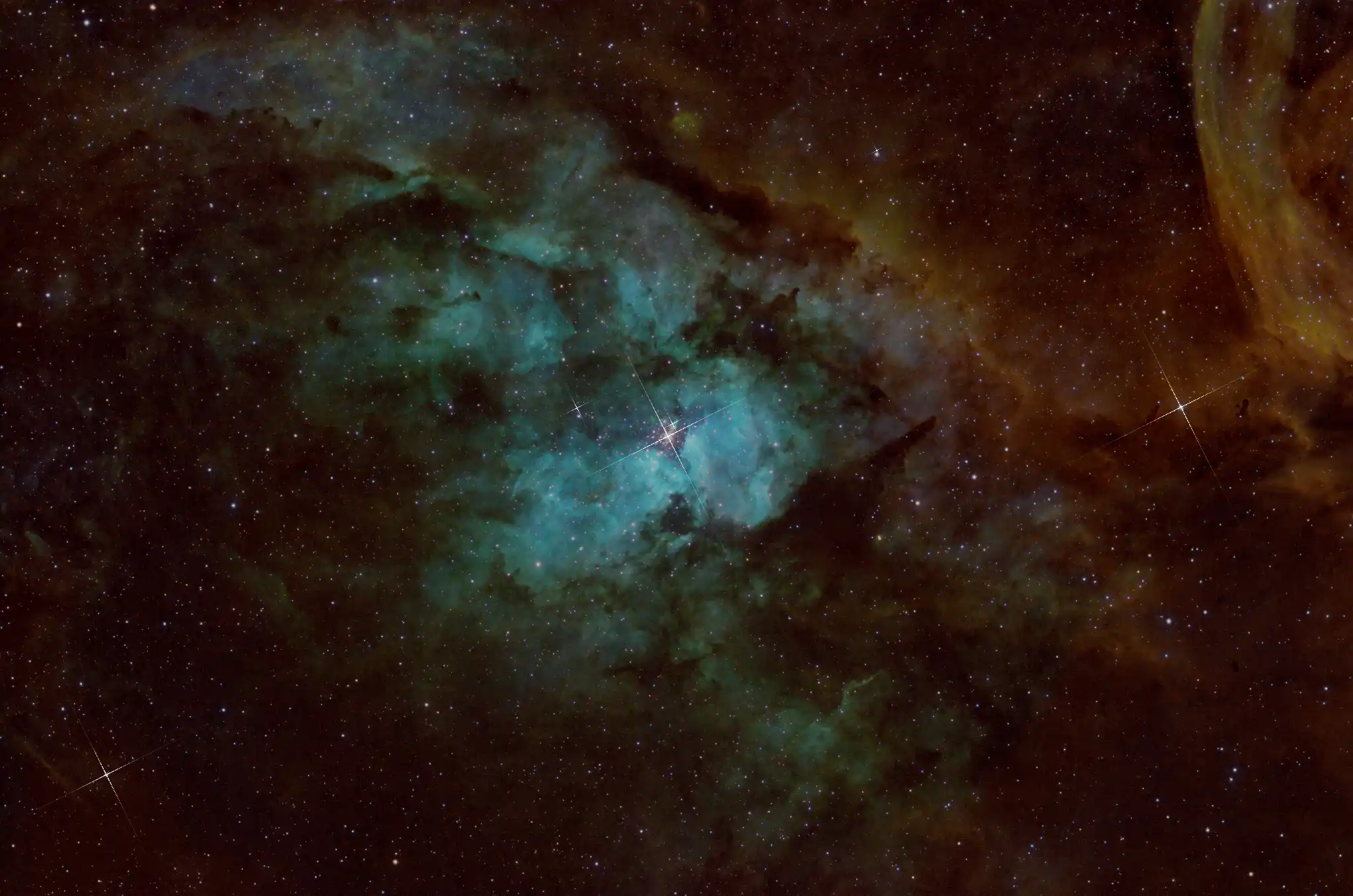
If you want to see what happens when the galaxy truly unleashes its power, look toward the Carina spiral arm. Located approximately 22,000 light-years away, NGC 3603 isn't just a cluster; it’s a "super star cluster"—a rare galactic template for the violent starbursts usually only seen in distant, high-energy galaxies.
**An Engine of Cosmic Proportions**
NGC 3603 represents the extreme upper limit of star formation in the Milky Way. It packs a total mass of over 10,000 suns into an incredibly compact volume. At its heart lies HD 97950, a central engine so dense that ground-based telescopes struggle to resolve its individual members. This core boasts the highest density of high-mass stars known in our galaxy, including three Wolf-Rayet stars and several O-type giants. For me, this means I am imaging a region where the ionizing radiation is roughly 100 times more luminous than the Orion Nebula.
**A Visual Masterpiece: Winds and Cavities**
This immense power creates a dramatic landscape. Fierce stellar winds and radiation have carved a bubble-like cavity into the surrounding molecular cloud, clearing a space roughly 8 light-years across. It really does create a "curtain-lifting" effect that allows me to peer directly into the nursery, revealing protostars like IRS 9A-C, which are still actively accreting mass. High-resolution images also reveal striking "pillars" and ionization fronts, reminiscent of the famous Pillars of Creation.
**The Mystery of Sher 25**
And that is just the beginning. Perhaps the most intriguing target here is Sher 25. Located just north of the main cluster, this blue supergiant is surrounded by a unique hourglass-shaped nebula. Its structure bears a haunting resemblance to the star that became Supernova 1987A, marking it as a star on the brink of a violent death. Its presence suggests that star formation here has been a progressive event occurring in stages, rather than a single, isolated burst.
**A Dynamic, Evolving System**
NGC 3603 represents all that is magical about life, the Universe, Everything!!! It is a living system. Fragments of this scene literally make up the elements of our being. Recent Gaia data analyses have revealed a "halo" of O-type stars extending well beyond the core, with evidence of stars being ejected from the cluster at high speeds. Some of these "runaway stars" hint at a complex gravitational history and a chaotic, collapsing core.
For me, NGC 3603 is more than a pretty picture; it is a massive star factory where we can witness the complete lifecycle of the cosmos—from the birth of protostars to the final, tense moments before a supernova.
I am experimenting with a new way of processing images here on TL - I recorded notes that I made and saved them as a presentation. It is poor right now but each post I hope to get better and better, quickly. Over time I can then recall the advances and mess I created. I will be using the new Affinity free image programme and will also be recording that process as I learn how to use it. Existing How To's tend to use the old version and it is painful to try and adapt them to new formats.
The old form of 'X light years and Y dry facts' is over now that Agentic systems give us cutting edge astronomy capabilities, and while I have no idea what I am doing I intend to drive these systems as hard and fast as I can. Caveat Emptor!!!!
All comments welcome!
https://share.descript.com/view/EWH31wDFJ1D
NGC 3603
6 credit