02 Feb 2026
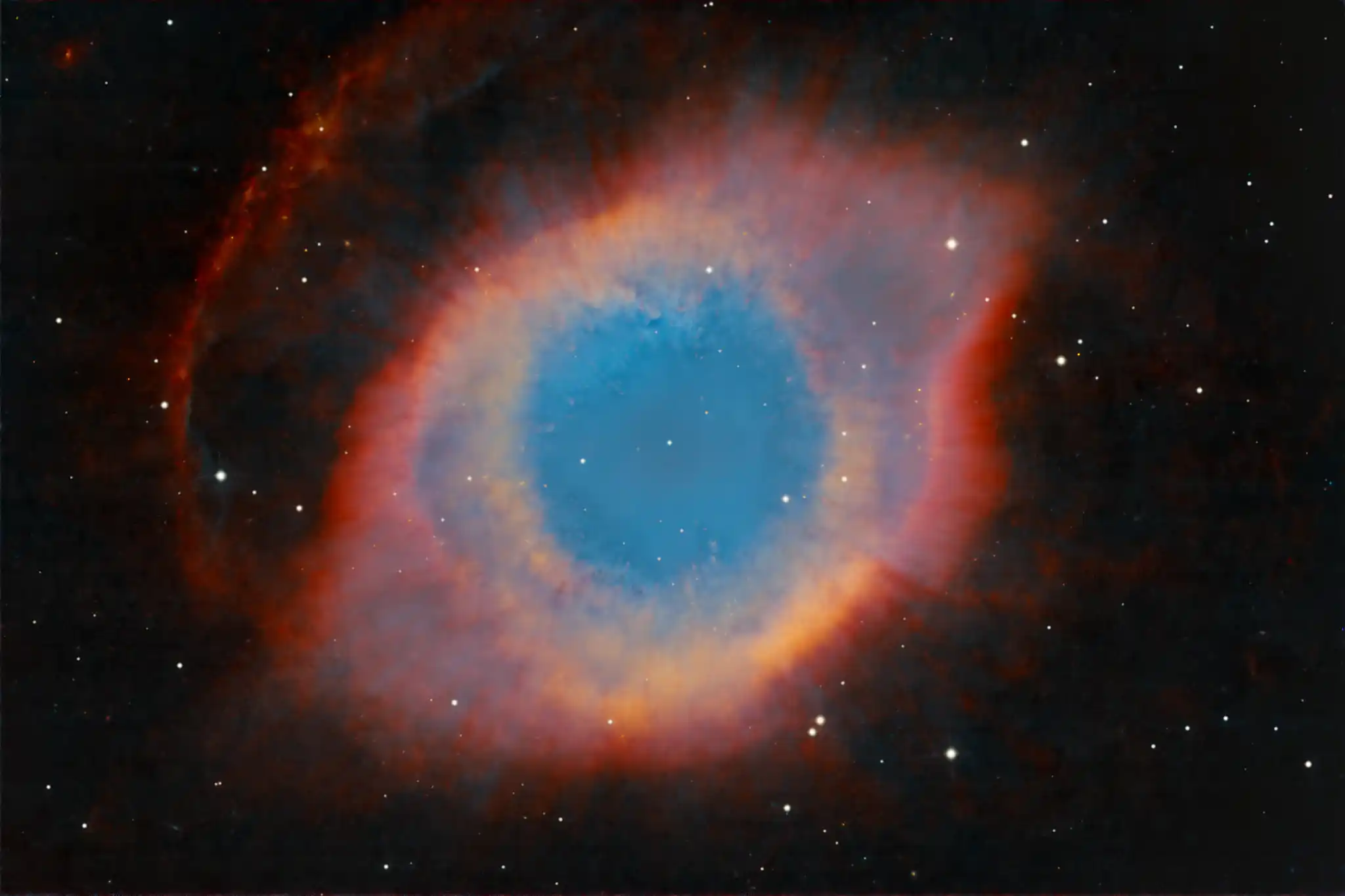
NGC 7293, the Helix Nebula, HOO,S
NGC 7293, the Helix Nebula, is a planetary nebula located in the constellation Aquarius. Planetary nebulas are remnants of a star at the end of it's life. A star similar to our Sun. It blows off it's outer shells forming the nebula. The core of the star collapses to form a dense hot white dwarf. The radiation from the white dwarf excites the gas in the nebula causing it to glow. (NASA Science)
The white dwarf can be seen at the center of the blue core of the nebula.
This image is a narrowband image, (HOOS). It enhances the planetary nebulas contribution of H-alpha, OIII, and SII.
The table below shows the RGB channel assignments as well as the addition of a yellow channel. Assignments are as follows:
Channel --> Narrowband
Red --> H-alpha
Green --> OIII
Blue --> OIII
Yellow --> SII
Stars are standard RGB color.
The purpose of this Narrowband image is to show the composition of the planetary nebula. The ejection of the stars atmosphere pushes the gas outward. Hydrogen compared to oxygen and sulfur is very light. Therefore, oxygen (blue) and sulfur (yellow) compose the inner part of the nebula. Hydrogen (red) is located beyond the core of the planetary nebula.
Image processed by Andrew Macica, original data from Telescope Live.
Imaging Details:
Observatory: Rio Hurtado Valley, Chile
Telescope: Planewave CDK24
Aperture: 610 mm (24 inches), f/6.5
Focal Length: 3962 mm
Camera: QHY 600M Pro CMOS
Filters: Ha, OIII, OIII, SII
Total Exposure: 34 hours 35 minutes
Image Processing:
PixInsight 1.8.9-3 Ripley (x64);
BlurXTerminator, NoiseXTerminator, StarXTerminator (RC Astro);
Adobe Photoshop 25.12.4;
Adobe Lightroom Classic 15.0.1
Instruction on PixInsight from Adam Block Studios.
NGC 7293
19 credit