04 Feb 2026
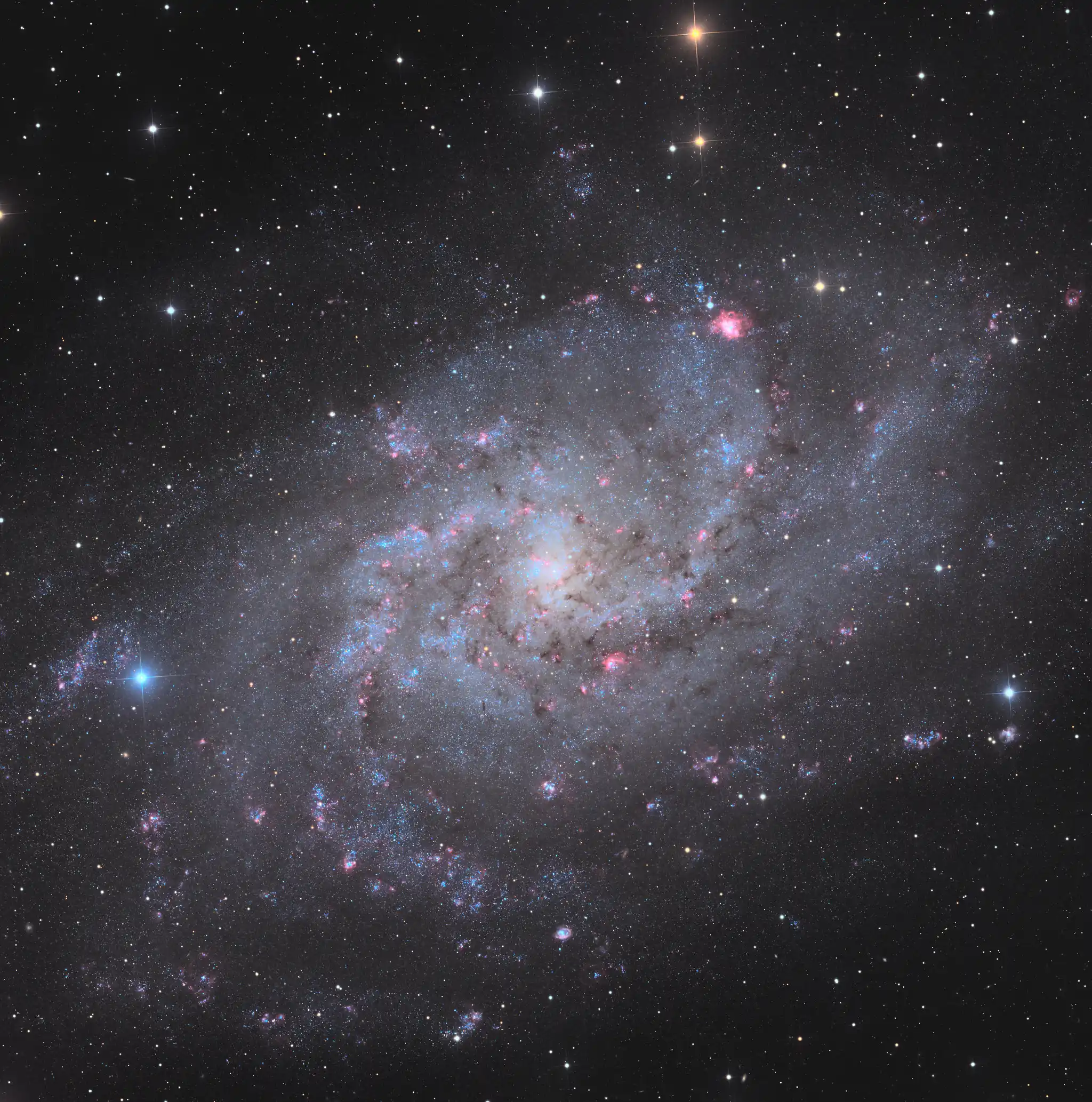
The Triangulum Galaxy (M33)
The Triangulum Galaxy (M33) is a spiral galaxy 2.73 million LY distant. Spiral galaxy M33 is located in the triangle-shaped constellation Triangulum, earning it the nickname the Triangulum galaxy. About half the size of our Milky Way galaxy, M33 is the third-largest member of our Local Group of galaxies following the Andromeda galaxy (M31) and the Milky Way. (NASA Science)
The red colored regions scattered throughout the image reveal numerous sites of rapid star birth in M33. In fact, Hubble’s observations reveal that the Triangulum galaxy’s star formation rate is ten times higher than the average found in the Andromeda galaxy, previously surveyed by Hubble in similar detail. A bright red patch in the upper right of this image, called NGC 604, is the largest star-forming region in M33 and one of the largest stellar nurseries in the entire Local Group of galaxies. (NASA Science)
M33's abundant reserves of cosmic dust and gas, which collapses under their own gravity within giant molecular clouds. Unlike many galaxies, M33's active star birth is not driven by external collisions but by its pristine spiral arms, indicating a lack of significant interactions with other galaxies. The presence of numerous ionized hydrogen clouds, or H-II regions, acts as stellar nurseries where high-mass stars form in the collisions of massive molecular clouds. (NASA Science)
Image processed by Andrew Macica, original data from Telescope Live.
Imaging Details:
Observatory: Bernard Miller, USA
Telescope: Planewave CDK17 on a Paramount ME Mount
Aperture: 430 mm (17 inches), f/6.8
Focal Length: 2940 mm
Camera: FLI Proline PL16803 CCD
Filters: Ha, LRGB
Total Exposure: 30 hours 10 min.
Image Processing: PixInsight 1.9.3 Lockhart (x64);
BlurXTerminator, NoiseXTerminator, StarXTerminator (RC Astro);
Adobe Photoshop 25.12.4;
Adobe Lightroom Classic 14.5
Instruction on PixInsight from Adam Block Studios.
M33
20 credit