05 Feb 2026
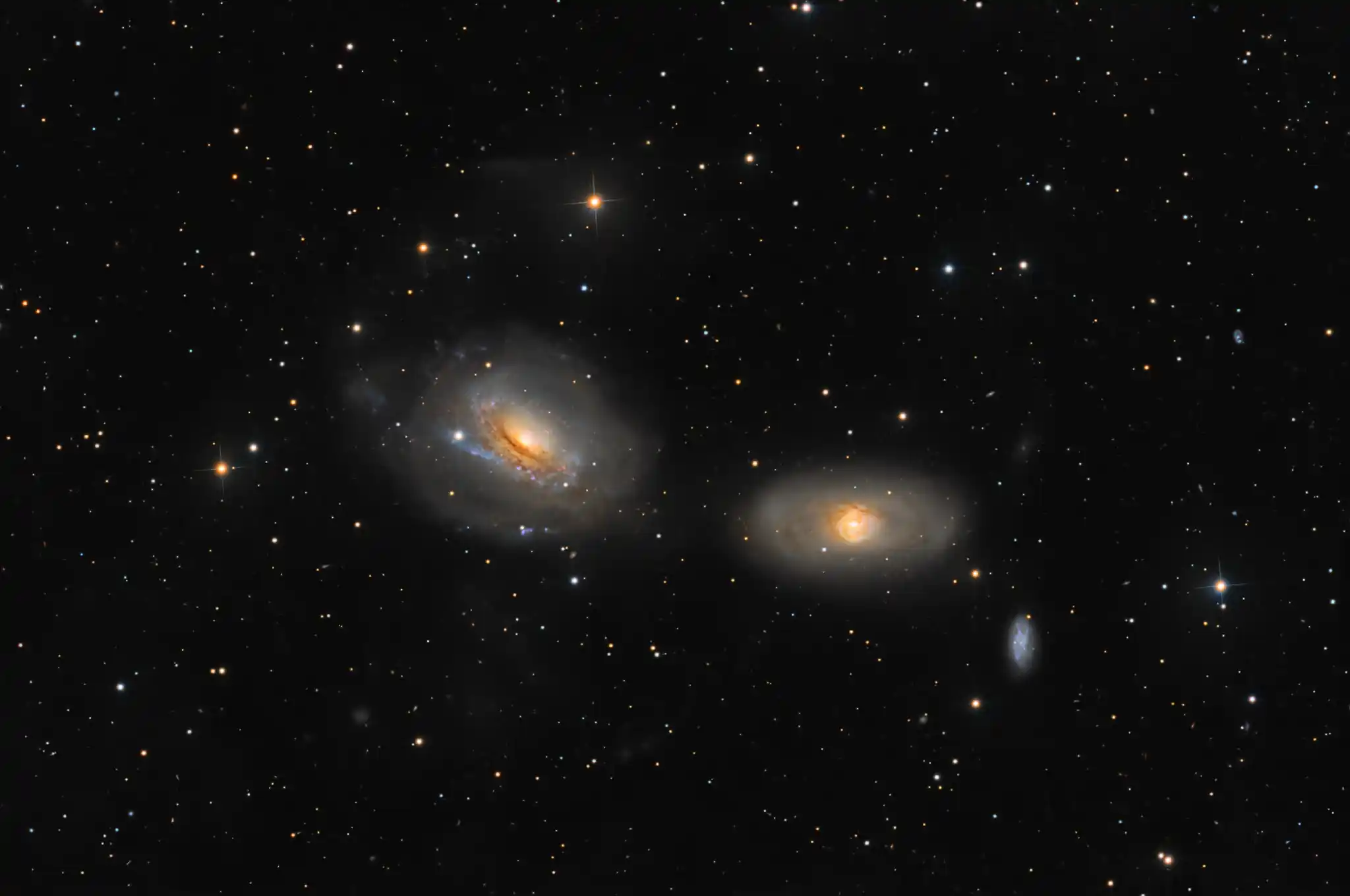
NGC 3166/3169 - Interacting Galaxy Pair in Sextans
NGC 3166 and NGC 3169 form an interacting galaxy pair in the constellation Sextans, located at a distance of roughly 70 million light-years. They are the brightest members of a small galaxy group and are caught in an early but clearly visible stage of gravitational interaction. From our vantage point, the two galaxies appear close together on the sky, but their distorted outer structures reveal that this is more than a simple line-of-sight pairing—tidal forces are already at work, subtly reshaping both systems.
NGC 3169 is the more visually dramatic of the two, a barred spiral galaxy whose disk shows signs of disruption along its outer arms. Tidal stretching and asymmetries hint at gas and stars being pulled outward as the galaxies exchange angular momentum. NGC 3166, by contrast, is a lenticular or early-type spiral with a smoother appearance, but deep imaging reveals that it too is participating in the interaction, with faint extensions and irregularities in its halo betraying past or ongoing gravitational disturbance.
This pair is of particular interest because it represents a pre-merger system—the galaxies are close enough to influence one another, yet they have not reached the violent stages seen in advanced mergers. Such systems offer a valuable snapshot of how interactions begin: spiral structure is loosened, gas is redistributed, and conditions are set for future bursts of star formation or morphological transformation. Over the next few hundred million years, NGC 3166 and NGC 3169 are expected to continue drawing closer, eventually evolving into a far more disturbed and unified system.
This image is based on a total of just 3 hours of integration, combining two independent Telescope Live datasets acquired with the SPA-2-CCD and CHI-1-CMOS instruments.
NGC 3166
1 credit