07 Feb 2026
WR 16
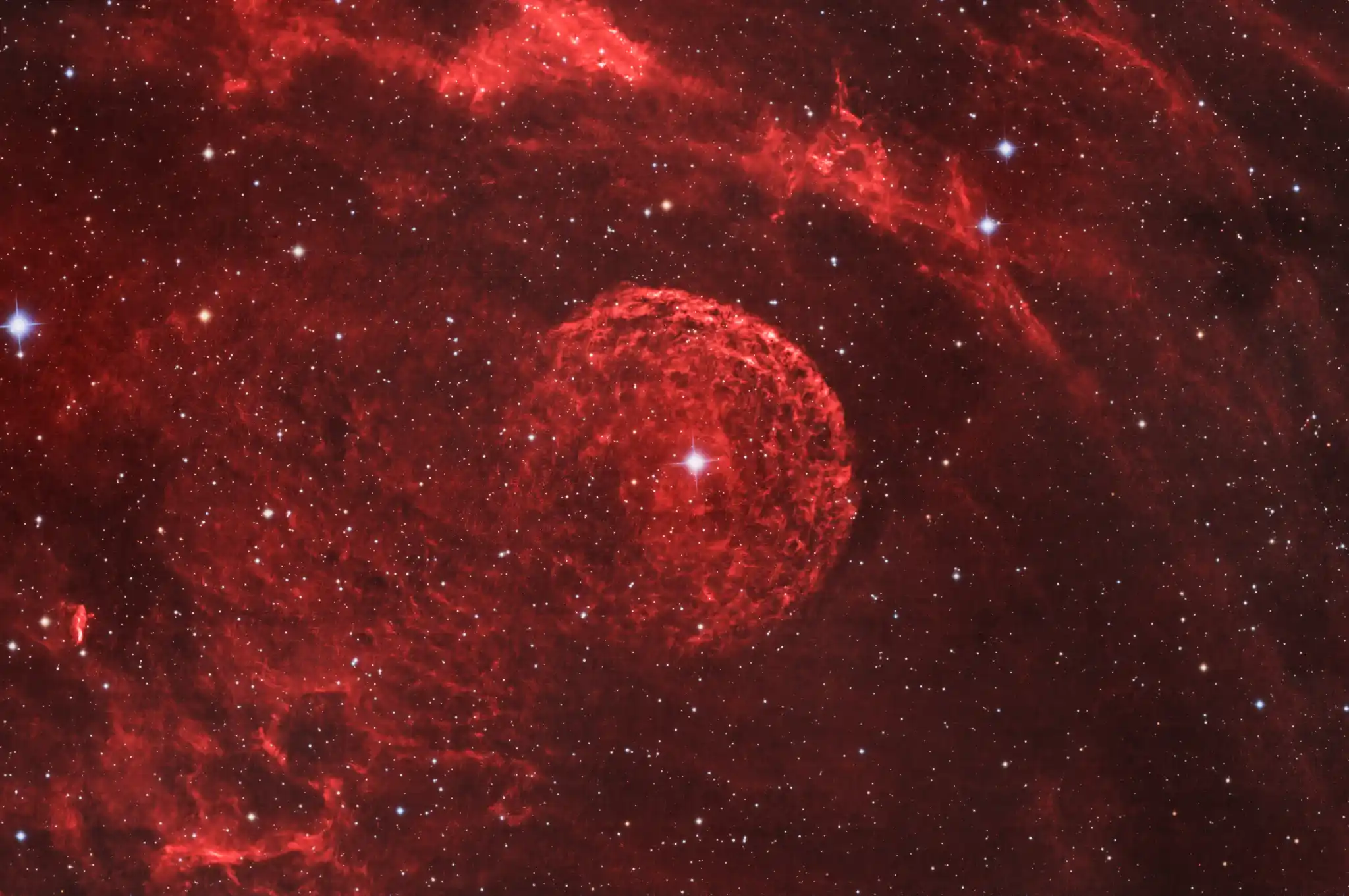
WR 16 (HD 86161) is a Wolf-Rayet star located in the constellation Carina. It is a massive, bright, and evolving star in a late stage of evolution, surrounded by a complex nebula created by strong stellar winds and ancient mass ejections. WR 16 is classified as a runaway star due to its high velocity in the interstellar medium.
Of the billions of stars in our galaxy, fewer than 700 Wolf-Rayet (WR) stars have currently been identified. It is estimated that there are only 6,000 in the entire galaxy, making them extremely rare. Their detection is facilitated by their strong emission lines, which allow them to be detected in other galaxies.
These supergiants have absorbed all their hydrogen, which was ejected in powerful winds, forming a structure around them. In the case of WR16, it was ejected in all directions, creating the bubble visible in the image. Fission occurs, producing helium and other elements. The space around the bubble is filled with hydrogen clouds.
Motion measurements from the Gaia satellite show that WR 16 is moving at about 61 km/s relative to its local interstellar medium, qualifying it as a runaway star. This rapid motion influences the shape of the surrounding nebula.
WR 16 is surrounded by a bubble-like nebula, formed from material ejected during earlier stages of its evolution and shaped by strong stellar winds. Observations reveal a circular, bubble-shaped nebula visible at optical and infrared wavelengths. The star is surrounded by numerous rings, likely formed by episodic mass ejections during its earlier phase as a bright blue variable star (LBV). Ionized hydrogen (H II regions) and nitrogen-enriched gas are present, indicating processed stellar material.
This material is incredibly difficult; practically only the R and Ha channels showed any signs of "life."
Telescope: Planewave CDK24
Camera: QHY 600M
Location: Rio Hurtado, Chile, TelescopeLive
LRGB 300 sec x 3 h per channel
WR 16
8 credit