09 Feb 2026
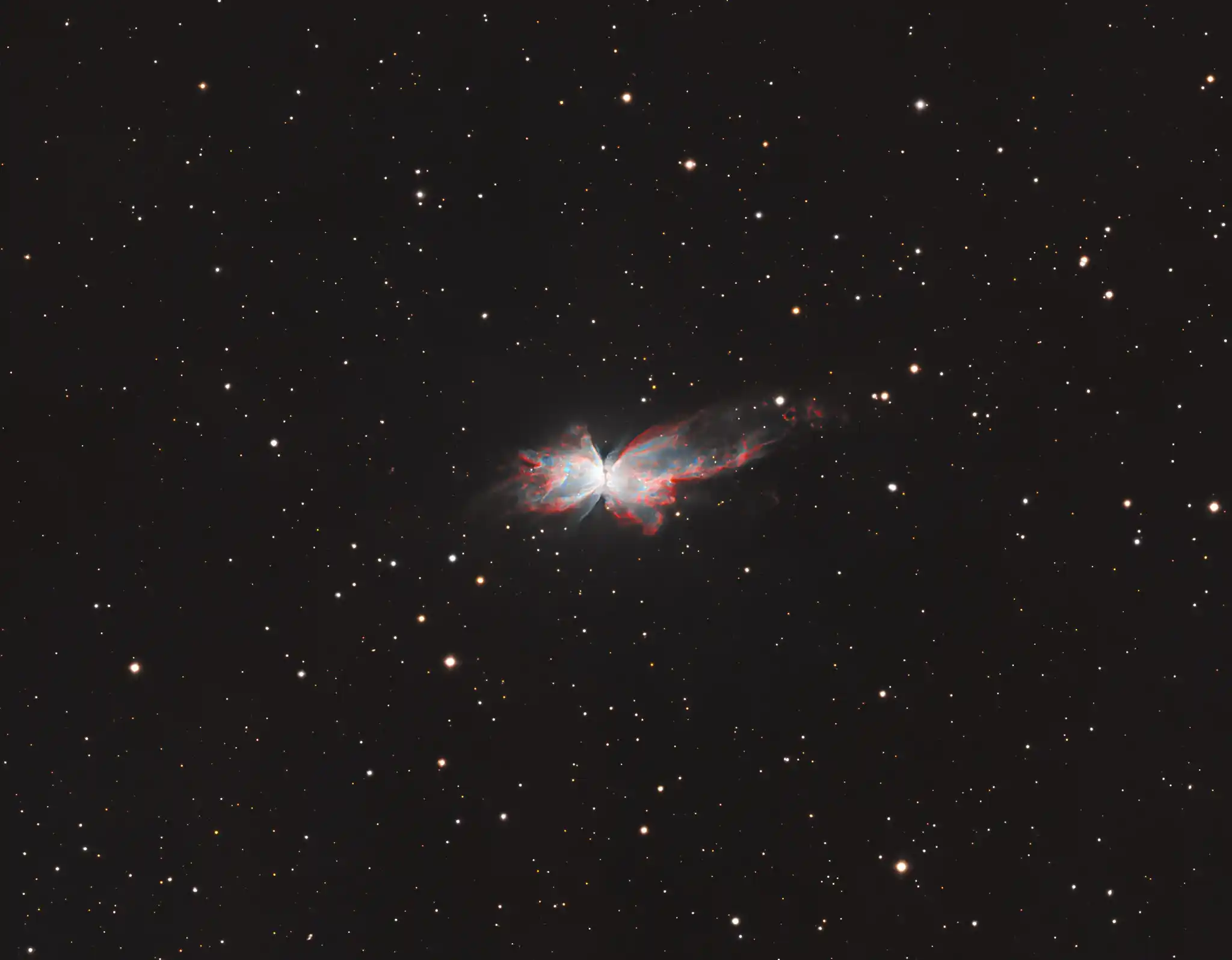
NGC 6302, the Butterfly Nebula
This image is a narrowband image of the Butterfly Nebula or NGC 6302. It is a bipolar planetary nebula in the constellation Scorpius.
Planetary nebulas are remnants of a star at the end of it's life. It blows off it's outer shells forming the nebula. The core of the star collapses to form a dense hot white dwarf. The radiation from the white dwarf excites the gas in the nebula causing it to glow. The white dwarf in this image is embedded in the center of the nebula and is not visible. (NASA Science)
This image is a narrowband image. Ionized gases in this nebula produce three prominent emissions: Hydrogen Alpha (656.3 nm), Sulfur II (672 nm) and Oxygen III (500.7 nm).
The color mapping, for this image, is as follows:
Red: Hydrogen Alpha (656.3 nm)
Green: Oxygen III (500.7 nm)
Blue: Oxygen III (500.7 nm)
The Sulfur II channel was not incorporated into this image.
This mapping communicates the composition of different regions in the nebula. It does not represent the way the nebula appears to our eyes. Although my color mapping is more consistent with our color perception as opposed to using the Hubble Palette.
Image processed by Andrew Macica, original data from Telescope Live.
Imaging Details:
Observatory: Rio Hurtado Valley, Chile
Telescope: Planewave CDK24
Aperture: 610 mm (24 inches), f/6.5
Focal Length: 3962 mm
Camera: FLI PL 9000 CCD
Filters: Ha, SII, OIII
Total Exposure: 15 hours 0 min.
Image Processing:
PixInsight 1.8.9-3 Ripley (x64);
BlurXTerminator, NoiseXTerminator, StarXTerminator (RC Astro);
Python 3.9;
Adobe Photoshop 25.12.1;
Adobe Lightroom Classic 14.2
Instruction on PixInsight from Adam Block Studios.
NGC 6302
10 credit