09 Feb 2026
R Aquarii
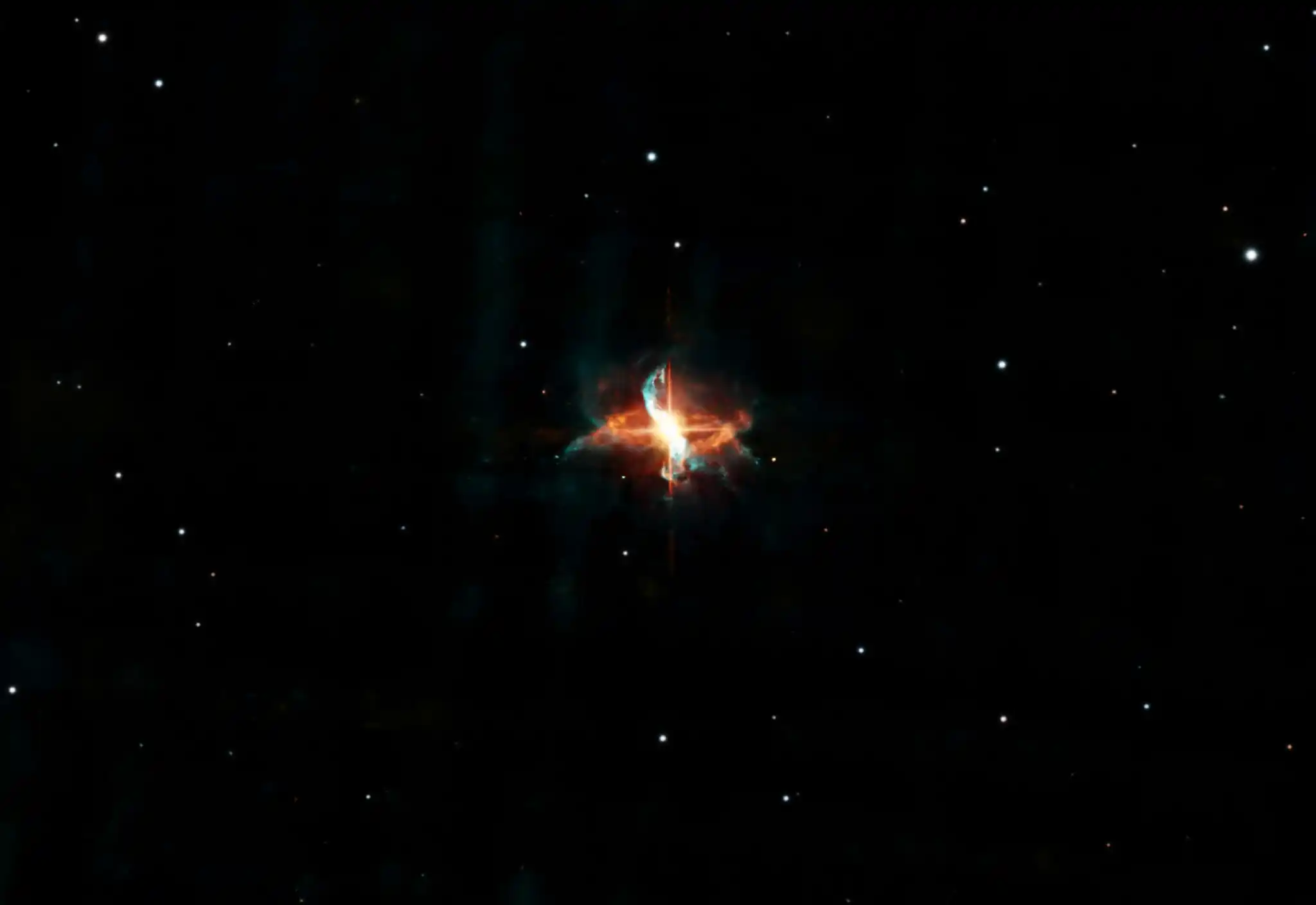
Residing only roughly 700 light-years from Earth in the constellation Aquarius, R Aquarii is a symbiotic binary star: a type of binary star system consisting of a white dwarf and a red giant that is surrounded by a large, dynamic nebula. As the closest symbiotic star to Earth, R Aquarii was studied by none other than Edwin Hubble in an effort to understand the mechanism that powers the system. (ESA)
R Aquarii undergoes violent eruptions that blast out huge filaments of glowing gas. This dramatically demonstrates how the Universe redistributes the products of nuclear energy that form deep inside stars and jet back into space. (ESA)
R Aquarii belongs to a class of double stars called symbiotic stars. The primary star is an aging red giant and its companion is a compact burned-out star known as a white dwarf. The red giant primary star is classified as a Mira variable that is over 400 times larger than our Sun. The bloated monster star pulsates, changes temperature, and varies in brightness by a factor of 750 times over a roughly 390-day period. At its peak the star is blinding at nearly 5,000 times our Sun’s brightness. When the white dwarf swings closest to the red giant along its 44-year orbital period, it gravitationally siphons off hydrogen gas. This material accumulates in the accretion disk surrounding the white dwarf, until it undergoes a powerful outburst and jet ejection, especially during the closest approach of the white dwarf to the red giant donor star. (ESA)
This image is a narrowband image, (HOOS). It enhances the nebula's contribution of H-alpha, OIII, and SII.
The table below shows the RGB channel assignments as well as the addition of a yellow channel. Assignments are as follows:
Channel --> Narrowband
Red --> H-alpha
Green --> OIII
Blue --> OIII
Yellow --> SII
Stars are HOO.
The purpose of this Narrowband image is to show the composition of the nebula. The ejection of the stars atmosphere pushes the gas outward. Hydrogen compared to oxygen and sulfur is very light. Therefore, oxygen (blue) and sulfur (yellow) compose the inner part of the nebula. Hydrogen (red) is located beyond the core of the nebula. On the other hand, the chaotic and powerful nature of this system, on occasion, pushes the heavier elements out into the furthest extent of the nebula.
Image processed by Andrew Macica, original data from Telescope Live.
Imaging Details:
Observatory: Rio Hurtado Valley, Chile
Telescope: Planewave CDK24
Aperture: 610 mm (24 inches), f/6.5
Focal Length: 3962 mm
Camera: QHY 600M Pro CMOS
Filters: Ha, OIII, OIII, SII
Total Exposure: 17 hours 20 minutes
Image Processing:
PixInsight 1.8.9-3 Ripley (x64);
BlurXTerminator, NoiseXTerminator, StarXTerminator (RC Astro);
Adobe Photoshop 25.12.4;
Adobe Lightroom Classic 15.0.1
Instruction on PixInsight from Adam Block Studios.
R Aquarii
11 credit