09 Feb 2026
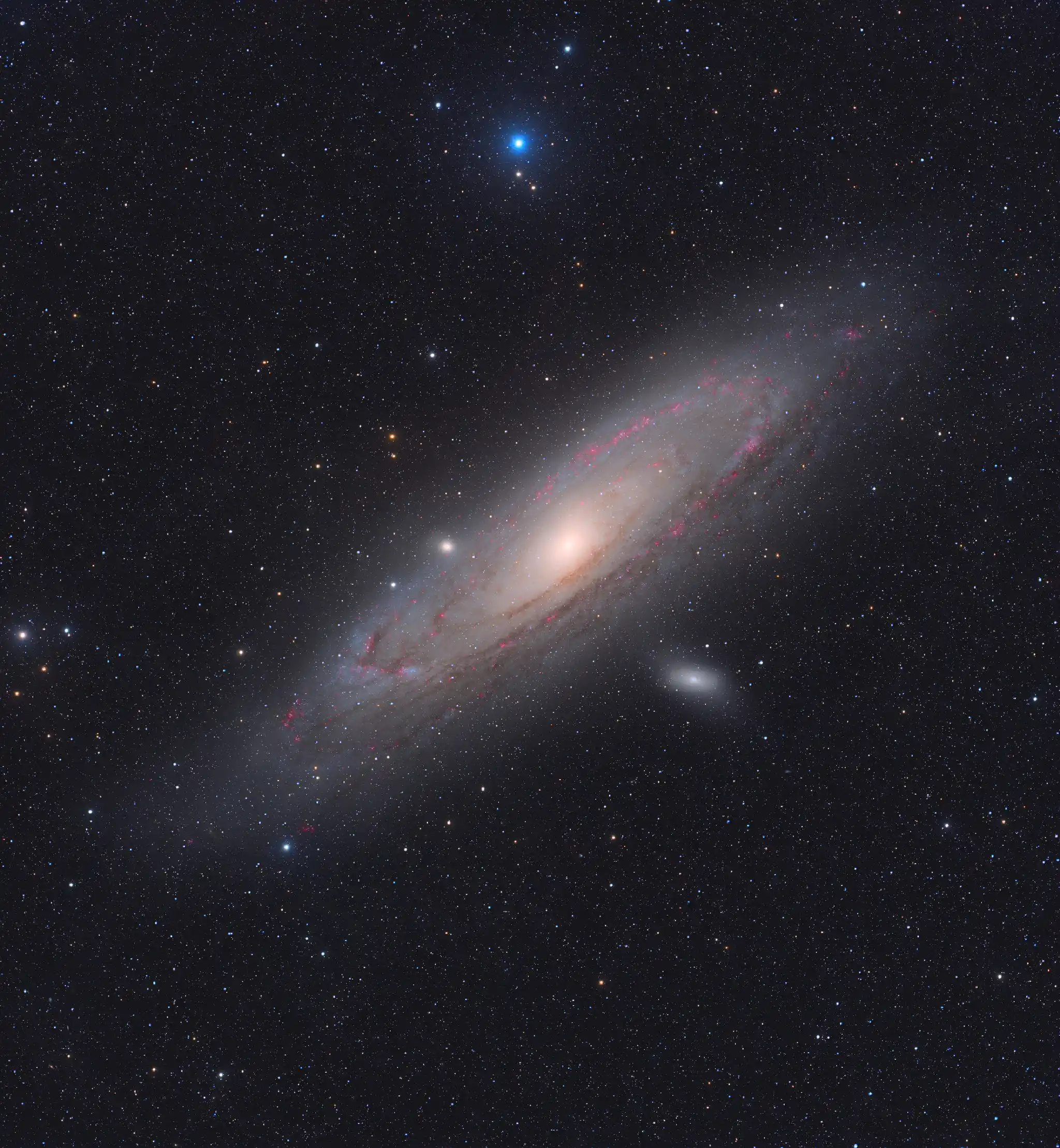
The Andromeda Galaxy, M31, NGC 224
The Andromeda Galaxy, M31, NGC 224, is a spiral Galaxy that is the nearest major galaxy to the Milky Way. It s 2.5 MLy distant.
It is an object that I frequently viewed and never got tired of viewing it while working and volunteering at Lick Observatory. It is common to see the central bulge of the galaxy. I was able to see it naked eye using averted vision at Lick Observatory, when a marine layer of clouds would roll in below the observatory blocking the city lights from San Jose.
It was only the telescopes at Lick Observatory, specifically the Great 36 Inch Refractor and the 40 Inch Nikel's reflector that I could see structure in M31. I could see the dust lanes.
In the image the red, bead like objects, forming concentric circles within the galaxy are HII regions. These are hydrogen gas clouds that condense to form stars. Older stars compose the center of the galaxy and are yellow in color. Older, cooler stars have lifetimes on the order of billions of years, like our sun. The outer portion of the galaxy is composed of large hot blue stars that have a shorter life time.
The galaxy below M31, just right of center is M110. M110 is an elliptical satellite galaxy of M31.
Up and to the left of the center of M31 is the satellite galaxy M32. M32 is a dwarf "early-type" galaxy.
Image processed by Andrew Macica, original data from Telescope Live.
Imaging Details:
Observatory: IC Astronomy Observatory, Oria, Almería, Spain
Telescope: Takahashi FSQ-106EDX4
Aperture: 106 mm, w/ 0.73x focal reducer, f/3.6
Focal Length: 382 mm
Camera: QHY 600M Pro CMOS
Filters: LRGB, Ha
Total Exposure: 22 hours 10 minutes
Image Processing:
PixInsight 1.8.9-3 Ripley (x64);
BlurXTerminator, NoiseXTerminator, StarXTerminator (RC Astro);
Python 3.9;
Adobe Photoshop 25.12.1;
Adobe Lightroom Classic 14.2
Instruction on PixInsight from Adam Block Studios.
Andromeda Galaxy
37 credit