21 Feb 2026
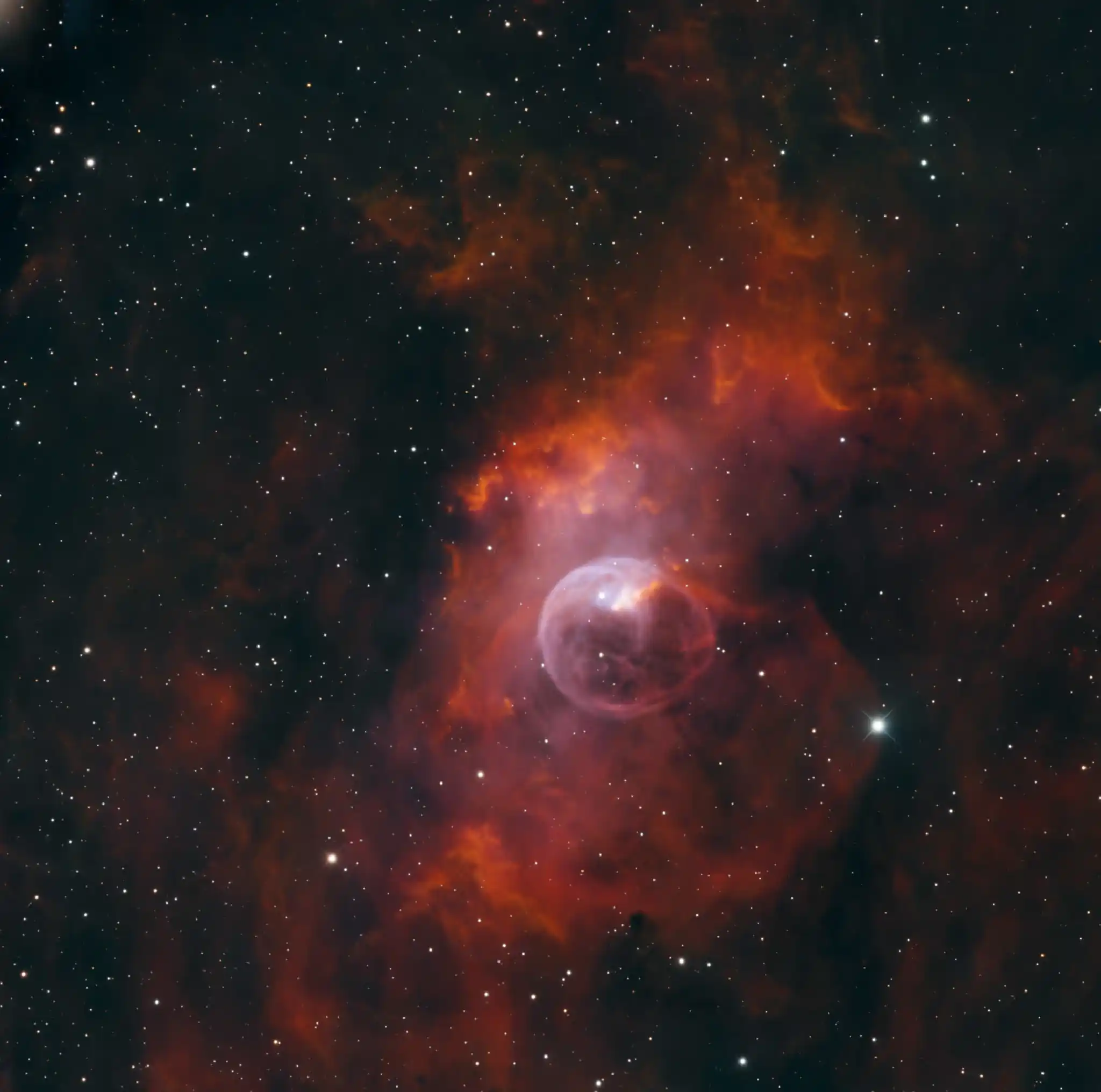
NGC 7635, the Bubble Nebula
NGC 7635, the Bubble Nebula. The Bubble Nebula is 7 light-years across – about one-and-a-half times the distance from our sun to its nearest stellar neighbor, Alpha Centauri – and resides 7,100 light-years from Earth in the constellation Cassiopeia. (NASA Science)
The seething star forming this nebula is 45 times more massive than our sun. Gas on the star gets so hot that it escapes away into space as a "stellar wind" moving at over 4 million miles per hour. This outflow sweeps up the cold, interstellar gas in front of it, forming the outer edge of the bubble. (NASA Science)
This image is a narrowband image. Ionized gases in this nebula produce three prominent emissions: Hydrogen Alpha (656.3 nm), Sulfur II (672 nm) and Oxygen III (500.7 nm). I used the Seti Astro Realistic 2 Palette to map these emissions to RGB image channels. The palette provides a close representation to the natural appearance of the nebula.
Image processed by Andrew F. Macica, original data from Telescope Live.
Imaging Details:
Observatory: Oria, Spain
Telescope: Officina Stellare 700 RC
Aperture: 700 mm (27.5 inches), f/8
Focal Length: 5600 mm
Camera: FLI ProLine PL16803 CCD
Filters: H alpha, SII, OIII
Total Exposure: 7 hours 20 min.
Image Processing: PixInsight 1.8.9-3 Ripley (x64);
BlurXTerminator, NoiseXTerminator (RC Astro);
Adobe Photoshop 25.12.4;
Adobe Lightroom Classic 15.1.1
Instruction on PixInsight from Adam Block Studios.
NGC 7635
5 credit