07 Apr 2026
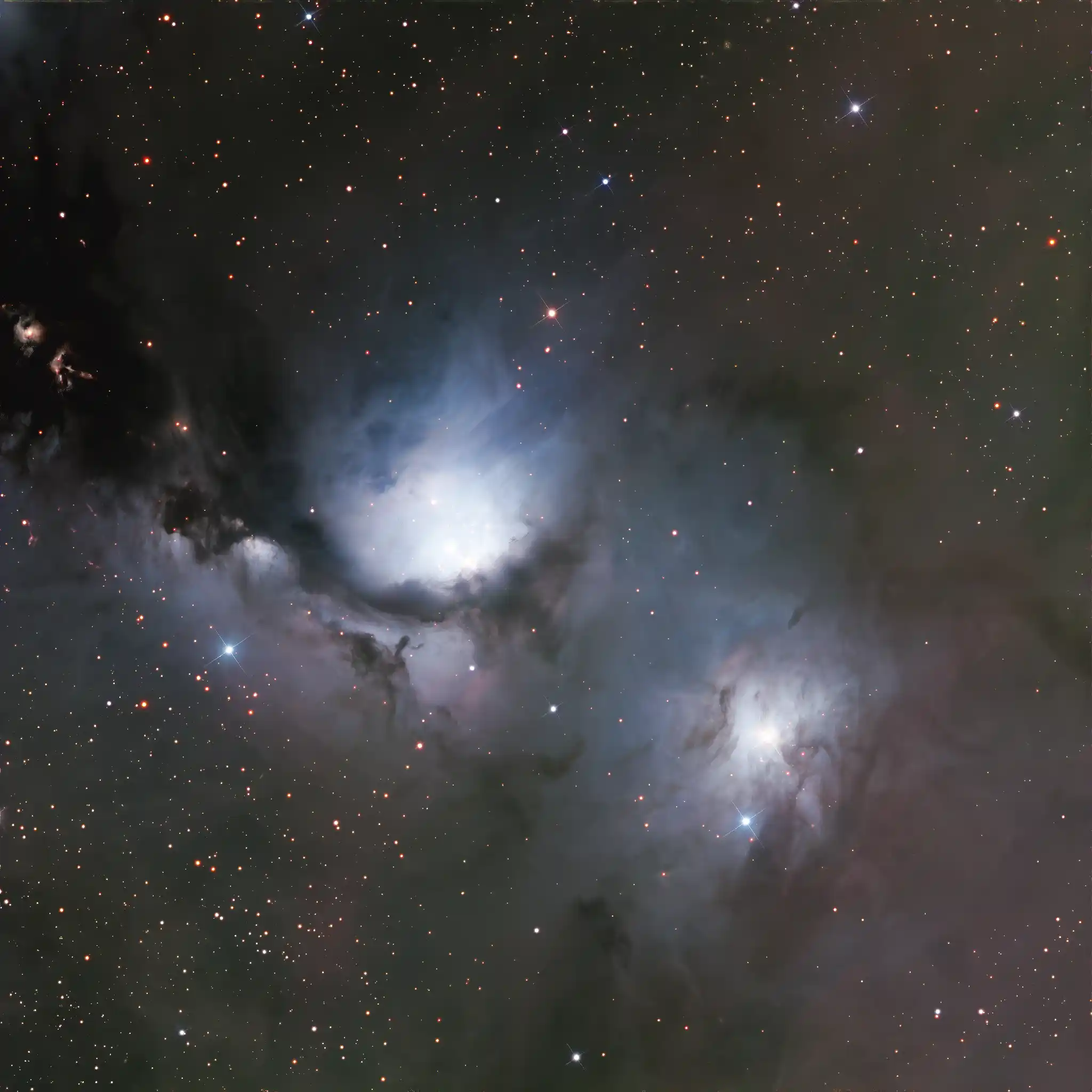
M78. The Brightest Reflection Nebula In The Sky.
**My processing of M78 in PixInsight following Philippe Bernhard's workflow**
To process this image of M78 I followed Philippe Bernhard's LRGB workflow in PixInsight, a methodology that has given me very good results on reflection nebulae like this one.
**Calibration and stacking**
The first thing I did was calibrate all the subframes for each channel with their corresponding bias, dark and flat masters using *ImageCalibration*. I then applied *cosmetic correction* to eliminate hot pixels and sensor defects. Once calibrated, I aligned all the frames with *StarAlignment* and integrated them with *ImageIntegration*, using Winsorized Sigma Clipping as the rejection algorithm to get rid of noise and unwanted artifacts.
**Luminance processing**
The luminance is where I spent the most time, as it is the structural foundation of the entire image. First I removed the background sky gradients with *DynamicBackgroundExtraction* (DBE), which in M78 are quite noticeable due to the amount of interstellar dust in the surrounding area. For noise reduction I used *NoiseXTerminator*, preserving the most delicate filaments of the nebula. I performed the stretch from linear space with *GeneralizedHyperbolicStretch*, carefully controlling the highlights to avoid saturating the bright cores of the two main lobes.
**RGB processing and color calibration**
I processed each RGB channel in a similar way to the luminance. Once the three channels were stretched, I combined them with *ChannelCombination* and calibrated the color with *PhotometricColorCalibration*, referencing the field stars against photometric catalogues. This was key to obtaining the characteristic and accurate blue of this reflection nebula without artificially forcing the saturation.
**Star separation**
Before combining, I used *StarXTerminator* to separate the stars from the nebulosity and work each layer independently. This allowed me to enhance the faintest details of the nebula without the bright field stars interfering with the process.
**Final LRGB combination**
I performed the final merge with *LRGBCombination*, carefully adjusting the luminosity and chrominance parameters to balance structural detail with color saturation. This step always requires several iterative adjustments to find the point where the luminance does not excessively desaturate the RGB.
**Final retouch in Photoshop**
With the image already exported at 16 bits, I applied the last adjustments in Photoshop: curves to fine-tune the dynamic range, some local contrast enhancement and a final touch of selective saturation to bring out the blues of the nebula and the reds of the field stars, without losing the natural look of the result.
M78
20 credit