15 Apr 2026
M33
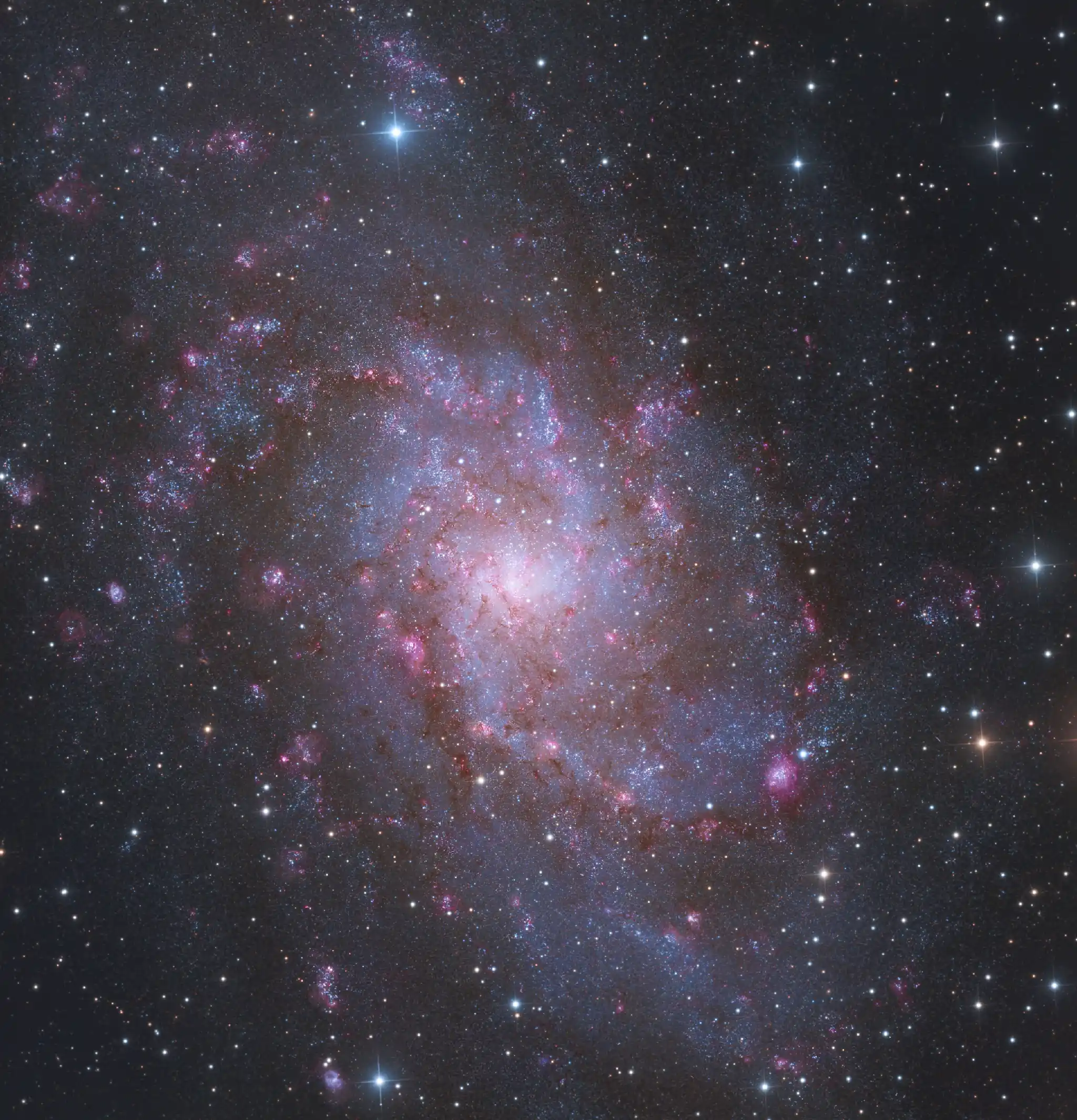
The spiral galaxy M33, also known as the Triangulum Galaxy, is one of our closest neighbors, located just three million light-years away. It is home to about forty billion stars and is the third largest galaxy in the Local Group, after the Andromeda Galaxy (M31) and our own Milky Way. Its diameter is about 60,000 light-years, compared to Andromeda's diameter of about 200,000 light-years.
M33 is popular with astrophotographers, and from exceptionally dark locations it can even be seen with the naked eye. Thanks to its fortunate location in space, we can admire the beautiful spiral structure of the galaxy's disk almost head-on.
This image shows M33 in the far infrared, revealing the glow of cosmic dust and H-II in the interstellar medium that fills the galaxy. The brightest spots scattered along the spiral arms are dense clumps of gas and dust where massive stars are being born. The most prominent of these is NGC 604, visible in the lower right spiral arm (5:00 p.m.). This is a massive star-forming region, where hundreds of thousands of stars are forming.
The bright blue arms of the Triangulum Galaxy indicate the presence of extremely hot, young stars, evidence that this galaxy is undergoing a rapid star formation process—potentially forming a star the mass of our Sun every two years. The enormous H-II regions in Messier 33 are among the largest known stellar nurseries in the Universe.
The ordered spiral structure of the Triangulum Galaxy shows few signs of interaction with nearby galaxies. However, this may change in the future. M33, located only slightly farther from us than the Andromeda Galaxy, is about 3 million light-years from Earth. M33 could become the third participant in the upcoming collision of the Andromeda galaxy with the Milky Way in over 4 billion years, so you need to be alert and careful 😂😜 you never know when it will surprise you 🙃.
The apparent graininess of the image is actually the swarms of countless stars filling M33 and its surroundings.
In short – chaos that creates and destroys in an infinite, chaotic Universe.
M33
20 credit