28 Apr 2026
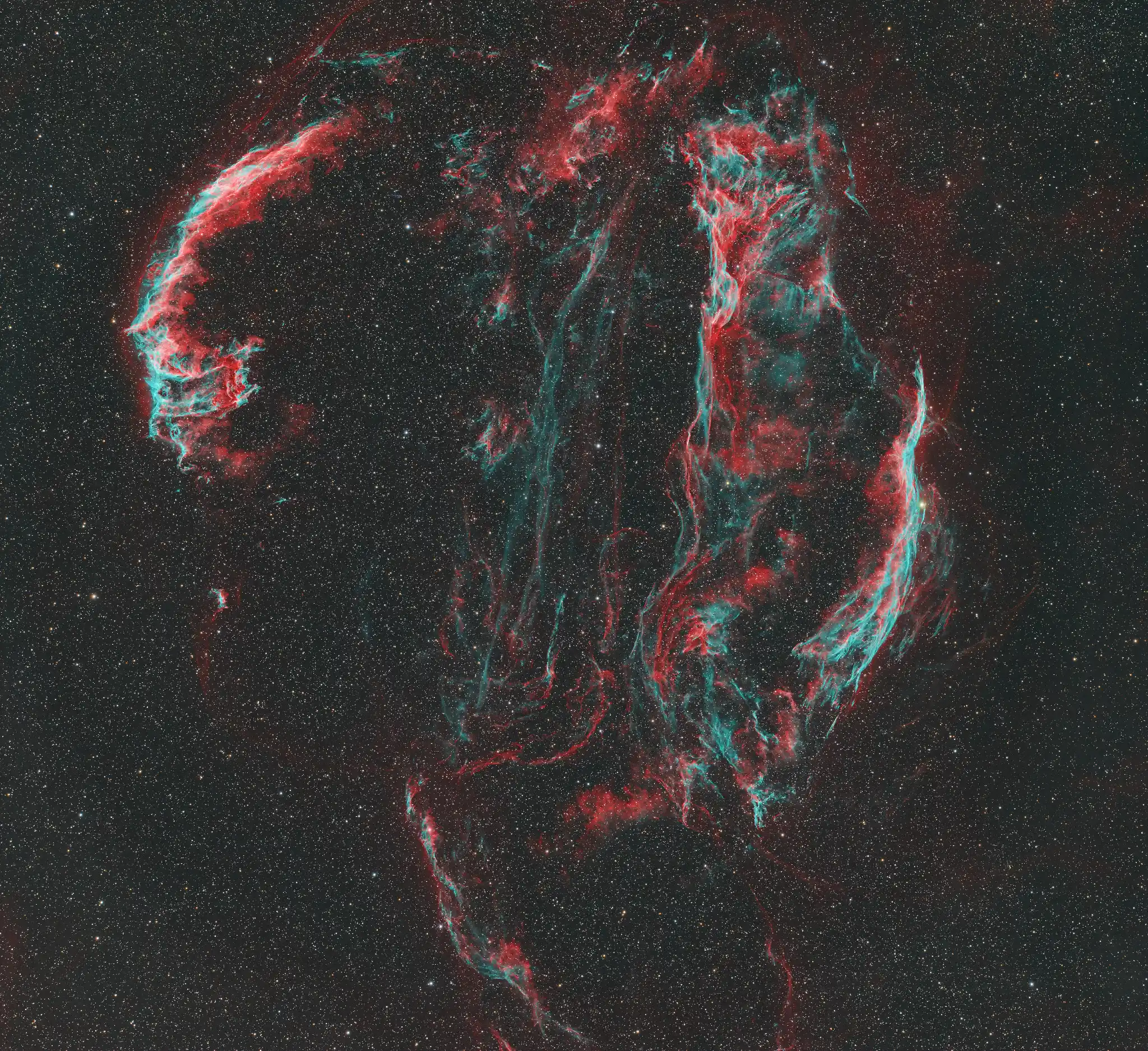
Cygnus Loop - HOO palette
Around 5000 years ago, as the Sumerians were inventing written history with their cuneiform script, sky watchers looking up would have seen a new star erupt in the northern sky, one that rivaled the Moon in brightness. Today, the remnants of that explosion are scattered on wide area of 3,5° x 2,6° in the Cygnus constellation, which gives this formation the name of Cygnus Loop. It also has several identifiers, as it is split visually into bright segments of ionized gas. At an estimated distance of 1750 light-years, its true dimension is around 35 light-years. The 2 main components are NGC 6992 + 6995 (Western Veil) and NGC 6990 (Eastern Veil), but in between there are other intricate nebular sections, like NGC 6979, NGC 6974 or Pickering’s Triangle. NGC 6960 is in the vicinity of the bright star 52 Cygni and is therefore easier to spot through a telescope.
William Herschel discovered parts of the Cygnus Loop, but not all of it. He is credited with discovering NGC 6960, NGC 6992 and the central NGC 6979. Discovery dates are subject to uncertainty, but documents from that period suggest that the year of discovery is 1784.
Astronomers now know that the Cygnus Loop was created from a core collapse supernova of a supermassive star (around 20 solar masses). Even after so many thousands of years after the cataclysmic event, some parts of the Loop are still in a state of shock. The asymmetries in the nebular body are attributed to irregular densities of the interstellar medium, with which the expanding shockwaves still interact. The smoother arcs are more recent interactions with the interstellar medium, while the more ragged ones are older sections. The edges of the shockwaves are travelling at more than 400 km/s. It will take several million years for the Cygnus Loop to completely dissipate in the surrounding environment.
The searches for compact stellar remnants have been fruitless so far. In the southern section of the Loop there is a “hole” in the gas density and in the overall emissions in the region, which would consist with the presence of a neutron star. However, nothing was found in the area.
Sh 2-103
3 credit